












Atiku breaks silence as his son Abba joins APC
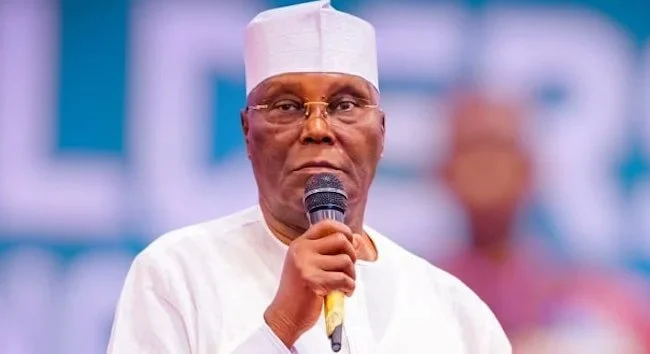
Former Vice President Atiku Abubakar has finally spoken publicly after his son, Abba Atiku Abubakar, formally defected from the Peoples Democratic Party (PDP) to the ruling All Progressives Congress (APC), a political move that has triggered fresh debate across Nigeria’s political landscape.
The defection, which was announced in Abuja during a well-publicised APC event, immediately raised questions about loyalty, family dynamics, and the shifting alignments ahead of the 2027 general elections. Many observers wondered whether the move signaled deeper cracks within Atiku’s political structure or simply reflected the independent choices of a young politician.
In his first reaction since the development, Atiku breaks silence as his son Abba joins APC making it clear that political differences should not be mistaken for family conflict.
A Father’s Reaction to a Political Shift
Speaking through a statement issued from his media office, the former vice president said he respected the right of every Nigerian, including members of his family, to make independent political decisions.
“Democracy thrives on freedom of choice,” Atiku said. “My son Abba is an adult and a citizen of Nigeria with the right to decide his political path. Politics should not divide family.”
The statement marked the first time Atiku breaks silence as his son Abba joins APC addressing weeks of speculation about his personal reaction to the defection.
He added that his commitment to the PDP and to democratic ideals remains unshaken, stressing that individual political decisions do not alter his long-standing vision for Nigeria.
How the Defection Unfolded
Abba Atiku Abubakar, who has been active in youth and grassroots politics for years, was formally received into the APC by senior party officials in Abuja.
During the event, he explained that his decision to leave the PDP was based on what he described as a desire to align with a platform that better reflects his current political goals.
“I believe in service to the people, and at this moment, I feel the APC offers a stronger platform for me to contribute meaningfully to national development,” Abba Atiku said.
His defection quickly became national news, largely because of his father’s prominent role as the PDP’s presidential candidate in the 2019 and 2023 elections.
Political analysts noted that the optics of a high-profile PDP figure’s son joining the APC were bound to generate controversy, regardless of the personal reasons behind the move.
Political Implications for Atiku and the PDP
Ever since the announcement, political commentators have debated what the development means for Atiku Abubakar and for the opposition PDP.
Some analysts have suggested that the move could be used by the APC to project internal divisions within the PDP, especially as the country gradually heads toward another election cycle.
Others argue that family members of politicians often take different political paths without necessarily weakening their relatives’ influence.
The former vice president appeared to address such concerns directly when he insisted that the PDP remains his political home and that he will continue to support efforts to strengthen the party.
“Nothing has changed about my political convictions,” Atiku stated. “My focus remains on helping to build a Nigeria that works for all.”
Not the First Family Political Split

Nigeria’s political history is filled with examples of relatives belonging to different political parties.
From governors to senators and prominent party leaders, family ties have often crossed party lines without creating lasting political damage.
Observers say the situation involving Atiku and his son may simply be another case of generational difference rather than an indicator of a major political realignment.
Still, the fact that Atiku breaks silence as his son Abba joins APC shows the sensitivity of the moment and the need to manage public perception.
https://ogelenews.ng/atiku-breaks-silence-as-son-abba-joins-apc
APC Welcomes the Defection
For the ruling party, the defection was celebrated as a symbolic victory.
APC leaders described Abba Atiku as a valuable addition to their fold and praised his decision as evidence that the party is attracting young and vibrant Nigerians.
One senior APC official described the move as “a sign that the APC remains the most progressive political platform in Nigeria today.”
However, PDP officials have downplayed the significance, insisting that Abba Atiku’s decision was purely personal and does not reflect any official position of the Abubakar political family.
What This Means Going Forward
As Nigeria’s political climate continues to heat up, defections and counter-defections are likely to become more frequent.
The episode has reminded many Nigerians that political affiliation, even within families, can be fluid.
For now, the former vice president appears determined to keep the matter in perspective.
By choosing a calm and measured response after Atiku breaks silence as his son Abba joins APC, he has attempted to draw a clear line between personal relationships and partisan politics.
A Test of Political Maturity
Beyond the headlines, the situation highlights a broader issue in Nigerian politics: the need to normalize disagreement without hostility.
Atiku’s reaction, many believe, sets an example that political differences do not have to translate into personal conflict.
As debates continue, one fact remains clear—Nigeria’s political space is entering another season of realignments, and the Abubakar family story is only one chapter in a much larger national narrative.
https://peoplesdemocraticparty.com.ng