



















The coastal security model in Nigeria has been shaped by years of practical experience, community trust and the grounded leadership of Senior High Chief Bibopere Ajube. It is a model built from the realities of the creeks, not from theory. Few figures embody this evolution more clearly than SHC Ajube, whose work grew from direct engagement with the people and the terrain.
The creeks of the Niger Delta carry stories told by early fishermen, traders who know every bend of the waterways and residents who have watched the corridor linking Ondo, Edo and Lagos change over time. These waterways have long been places where opportunity and danger coexist. Securing them requires more than patrol boats or formal authority—it demands a deep understanding of the environment and the people who live within it.
Before Gallery Security Services Limited (GSS) became a structured institution, SHC Ajube was already part of the daily rhythm of the creeks. His leadership began with presence, not title. He studied the tides, the movement patterns of travellers and the small signs that signalled danger. This grounded approach built trust—a currency that matters greatly in coastal communities where silence is common and legitimacy must be earned, not declared.
That trust became the foundation for what would later grow into a functional coastal security model in Nigeria. Because communities believed in him, information flowed where outsiders met closed doors. GSS was able to operate in terrain where familiarity matters as much as authority, making it possible to gather intelligence long before threats escalated.
https://ogelenews.ng/coastal-security-model-in-nigeria
The Coastal Security Model in Nigeria and the GSS Experience
From these early beginnings, GSS developed a model built on consistent patrols, disciplined surveillance and strong community integration. Patrol work may appear routine, but its consistency creates pressure that disrupts criminal activity. Surveillance rarely attracts attention, yet a single observation can change the direction of an operation. Over the years, GSS strengthened its partnerships with the Nigerian Navy, Police, DSS and other agencies—not only through meetings, but through shared risks and a shared understanding of the creeks.“Over the years, GSS strengthened its partnerships with the Nigerian Navy…”
Link “Nigerian Navy” to their official website.
One defining example came after a major bank robbery in Ondo State. The fleeing attackers escaped into the waterways with stolen rifles. Security agencies turned to GSS because the terrain required deep familiarity. Within forty-eight hours, the stolen weapons were recovered. The success highlighted why this coastal security model in Nigeria works: knowledge of the creeks, understanding of criminal movement patterns and steady cooperation among security actors.


GSS expanded this model by investing heavily in young people. Ajube recognised that insecurity thrives where purpose is lacking. Through Bradama International Skills Centre, hundreds of young men have been trained in welding, fabrication, engine repair and other trades. Some joined GSS; others now work independently across coastal states. This reduced the number of youths vulnerable to criminal recruitment and strengthened both security and livelihood.
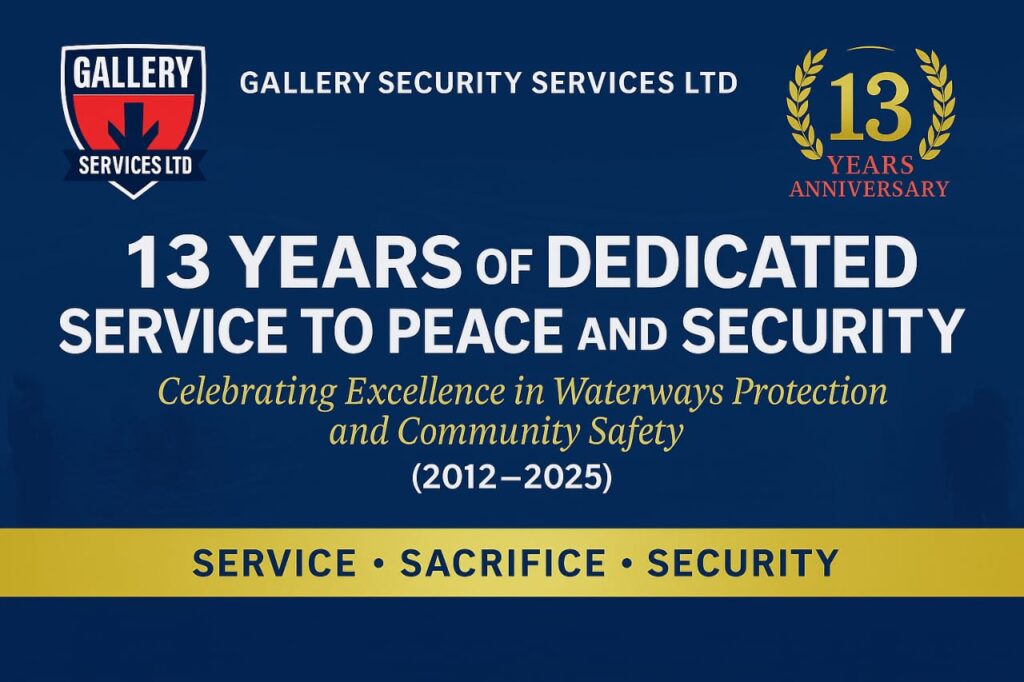
These principles were on full display at the 13th Anniversary of GSS. The Youth in Coastal Defence Summit brought together more than a thousand young people, reinforcing that coastal defence is a shared responsibility, not just the job of security agencies. The medical outreach reached more than five hundred residents, reminding the public that security also includes wellbeing. Honouring fallen personnel added emotional weight, acknowledging sacrifices that rarely reach the headlines.
After thirteen years, the work of GSS reflects more than operational success—it represents a coastal security model in Nigeria built on intelligence, consistency, community insight and long-term investment. It is not shaped by spectacle but by patience, presence and steady engagement. The gradual decline in violent incidents along the corridor shows the strength of this approach.
As Nigeria expands inland waterway infrastructure and relies more on coastal routes for commerce, this model will become even more important. The GSS story is not only a regional achievement—it is proof that stable communities can emerge when security is rooted in understanding rather than force. The coastal security model in Nigeria stands today as both a product of lived experience and a guide for the future.
For more regional security updates, visit ECOWAS athttps://www.ecowas.int.