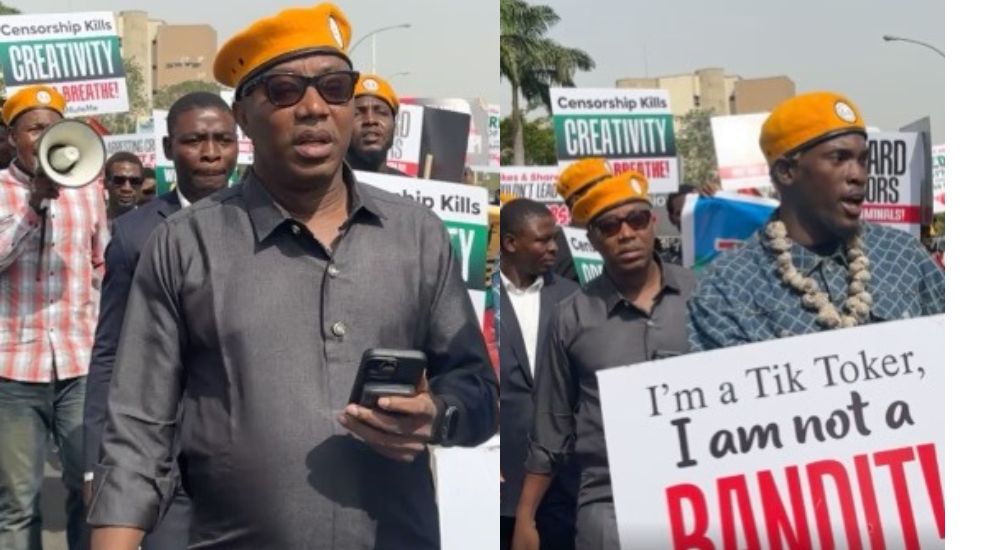

















NLC nationwide protest against insecurity in Nigeria entered a new phase on Wednesday as workers gathered at the Labour House in Abuja to demand urgent action from the federal government.
NLC Nationwide Protest Against Insecurity in Nigeria
Leaders of the Nigeria Labour Congress (NLC), civil rights activists, and concerned citizens converged on the Labour House in Abuja on Wednesday as part of a nationwide protest against worsening insecurity and deepening economic hardship across the country.
The gathering followed days of tension and speculation after President Bola Ahmed Tinubu held a late-night meeting on Tuesday with NLC leaders in an effort to avert the planned demonstration. Despite the high-level engagement, the labour movement insisted that the protest would proceed, citing unresolved concerns affecting Nigerian workers and citizens.
Speaking to journalists at the NLC secretariat, NLC President Joe Ajaero confirmed that no agreement had been reached to suspend the protest. He disclosed that labour leaders were still consulting internally and engaging a committee set up during the meeting involving the Presidency and the Nigeria Governors’ Forum.
However, Ajaero made it clear that dialogue alone would not address the growing frustration among workers, many of whom feel increasingly vulnerable due to rising insecurity, inflation, and declining living standards.
“Workers are not asking for luxury. They are asking for safety, dignity, and a government that takes responsibility for their welfare,” one labour official said at the venue.
Workers Await Outcome as Protest Momentum Builds
As discussions continued behind closed doors, workers and union members gathered peacefully at the Labour House, awaiting the outcome of the meeting. While some leaders urged caution, others openly expressed determination to proceed with the nationwide protest if their demands were not met.
The atmosphere remained tense but orderly, reflecting widespread public anxiety over kidnappings, violent attacks, and economic pressures that have continued to affect households across Nigeria.
Observers noted that the mobilisation underscored the growing gap between government assurances and lived realities, particularly for low-income earners and public sector workers.
Sowore’s Presence Sparks Debate
Among those present at the NLC secretariat was former presidential candidate and activist Omoyele Sowore, alongside members of the Revolution Now Movement. Sowore’s presence immediately drew attention and sparked debate, given his identity as a politician and outspoken critic of successive administrations.
While some labour supporters welcomed his participation as an ally in the fight for accountability and social justice, others questioned whether political figures should be visibly involved in union-led protests.
Labour officials, however, insisted that the protest remains non-partisan, stressing that insecurity and economic hardship affect all Nigerians regardless of political affiliation.
NLC Demands: Security, Accountability, Electoral Reform
According to information obtained by Ogele News, the NLC is demanding the establishment of a dedicated national fund to rehabilitate and compensate victims of insecurity, including workers and families displaced or harmed by violent incidents.
The congress is also calling for Section 2 of the 1999 Constitution, which assigns responsibility for the security and welfare of citizens to the government, to be made justiciable. Labour leaders argue that making the provision enforceable would allow citizens to legally hold the government accountable for failures in protecting lives and property.
In addition, the NLC is pushing for comprehensive electoral reforms. These include strengthening an independent, people-oriented electoral commission, ensuring swift prosecution of electoral offenders, and ending the militarisation of elections, which labour groups say undermines democracy and fuels instability.
https://ogelenews.ng/category/security
National Context and Political Implications
The NLC nationwide protest against insecurity in Nigeria comes at a sensitive time for the Tinubu administration, which is already facing public criticism over economic reforms, subsidy removal, and rising costs of living.
Analysts say labour’s action reflects broader national frustration and could influence political narratives ahead of future elections. Whether the protest escalates or gives way to renewed negotiations may depend on how quickly the government responds with concrete measures rather than assurances.
For now, the presence of labour leaders, activists like Sowore, and anxious workers at the Labour House signals a moment of reckoning in Nigeria’s ongoing debate over governance, security, and the social contract between the state and its citizens.
NLC Nationwide Protest Against Insecurity in Nigeria