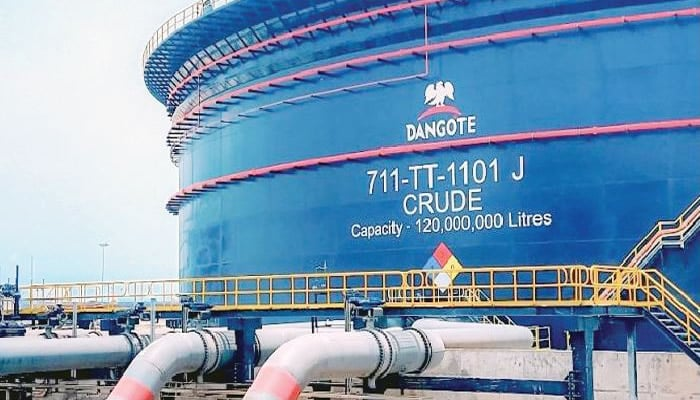



















NNPC boosts Dangote refinery crude supply to seven cargoes
Nigeria’s state oil company is moving more crude to the Dangote Petroleum Refinery, in what appears to be a calculated effort to ease supply pressure at Africa’s largest refining complex and reduce its dependence on expensive imported barrels. According to Reuters, the Nigerian National Petroleum Company is allocating seven crude cargoes for May loading to Dangote refinery, up from the five cargoes it received in previous months. The report cited two trade sources and a refinery official.
That is why the phrase NNPC boosts Dangote refinery crude supply to seven cargoes has quickly become one of the most closely watched energy stories in Nigeria. It arrives at a moment when the country is battling record fuel-price pressure, global crude market disruption, and renewed scrutiny over whether the Dangote refinery can truly shield Nigerians from external shocks. Reuters reported that the increase comes as the Iran war tightened oil supply conditions and drove up the cost of crude for refiners around the world, including Dangote.
At first glance, NNPC boosts Dangote refinery crude supply to seven cargoes looks like an unambiguously positive development. More local crude should mean lower shipping costs, less reliance on foreign supplies, and potentially stronger domestic refining stability. Reuters noted that local cargoes are cheaper for the refinery because they avoid some of the higher shipping and premium costs attached to imported crude. That matters because imported crude had reportedly been landing at steep premiums, worsening cost pressure for the refinery.
But the deeper truth is more complicated. Even with the increase, NNPC boosts Dangote refinery crude supply to seven cargoes still falls short of what the refinery reportedly needs to run more comfortably. Reuters said Dangote requires around 13 to 15 cargoes a month. So while seven cargoes mark an improvement over five, the refinery is still not receiving enough local barrels to fully close its supply gap. That shortfall is the real centre of the story.
This is why the headline should not be written like a victory parade. A disciplined reading of NNPC boosts Dangote refinery crude supply to seven cargoes shows a partial fix, not a total breakthrough. Dangote still has to negotiate for more volumes, and Reuters reported that talks are ongoing for additional supply. In other words, the refinery is getting some relief, but not full comfort.
The timing of the move is no accident. Nigeria has been dealing with unusually high petrol prices, and Reuters reported just days earlier that the Dangote refinery had failed to prevent record gasoline prices despite reaching full-scale operations. That report linked the pressure not only to local supply constraints but also to a global oil market shock tied to conflict involving Iran and disruption around the Strait of Hormuz. In that context, NNPC boosts Dangote refinery crude supply to seven cargoes is also a defensive move by the Nigerian system to reduce exposure to international volatility.
https://ogelenews.ng/nnpc-boosts-dangote-refinery-crude-supply-to-seven-…
There is another layer to the story. Dangote refinery has increasingly become central to Nigeria’s domestic fuel balance. Reuters reported that the refinery now covers more than two-thirds of Nigeria’s daily gasoline demand of about 60 million litres. That means any improvement or disruption in its crude feedstock immediately matters to households, transport operators, manufacturers, and inflation. So when NNPC boosts Dangote refinery crude supply to seven cargoes, it is not just a refinery logistics story. It is a national cost-of-living story.
Still, Nigerians hoping for immediate petrol price relief may need to temper expectations. Reuters reported that Dangote had recently raised petrol depot prices by roughly 13 percent due to cost pressure. That fact is crucial because it shows that extra crude cargoes alone do not erase the economics of a heated global oil market. If crude remains expensive, refined fuel prices will remain under strain, even with more local allocation. That is why NNPC boosts Dangote refinery crude supply to seven cargoes should be seen as a stabilising measure, not an instant price-cut mechanism.
From a policy standpoint, the development also revives a longstanding debate in Nigeria’s energy sector: should domestic refiners have more reliable first claim on Nigerian crude, especially when the nation is struggling with imported fuel inflation? The Dangote refinery has repeatedly faced questions over local crude access, while much of Nigeria’s production is tied up in existing trade arrangements and oil-backed obligations. Reuters said that one reason the refinery has had to import crude is that a significant share of Nigeria’s output is already committed elsewhere. That context makes NNPC boosts Dangote refinery crude supply to seven cargoes politically important as well as commercially important.
There is also the export angle. More crude going to Dangote could reduce the volume available for export in the short term, a point reflected in follow-up reporting that noted increased allocations to the refinery may curb some Nigerian crude exports at a time of strong international demand. That trade-off matters. Nigeria wants export earnings, but it also needs domestic energy stability. So NNPC boosts Dangote refinery crude supply to seven cargoes reflects a balancing act between foreign exchange logic and domestic economic protection.
For ordinary Nigerians, the practical question remains straightforward: will this help lower fuel stress? The honest answer is that it may help at the margins, but it does not solve the full problem yet. More cargoes improve local supply security. They reduce some import exposure. They strengthen Dangote’s operating position. But as long as the refinery is still below its full local crude requirement and global crude prices remain elevated, fuel affordability will stay fragile. That is the fairest reading of NNPC boosts Dangote refinery crude supply to seven cargoes.
In the end, this is a significant move, but not a magic one. NNPC has reportedly increased May crude supply to Dangote refinery from five to seven cargoes. That is real progress. But the refinery still needs much more crude to run with less strain, and Nigerians are still living with the consequences of a volatile global oil market. So the best way to understand NNPC boosts Dangote refinery crude supply to seven cargoes is this: a welcome shift, a strategic relief measure, and a reminder that Nigeria’s fuel challenge is still larger than one month’s allocation.
https://punchng.com/nnpc-boosts-dangote-refinery-crude-supply-to-seven-cargoes-sources/