















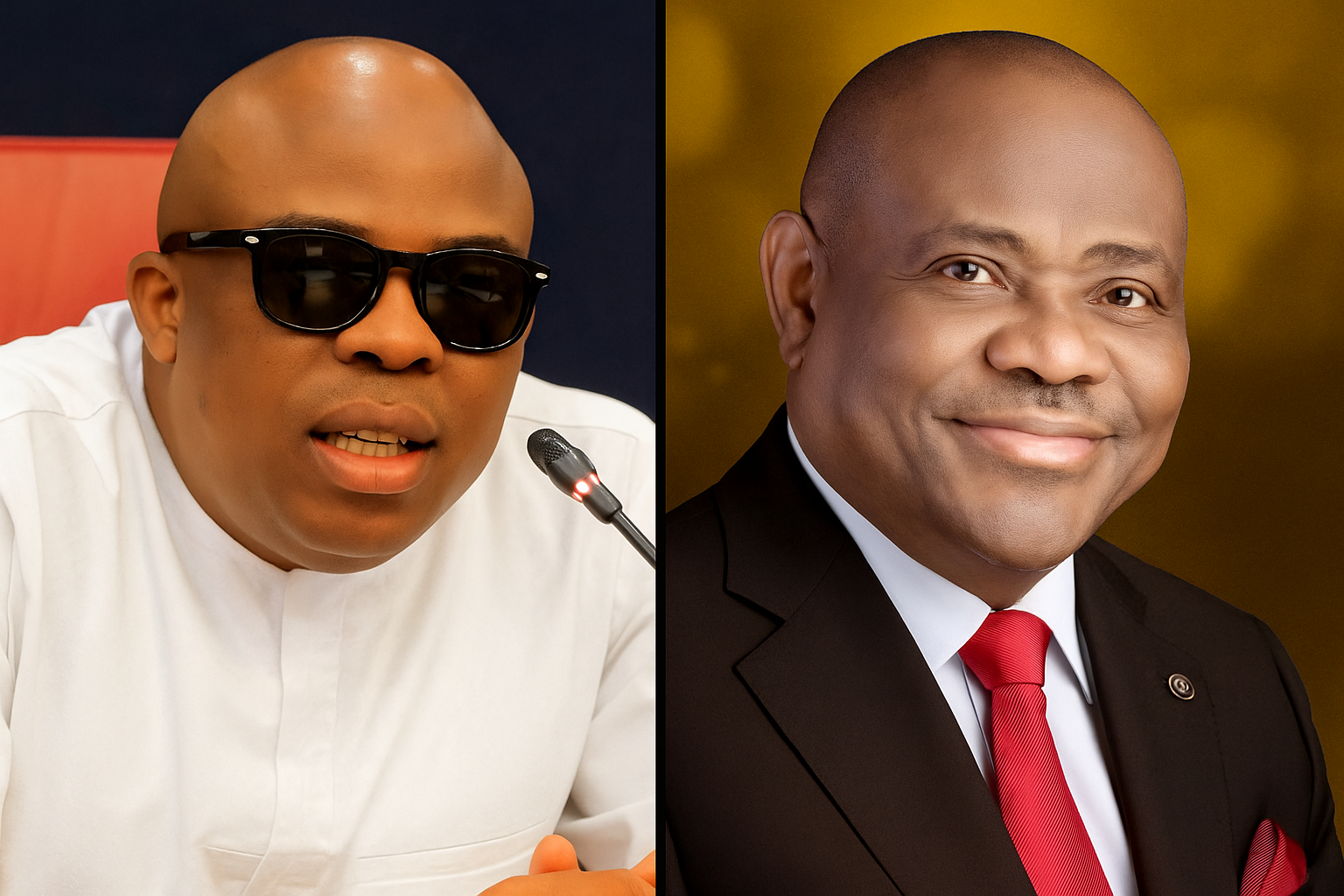
Inside the APC’s Rivers Calculus: Why Abuja Can’t Ignore Either Wike or Fubara
Ogele News | Political Analysis
Rivers State political analysis begins with one reality: power is rarely announced loudly, it is negotiated quietly.The Fubara Wike Rivers crisis has become the defining political struggle shaping Rivers State.This Rivers State political analysis examines the forces driving the prolonged power struggle and why it continues to shape governance in the state.
There was no public embrace from the party’s national leadership, no presidential signal that the Rivers crisis had been resolved, and no attempt to declare the moment a turning point. In Port Harcourt, tensions remained. In Abuja, caution took hold.
That restraint has become the most revealing feature of the crisis. With the 2027 general election now less than two years away, Rivers is a state where federal power is being exercised less through instruction than through timing. The ruling party is watching carefully, aware that a misstep could turn a state-level struggle into a national complication.
At the centre of this calculation are two figures the APC cannot afford to mishandle: Nyesom Wike, whose influence in Rivers politics has survived his exit from office, and Siminalayi Fubara, the sitting governor now in the ruling party but governing amid resistance.
https://ogelenews.ng/category/today-in-nigeria
The moment that forced Abuja to pay attention
The fallout between Wike and Fubara did not, by itself, force a recalibration in Abuja. That rupture had been visible for months. What changed the equation was the convergence of three developments.
First was Fubara’s defection to the APC, which he later framed as a response to political isolation during the height of the Rivers crisis. By joining the ruling party, the governor pulled the conflict out of the realm of internal party dispute and into national political space.
Second was the continued posture of the Rivers State House of Assembly. Despite the governor’s new party alignment, the legislature showed no sign of recalibrating its stance. Press briefings and institutional actions continued along familiar lines, underlining the reality that party labels had not altered loyalties.
Third was Abuja’s refusal to rush a response. There were no publicised meetings, no statements imposing discipline, and no visible attempt to project unity. In Nigerian politics, such pauses usually signal assessment rather than indecision.
At the heart of this Rivers State political analysis is the breakdown of trust between political actors and institutions meant to balance power.
At that point, the Rivers crisis stopped being merely a state matter and began to register as a 2027 concern.
Silence as a signal
Silence from the centre, particularly during political tension, often carries intent. In this case, it reflects caution shaped by risk.
Abuja has avoided any statement that could be read as backing one camp or disciplining the other. The crisis has not been recast as settled, nor has federal authority been asserted openly. This departure from precedent is notable.
Analysts say the Fubara Wike Rivers crisis reflects deeper battles over power, loyalty, and political survival.
Open support for the governor could deepen resistance within the Assembly. A visible tilt toward Wike’s camp could undermine the authority of a sitting APC governor and complicate the party’s cohesion narrative. With the election clock ticking, restraint preserves flexibility.
Here, silence functions as control. By withholding a clear signal, the centre keeps all actors uncertain and prevents any camp from claiming federal backing.
https://ogelenews.ng/tag/rivers-state-politics
Why Wike still matters
For Abuja, Wike remains relevant not because of sentiment, but because of structure.
Over two terms as governor, he built political networks that extended into party machinery and local government structures. Those networks did not dissolve with the change of administration, nor were they automatically transferred to his successor.
His federal position adds another layer. As a serving minister, Wike sits close to the centre while remaining deeply rooted in state politics. That dual presence complicates any attempt to marginalise him without consequence.
Notably, Wike has avoided overt attempts to claim ownership of the crisis. He has spoken selectively, allowing institutions and allies to take the foreground. The result is influence without exposure.
Why Fubara cannot be discarded
If Wike represents continuity of influence, Fubara represents institutional reality.
As governor, he retains constitutional authority and control of the formal machinery of government. That status alone confers relevance, even under hostile political conditions.
Fubara’s decision to join the APC altered the optics of the crisis. Any attempt to weaken or isolate a sitting APC governor risks projecting internal contradiction at a time when cohesion matters. It also raises questions about the value of defection as a stabilising tool.
Fubara’s vulnerabilities are real. His support within the Assembly is limited, and his authority has been tested. But from Abuja’s perspective, sidelining him could create more problems than it solves.
Rivers as electoral math
Beyond personalities, Rivers matters because of numbers.
It remains one of the larger voting states in the South-South and has historically influenced regional outcomes in national elections. Instability here complicates mobilisation, messaging, and alliance-building.
For the ruling party, Rivers is less a prize to be claimed than a variable to be managed. In national planning, predictability is prized. Uncertainty is not.
Ogele News Insight
For the APC, Rivers is not about choosing between Wike and Fubara. It is about containment. Any move that deepens instability risks weakening the party’s authority as the 2027 election approaches.
What comes next
Within the party, some argue the crisis can wait. Time, they believe, will clarify loyalties. But prolonged uncertainty can harden positions and encourage escalation.
For now, attention has shifted to indicators rather than declarations: the conduct of the Assembly, court developments, and the evolution of party alignment. As timelines tighten, tolerance for uncertainty will narrow.
Rivers remains suspended between resolution and escalation. The absence of intervention should not be mistaken for indifference. It reflects a judgement that timing, not force, will decide the next phase.
Until then, Rivers remains a place where power is negotiated quietly and every move is weighed against what lies ahead.Until resolved, the Fubara Wike Rivers crisis is expected to continue influencing governance and political alignments in Rivers State.
Ultimately, this Rivers State political analysis shows that the crisis is not just about personalities, but about how political authority is exercised and contested.