

















7-1-7 Strategy Game
The World Health Organisation (WHO) is testing a new simulation tool it believes can help countries detect and contain outbreaks faster by strengthening real-time decision-making, coordination and accountability during the earliest days of a health emergency.
The tool, called the 7-1-7 Strategy Game, is built around the 7-1-7 target — a benchmark that sets a simple but demanding goal for outbreak control: detect a suspected outbreak within seven days, notify public health authorities within one day, and complete key early response actions within seven days.
WHO’s argument is straightforward: outbreaks don’t just spread because viruses are fast. They spread because systems are slow — surveillance misses early warning signs, labs delay confirmation, reporting chains break, and response teams lose precious time waiting for approvals, logistics, and clear leadership. The 7-1-7 Strategy Game is designed to make those weak points visible and to help decision-makers practice fixing them before a real outbreak hits.
What exactly is the 7-1-7 Strategy Game?
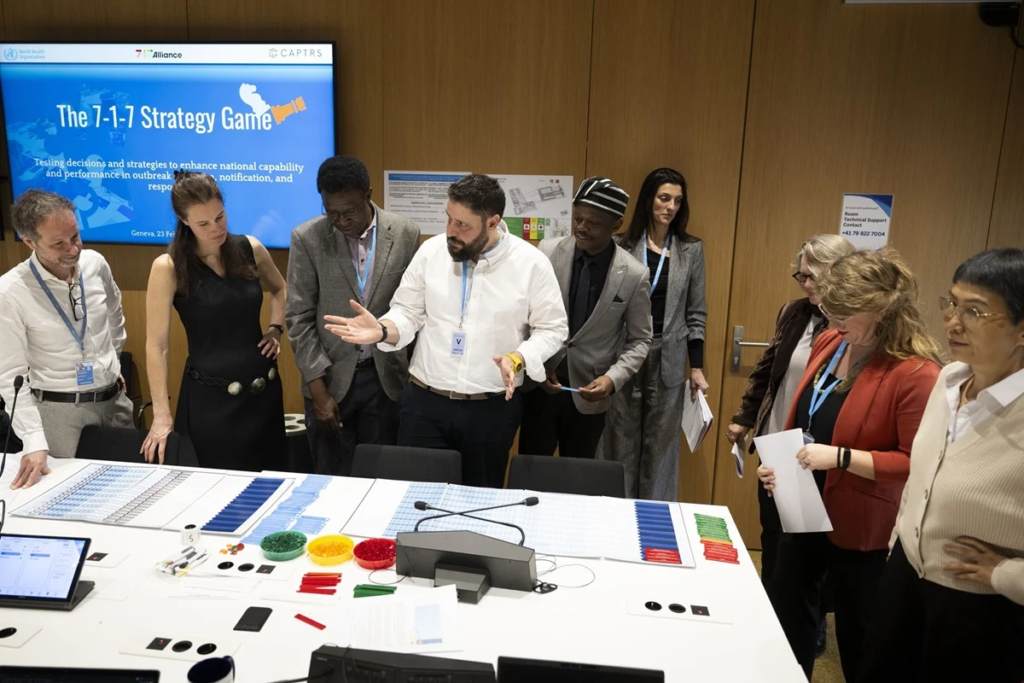
WHO describes the 7-1-7 Strategy Game as an analog, team-based exercise, not a computer app. It brings small groups of decision-makers together to test how coordination across the outbreak chain actually plays out under pressure — from surveillance and laboratories to emergency operations, risk communication and leadership.
The game was developed by the Center for Advanced Preparedness and Threat Response Simulation (CAPTRS) in collaboration with the 7-1-7 Alliance and WHO’s Emergency Preparedness Department.
WHO says the game has two structured modules. In the first module, participants choose and prioritise actions they believe will improve speed across the 7-1-7 timeline, assign time durations to each activity, and test assumptions about where delays pile up. In the second module, teams face a simulated outbreak scenario and see whether their earlier choices actually translate into faster detection, notification and response.
That design is intentional: it forces teams to confront trade-offs. If you invest in lab capacity, does it cut delays more than investing in community surveillance? If reporting is the bottleneck, does technology help more than leadership clarity? The 7-1-7 Strategy Game is trying to turn those debates into measurable practice, not just meeting-room theory.
The playtest: why WHO focused on Uganda and Sudan Ebola
WHO says it held a playtest session on 23 February 2026, bringing together staff familiar with the 7-1-7 framework to stress-test the design before broader country-level pilots planned later in the year.
The simulated scenario used in the 7-1-7 Strategy Game focused on an outbreak of Sudan Ebola virus disease in Uganda, pushing participants to grapple with real-world challenges such as delayed case recognition, reporting breakdowns and operational constraints.
WHO’s point here is not that every country will face Sudan Ebola. The point is that nearly every outbreak — whether cholera, meningitis, Lassa fever, measles, mpox, or an unknown pathogen — will expose the same system weaknesses: late recognition, slow escalation, and fragmented response.
Why the 7-1-7 target matters in outbreak response
The 7-1-7 target is increasingly treated in global health as an organising benchmark for accountability in the earliest phase of an outbreak. It sets three timing measures: ≤7 days to detect, ≤1 day to notify, and ≤7 days to complete early response actions.
Researchers have argued that these time markers matter because small delays stack up. A day lost to missed symptoms can become a week lost to delayed confirmation, and by the time the response is organised, an outbreak that could have been contained locally is suddenly national — or cross-border.
The CDC also frames the 7-1-7 approach as a way to standardise how countries evaluate outbreak detection and response performance, making it easier to identify bottlenecks and improve systems.
Why WHO is using a game, not another guideline
The blunt truth in outbreak preparedness is that many countries already have guidelines. What they often lack is practiced coordination — knowing who does what first, what information triggers escalation, and how to make decisions quickly under uncertainty. WHO says the 7-1-7 Strategy Game reflects a growing recognition that preparedness is not only about plans, but about decision-making capability.
That matters for Africa and other regions where outbreaks can move fast through densely populated areas and where health systems can be stretched by workforce shortages, weak labs, limited surveillance coverage, and delayed funding.
What happens next
WHO says the 7-1-7 Strategy Game will undergo further refinement and piloting and is expected to support Member States in strengthening outbreak readiness — with the ultimate aim of ensuring that when the next threat emerges, systems are ready to detect, notify and respond at speed.
For countries, the real test will be whether the game leads to concrete changes: faster reporting chains, better lab turnaround, clearer incident management, stronger risk communication, and real accountability for delays.