

















AKK gas pipeline
Nigeria’s long-delayed energy infrastructure ambitions are moving closer to reality as the AKK gas pipeline approaches completion, positioning the country for a new phase of industrial growth, energy security, and economic diversification. The Nigerian National Petroleum Company Limited (NNPC) has confirmed that construction work on the Ajaokuta–Kaduna–Kano (AKK) gas pipeline is nearing its final stages, raising expectations that gas supply to northern Nigeria could soon become a reality.
The AKK gas pipeline, one of the most ambitious energy projects in Nigeria’s history, is widely viewed as a strategic backbone for industrialisation. Designed to transport natural gas from the southern producing hubs to northern commercial and industrial centres, the project is expected to unlock manufacturing potential, support power generation, and reduce the country’s dependence on expensive imported fuels.
https://ogelenews.ng/akk-gas-pipeline-industrial-growth-nigeria
A Project Years in the Making
Originally conceptualised more than two decades ago, the AKK gas pipeline has long symbolised Nigeria’s struggle to translate its vast gas reserves into domestic economic value. Stretching over 600 kilometres from Ajaokuta in Kogi State through Abuja and Kaduna to Kano, the pipeline is designed to serve as a critical energy corridor linking southern gas resources with northern demand centres.
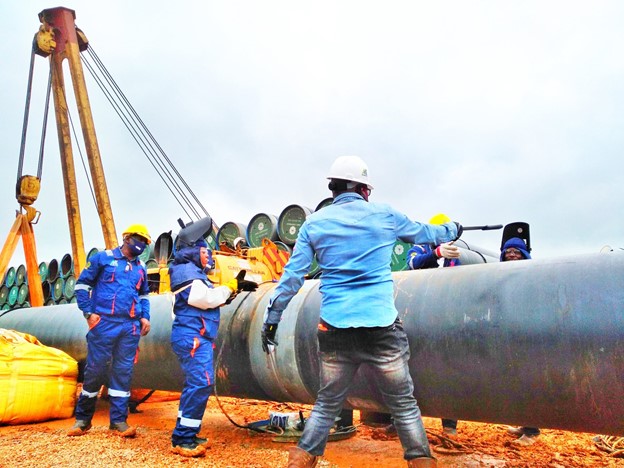
NNPC officials say the project has now reached about 90 percent completion, with welding, trenching, and pressure testing substantially completed across major sections. Critical crossings, including the technically demanding River Niger segment, have also been executed successfully.
According to NNPC Group Chief Executive Officer, Mele Kyari, final mechanical completion and commissioning are expected in early 2026, marking a turning point for Nigeria’s gas-driven development strategy.
Why the AKK Gas Pipeline Matters
The AKK gas pipeline is not just another infrastructure project. It sits at the heart of Nigeria’s broader gas master plan and long-term economic transition.
Once operational, the pipeline is expected to:
• Supply gas to power plants in Abuja, Kaduna, and Kano
• Reduce electricity shortages in northern Nigeria
• Support fertiliser, petrochemical, and manufacturing industries
• Lower production costs by replacing diesel and heavy fuel
• Encourage new industrial clusters and private investment
Nigeria holds one of the largest proven gas reserves in the world, yet much of it remains underutilised. The AKK project aims to change that narrative by converting gas into a driver of inclusive growth rather than a wasted resource.
Industrial Growth and Regional Development
NNPC believes the AKK gas pipeline will help rebalance Nigeria’s economic geography. For decades, industrial activity has been heavily concentrated in coastal regions due to easier access to energy and infrastructure. Northern states, despite their population and market size, have struggled with unstable electricity and high operating costs.
With the pipeline in place, industries such as:
• cement manufacturing
• fertiliser production
• agro-processing
• steel fabrication
• textile manufacturing
could expand or relocate closer to northern markets. This shift is expected to generate thousands of direct and indirect jobs while boosting regional economies.
NNPC officials have repeatedly stated that the pipeline will make it easier for private investors to establish gas-dependent facilities, creating value chains that extend far beyond the energy sector.
Connection to Nigeria’s Broader Gas Strategy
The AKK gas pipeline forms part of a larger national gas infrastructure network that includes the Obiafu–Obrikom–Oben (OB3) pipeline. Together, these projects are designed to interconnect gas supply corridors and ensure uninterrupted flow across regions.
The OB3 pipeline, which links eastern gas fields to western networks, is also nearing completion. Once both pipelines are fully operational, Nigeria will have a continuous gas transmission backbone capable of supporting domestic consumption and future exports.
This aligns with Nigeria’s “Decade of Gas” policy, which aims to reposition natural gas as the foundation of economic growth, cleaner energy transition, and industrial resilience.
Economic Impact and Investment Outlook
NNPC has stated that the completion of the AKK gas pipeline supports its goal of increasing national crude oil production to 1.8 million barrels per day in 2026, while also strengthening gas monetisation. The company projects that Nigeria could attract up to $30 billion in new energy investments by the end of the decade if infrastructure bottlenecks are removed.
The project also aligns with reforms introduced under the Petroleum Industry Act (PIA), which transformed NNPC into a commercially driven entity. This structural change allows the company to operate with greater financial independence, transparency, and investor appeal.
Analysts believe the pipeline could significantly improve investor confidence by demonstrating Nigeria’s ability to deliver large-scale projects despite past delays.
Challenges Still Ahead
Despite the optimism, experts caution that completing the AKK gas pipeline will require careful coordination. Final commissioning involves safety approvals, regulatory clearance, and alignment with off-takers ready to receive and utilise the gas.
There are also broader economic challenges such as inflation, foreign exchange volatility, and global energy market uncertainty. However, stakeholders argue that infrastructure like the AKK pipeline provides long-term stability and insulation against these shocks.
Security remains another concern, particularly along pipeline corridors. NNPC has emphasized collaboration with host communities and security agencies to safeguard infrastructure once operations commence.
What the AKK Gas Pipeline Means for Nigeria’s Future
When fully operational, the AKK gas pipeline could redefine Nigeria’s industrial future. It represents a shift from export-dependent oil economics toward domestic value creation, energy efficiency, and regional inclusion.
For northern Nigeria, the project offers the promise of reliable power, expanded manufacturing, job creation, and renewed investor confidence. For the country as a whole, it signals progress toward energy security and economic diversification.
As final commissioning draws closer, attention will turn to how quickly industries connect to the pipeline and how effectively the government translates infrastructure into measurable growth. If executed successfully, the AKK gas pipeline could stand as one of the most transformative infrastructure achievements in Nigeria’s modern history.