
















Alleged coup plot
In an emotional protest that brought tears, placards, and sharp questions about due process to the gates of the National Assembly, families of military officers detained over an alleged coup plot on Wednesday demanded justice, access, and a transparent trial.
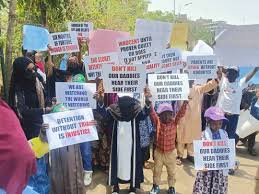
The protesters, made up largely of wives, children, and relatives of the detained officers, gathered at the entrance of the National Assembly complex in Abuja, insisting that the Federal Government and military authorities must either charge the officers in court or release them in line with the law. Multiple reports said the families described the continued detention as unjust, especially after months without open proceedings or regular family access.
The protest has now added a fresh human face to the alleged coup case, one that goes beyond security briefings and official statements. It is now about children asking where their fathers are, spouses questioning why investigations appear to be dragging on, and relatives saying the silence from authorities has deepened fear and hardship.
According to reports, the protesters carried placards bearing messages such as “Don’t Kill Our Daddies,” “Detention Without Trial is Injustice,” and “Six Months of Torture: Enough Is Enough.” The demonstration remained peaceful, but the message was unmistakable: the families want the alleged coup matter taken to court openly if the government truly has evidence.
One of the most affecting parts of the protest was the public appeal by the children of some of the detained officers. Punch reported that some of them said they had not seen their fathers for months and pleaded with the authorities to show mercy and allow justice to take its course. The report quoted children asking that their fathers be brought home safely or taken before a court, Alleged coup plot.
https://ogelenews.ng/alleged-coup-plot
The legal issue at the centre of this alleged coup story is simple, even if the politics around it are not. In a constitutional democracy, detention without prompt and transparent legal process raises serious questions. That was the core of the families’ message at the National Assembly. They were not uniformly asking for automatic freedom. Some were explicit that if there is evidence, the officers should be tried in public and allowed to defend themselves, Alleged coup plot.
Reports from TheCable and The Guardian said the families claimed the detained officers had spent more than 160 days in custody without trial or meaningful access to relatives. They also said the arrests were first announced on October 4, 2025 by then Director of Defence Information, Tukur Gusau, who disclosed that 16 officers had been taken into custody.
That timeline is important. It means the alleged coup case has now stretched over several months, moving from the initial military announcement into a prolonged period of uncertainty. That uncertainty is what the families brought to the public doorstep of the National Assembly on Wednesday.
Punch reported that an interim investigation had earlier suggested the existence of a clandestine network of officers allegedly involved in preliminary planning for a coup, including surveillance of strategic assets such as the Presidential Villa, the Armed Forces Complex, Niger Barracks in Abuja, and major airports, with October 25, 2025 cited as the planned date of the operation. The report also said the alleged targets included President Bola Tinubu and Vice President Kashim Shettima. These remain allegations, and no open court determination has yet been cited in the reports reviewed, Alleged coup plot.
That distinction matters. In a story as grave as an alleged coup plot, journalism must be careful not to substitute accusation for conviction. The state may have evidence. The military may believe its case is strong. But the rule of law demands more than internal confidence. It demands process.
This is where the National Assembly protest becomes bigger than one family grievance. It touches on a broader democratic test. Can the Nigerian state pursue a serious national security case while still respecting legal safeguards, access to counsel, and the presumption of innocence until guilt is established by a competent court?
For the families, this is not an abstract argument. The Nation reported that some wives said they had not been granted access to their husbands since the arrests and that the prolonged detention has left households in severe emotional and financial distress, with some children reportedly out of school and families struggling to survive.
That is why this alleged coup protest resonated. It was not only political. It was deeply personal.
There is also another layer to the story. A democracy shows its maturity not only by stopping unlawful threats, but by handling even its gravest accusations through credible institutions. If there is proof in this alleged coup matter, then a lawful and open trial would strengthen public confidence. If there is no sufficient case, prolonged detention only damages trust further.
For now, the core facts are these: families of detained officers protested at the National Assembly in Abuja on April 1, 2026; they demanded justice, access, and speedy trial; the officers were first publicly linked to the alleged coup case in October 2025; and multiple reports say the detainees have remained in custody for over 160 days.
What happens next will matter. If authorities move swiftly toward transparent proceedings, the state may regain some control of the narrative. If delay continues, the alleged coup case may become not just a security story, but a larger national debate about due process, military justice, and the rights of families left in limbo.
For now, the image that remains is a hard one to shake: children at the gates of Nigeria’s parliament, asking for their fathers back and pleading that justice should not remain hidden behind closed doors, Alleged coup plot.
https://punchng.com/alleged-coup-families-of-detained-officers-protest-at-nassembly/
Alleged coup plot