


















Bomb blast travelers lament 2km walk to cross checkpoints into Yobe Borno
Bomb blast: Travelers lament 2km walk to cross checkpoints into Yobe, Borno as tightened security measures imposed after the deadly Maiduguri bombings continue to disrupt movement along one of the North-East’s most sensitive corridors.
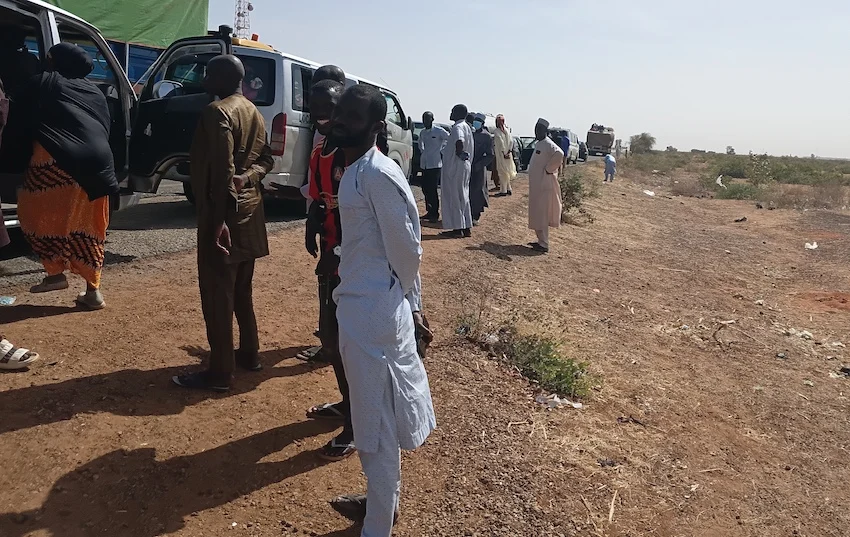
The new restrictions, introduced by security agencies after the March 16 attacks in Borno State, now require many commuters to disembark and walk a long distance before crossing into Yobe or Borno, a process that has triggered frustration among travelers, transport operators and local residents. Punch reported that the measure affects a wide range of people, including the elderly, women and children, many of whom have struggled under the burden of the new security checks. 
The hardship comes against the backdrop of one of Maiduguri’s deadliest attacks in recent years. Reuters and AP reported that multiple suspected suicide bombings on March 16 struck the post office area, Monday Market, the University of Maiduguri Teaching Hospital, and Kaleri, killing at least 23 people and injuring 108 others. 
That is the wider security climate behind the development that bomb blast: travelers lament 2km walk to cross checkpoints into Yobe, Borno. The travel restriction is not an isolated administrative decision. It is part of a broader emergency security response after a coordinated attack shook confidence in Maiduguri’s relative calm and revived fears of renewed insurgent violence in the North-East. 
According to Punch, security agencies, including the Nigerian Army and the police, have launched a new screening exercise along the corridor. Under the arrangement, travelers heading toward Borno from Yobe, or moving in the reverse direction, are now subjected to a checkpoint process that forces them to walk approximately two kilometres before they can continue their journey. 
For security officials, the logic is easy to see. Borno remains the symbolic and operational centre of Nigeria’s long-running insurgency, and every major blast inside Maiduguri reopens the same question: how do authorities tighten the net against attackers without paralyzing daily life?
For ordinary commuters, however, the experience is different. Bomb blast: travelers lament 2km walk to cross checkpoints into Yobe, Borno because the policy has turned a security response into a daily burden. What might look like a manageable distance on paper becomes something much harsher in reality when travelers are carrying bags, goods, children or food items across a hot and exposed stretch of road.
That burden matters more because inter-state movement between Yobe and Borno is not casual traffic alone. It includes traders, transport workers, civil servants, families and small-scale business owners whose livelihoods depend on predictable travel. In a region already battered by years of insurgency, each extra delay comes with an economic cost.
https://ogelenews.ng/bomb-blast-travelers-lament-2km
Reuters reported that the Maiduguri bombings came amid a broader uptick in militant activity by Boko Haram and the Islamic State West Africa Province, including recent assaults on military positions in the North-East. That context helps explain why security agencies are now acting with visible caution at gateways into Borno. 
Even so, bomb blast: travelers lament 2km walk to cross checkpoints into Yobe, Borno because security measures that ignore civilian realities can create their own backlash. In conflict-prone regions, public cooperation is a crucial asset. When people begin to see protective measures as punitive, frustration can undermine trust between communities and security agencies.
This is what makes the story more than a complaint about inconvenience. It is really a test of how security policy is implemented on the ground.
The Maiduguri bombings themselves were severe enough to justify heightened vigilance. AP reported that the attacks caused chaos across the city, overwhelmed emergency response systems and sent hospitals into crisis mode as the injured poured in. Reuters said the attacks targeted crowded civilian areas and bore the hallmarks of jihadist operations that have historically destabilized the region. 
Against that background, a stricter checkpoint regime is unsurprising. Yet what stands out is the method. A two-kilometre forced walk is not a small inconvenience for a healthy traveler, let alone for elderly passengers or parents moving with children. Punch’s reporting makes that human cost central to the story, and rightly so. 
There is also a symbolic dimension here. For years, the North-East has lived with a security culture shaped by bomb scares, military patrols, checkpoint searches and restricted movement. Each time a major attack occurs, the region slips back into a harder version of that reality. So when bomb blast: travelers lament 2km walk to cross checkpoints into Yobe, Borno, they are not only reacting to one day’s discomfort. They are reacting to the return of a condition many thought had begun to ease.
The challenge for authorities is to maintain security without deepening civilian suffering. Good security policy is not only about stopping attackers. It is also about minimizing collateral hardship for law-abiding people.
That is especially important now because Ramadan and Eid travel usually increase the flow of passengers across northern routes. Any measure that slows movement at a major checkpoint can quickly create congestion, frustration and economic losses. It can also expose vulnerable travelers to fatigue and stress, particularly if the arrangement continues for an extended period.
At this stage, the most solidly established facts are these: the Maiduguri bombings killed 23 people and injured 108 according to police; security agencies responded by tightening controls around Borno; and Punch reported that commuters are now being forced to walk about two kilometres through checkpoint areas linking Yobe and Borno. 
Everything else turns on how long the measure lasts and whether authorities adjust it.
For Ogele News readers, the strongest way to frame the story is simple: bomb blast: travelers lament 2km walk to cross checkpoints into Yobe, Borno because a region already scarred by insurgency is once again being asked to absorb the cost of emergency security. The checkpoints may be understandable. The hardship is real. And the real test of leadership lies in whether both truths can be handled at once. 
https://punchng.com/eid-el-fitr-security-on-high-alert-nationwide-after-borno-blasts
Bomb blast travelers lament 2km walk to cross checkpoints into Yobe Borno