















Civil society groups plan protest over amended electoral act
Civil society groups plan protest over amended electoral act as two major civic coalitions, the Nigeria Civil Society Situation Room and the Movement for the Transformation of Nigeria (MOTION), threaten a National Day of Action over what they describe as “major flaws” in the newly amended Electoral Act. 
In a statement issued on Friday, the Situation Room, through its co-convener Mma Odi, said the amended law failed to make electronic transmission of results to INEC’s result viewing portal mandatory, warning that the omission could weaken result integrity safeguards and reverse recent gains in public confidence. 
Civil society groups plan protest over amended electoral act days after President Bola Ahmed Tinubu assented to the Electoral Act 2026 (Amendment) at the Presidential Villa, despite loud public pressure for an unambiguous, compulsory clause on real-time electronic result transmission from polling units. 
What the groups are protesting
Civil society groups plan protest over amended electoral act because, in their view, the amended text still allows room for discretion: transmission becomes tied to connectivity and “as prescribed” rather than a compulsory, enforceable standard. 
Odi said the speed of assent did not cure what she described as a long-standing public demand: clear rules that lock down result management and limit post-poll manipulation. She warned that leaving the clause non-mandatory introduces ambiguity that can be exploited and that could deepen voter apathy. 
Civil society groups plan protest over amended electoral act with a clear ask: lawmakers should urgently review and correct the electronic transmission provision so it becomes mandatory without conditions. 
Why the courts keep coming up
Civil society groups plan protest over amended electoral act partly because of how election petitions have played out in court. The Situation Room pointed to precedents from the Supreme Court following the 2022 Osun governorship case and later petitions after the 2023 general election, noting that courts held that the Electoral Act did not expressly mandate e-transmission of results. 
Their argument is straightforward: when the law is not explicit, litigation becomes harder for petitioners who want to rely on electronic processes as the backbone of result credibility.
Civil society groups plan protest over amended electoral act on the belief that Nigeria is repeating an avoidable cycle: public demand rises, legislators compromise, elections happen, and the courts fall back on the same legal wording.
https://ogelenews.ng/civil-society-groups-plan-protest
The protest mood did not start today
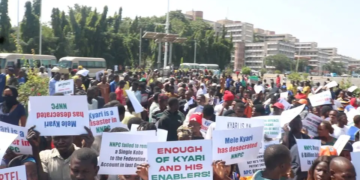
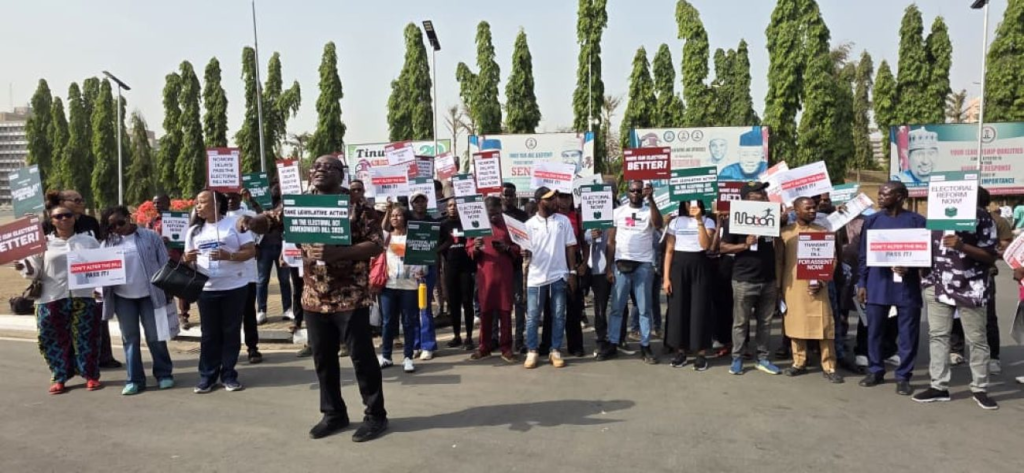
Civil society groups plan protest over amended electoral act after weeks of agitation around the same issue. Earlier this month, protesters gathered at the National Assembly under the #OccupyNASS banner, demanding clearer election laws and mandatory electronic transmission of results ahead of 2027. 
Reuters also reported that after public backlash, Nigeria’s Senate reversed an earlier stance and backed real-time electronic transmission, under pressure from labour unions, civil society and lawyers, before the final harmonisation and assent drama resumed. 
Civil society groups plan protest over amended electoral act because, in their reading, the final product still does not match the urgency and clarity citizens demanded during those protests.
FCT elections as the immediate pressure point
Civil society groups plan protest over amended electoral act as the Situation Room prepares to observe the FCT Area Council elections scheduled for Saturday, February 21, 2026, noting the poll spans six area councils and over 2,800 polling units. 
They warned that unresolved doubts about transparent result transmission could worsen voter apathy, especially in urban councils like AMAC, where turnout was reported as just over five per cent in the 2022 election. 
Civil society groups plan protest over amended electoral act, but the stakes are bigger than one council poll. Abuja is symbolic. If citizens can’t trust the mechanics of result reporting in the capital, confidence suffers nationwide.
What to watch next
Civil society groups plan protest over amended electoral act and say further announcements will follow on the National Day of Action. 
Three things will determine whether this protest wave moves the needle:
1. Legislative response: will the National Assembly reopen the clause, or defend the current drafting as sufficient?
2. INEC posture: will INEC issue firmer operational rules that reduce ambiguity even if the law remains flexible?
3. Public mobilisation: will labour, youth groups, professional bodies and election observers unify behind one demand?
Civil society groups plan protest over amended electoral act because, in their framing, this is not about technology hype. It is about whether the law locks in accountability at the most sensitive point of Nigerian elections: results.
https://punchng.com/civil-society-groups-plan-protest-over-amended-electoral-act