














Dangote now supplies 92% of petrol as FG pauses imports
Dangote now supplies 92% of petrol as FG pauses imports, marking a major shift in Nigeria’s downstream petroleum market as domestic refining begins to replace the country’s long-standing dependence on imported fuel.
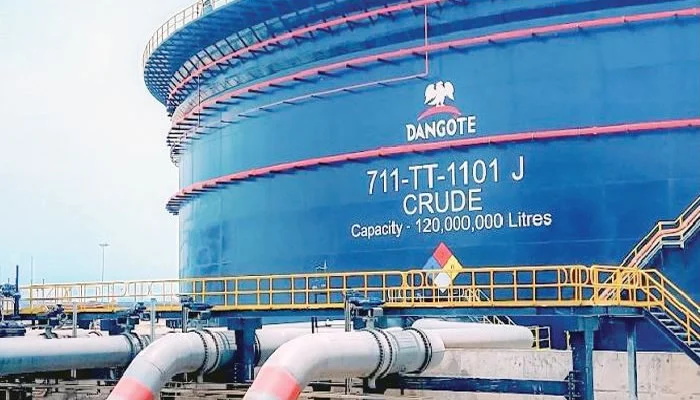
Data from the Nigerian Midstream and Downstream Petroleum Regulatory Authority indicates that the Dangote Petroleum Refinery supplied about 36.5 million litres of petrol per day in February 2026, accounting for approximately 92% of Nigeria’s daily fuel supply. 
The development coincided with a decision by the Federal Government to pause the issuance of petrol import licences, after regulators determined that local refining output was sufficient to meet national demand. 
The milestone represents one of the most significant changes in Nigeria’s fuel supply structure in decades, with domestic refining—led by the Dangote refinery—rapidly displacing imported petrol.
Nigeria’s petrol market undergoes historic transition
For decades, Nigeria relied almost entirely on imported petrol despite being one of Africa’s largest crude oil producers.
The country’s state-owned refineries in Port Harcourt, Warri and Kaduna struggled with operational inefficiencies and prolonged shutdowns, forcing the government to depend on imported refined products.
By 2025, imports still accounted for more than 62% of Nigeria’s petrol supply, highlighting the country’s heavy reliance on foreign fuel sources. 
However, the commissioning and gradual ramp-up of the 650,000-barrel-per-day Dangote Petroleum Refinery in Lagos began to change the dynamics of the market.
The refinery’s increasing output has now reached a point where Dangote now supplies 92% of petrol as FG pauses imports, signalling a major restructuring of the downstream sector.
How local refining overtook imports
The transformation of Nigeria’s fuel supply did not happen overnight.
Regulatory data shows that domestic refining gradually increased its share of the market during late 2025 and early 2026.
At the same time, petrol imports began to decline sharply as the Dangote refinery ramped up production capacity.
By February 2026, total national petrol supply averaged 39.5 million litres per day, with domestic refining accounting for roughly 92% of the volume. 
Imports dropped dramatically, contributing only a small portion of the supply.
As a result, Dangote now supplies 92% of petrol as FG pauses imports, reflecting the growing dominance of local refining in Nigeria’s energy market.
Why the Federal Government paused imports
Officials say the decision to halt petrol import licences was based on regulatory assessments that domestic supply was adequate.
Sources within the NMDPRA confirmed that no new licences for petrol importation had been issued this year, because local production met the country’s fuel requirements. 
The policy aligns with provisions of the Petroleum Industry Act, which allows petrol imports only when local production cannot meet national demand.
By prioritising domestic refining, authorities hope to reduce the country’s reliance on imported fuel and conserve foreign exchange.
Thus, Dangote now supplies 92% of petrol as FG pauses imports has become a symbol of Nigeria’s push toward energy self-sufficiency.
https://ogelenews.ng/dangote-now-supplies-92-of-petrol
Economic implications of the shift
Analysts say the shift toward domestic refining could have significant economic consequences for Nigeria.
First, reducing petrol imports may help lower pressure on the country’s foreign exchange reserves, since billions of dollars were previously spent annually on importing fuel.
Second, domestic refining could strengthen energy security, ensuring a more stable fuel supply within the country.
Third, the development could stimulate growth in related sectors such as logistics, distribution and petrochemicals.
However, some industry stakeholders have also raised concerns that the situation where Dangote now supplies 92% of petrol as FG pauses imports could create a near-monopoly if competing refineries fail to increase output.
Concerns about market dominance
While the dominance of local refining has been widely welcomed, some industry operators warn that relying heavily on a single refinery could create competition challenges.
Energy analysts argue that a healthy downstream sector requires multiple suppliers to ensure price competition and supply stability.
Some operators have therefore urged regulators to maintain policies that encourage the growth of modular refineries and rehabilitated state-owned refineries.
These measures would help diversify Nigeria’s refining capacity and reduce the risk of market concentration.
Nevertheless, Dangote now supplies 92% of petrol as FG pauses imports remains a major milestone in the country’s effort to reform its energy sector.
Petrol prices remain high
Despite the increase in domestic refining, petrol prices at filling stations have remained high in many parts of the country.
Reports indicate that pump prices in some cities still hover above ₦1,200 per litre, even after the Dangote refinery reduced its gantry price by about ₦100 per litre. 
Industry analysts say several factors continue to influence retail prices, including global crude oil prices, transportation costs and currency fluctuations.
As a result, the transition in supply structure has not yet translated into immediate price relief for consumers.
Still, Dangote now supplies 92% of petrol as FG pauses imports could eventually contribute to more stable pricing once the market fully adjusts to domestic refining.
Future of Nigeria’s fuel supply
The current situation suggests that Nigeria may finally be entering a new phase in its petroleum sector.
For decades, the country’s fuel supply chain was dominated by imports financed with scarce foreign exchange.
Now, the rise of domestic refining—particularly from the Dangote refinery—has begun to reverse that trend.
Experts believe that if domestic output continues to grow, Nigeria could eventually eliminate petrol imports entirely.
For now, however, the headline Dangote now supplies 92% of petrol as FG pauses imports reflects a transitional moment in the country’s energy history.
https://punchng.com/dangote-now-supplies-92-of-petrol-as-fg-pauses-imports