














Delta Governor Oborevwori Signs N1.729 Trillion 2026 Budget Into Law
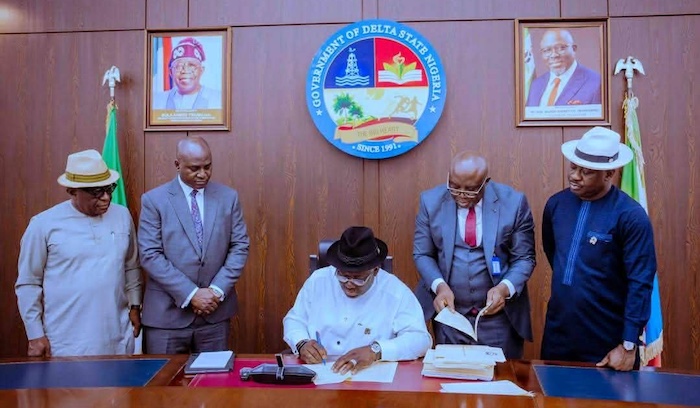
Asaba, Delta State — Delta State 2026 budget plans took a decisive step forward on Tuesday as Governor Sheriff Oborevwori signed the N1.729 trillion Appropriation Bill into law in Asaba, officially setting the fiscal direction for the state ahead of the 2026 financial year.development under its MORE Agenda.
The budget, officially tagged the “Budget of Accelerating the MORE Agenda,” represents a sharp increase of over 70 per cent from the state’s 2025 fiscal estimate, signalling an aggressive push toward infrastructure expansion, social investment, and economic growth.
Governor Oborevwori signed the bill at Government House, Asaba, following its passage by the Delta State House of Assembly.
Capital Spending Takes Priority
Under the 2026 budget framework, 70 per cent of the total allocation has been earmarked for capital expenditure, while 30 per cent is dedicated to recurrent spending, including salaries and government operations.
The heavy tilt toward capital projects reflects the administration’s intention to fast-track infrastructure development, public works, and long-term investments across the state.
Describing the budget, Governor Oborevwori said it was not merely a financial document but a roadmap for measurable progress.
“This is not just a budget of numbers,” the governor said. “It is a budget of vision, action, and deliverables that will shape the next phase of our development.”
He assured that implementation would commence early in 2026, with strict monitoring to ensure projects align with stated priorities.
https://ogelenews.ng/delta-state-2026-budget-oborevwori
Delta State 2026 Budget Prioritises Capital Spending
The 2026 budget places strong emphasis on infrastructure development, security enhancement, education, and sustainable economic expansion. The governor noted that improvements in internally generated revenue (IGR) recorded in 2025 were achieved without increasing the financial burden on residents, attributing the gains to improved fiscal discipline and better revenue administration.
According to government officials, the Delta State 2026 budget is structured to accelerate infrastructure delivery while maintaining fiscal discipline, the expanded budget size is intended to close infrastructure gaps, stimulate economic activity, and strengthen social safety nets across Delta communities.
Governor Signs Additional Laws
Beyond the budget, Governor Oborevwori also assented to three key bills passed by the Delta State House of Assembly, reinforcing the administration’s legislative agenda.
The newly signed laws include:
• Delta State Social Investment Programme Law, which provides a legal framework for structured welfare and social support initiatives.
• Delta State Colleges of Education Law, 2025, aimed at harmonising the operations of state-owned colleges and enabling them to award both NCE qualifications and degree programmes.
• Delta State Anti-Terrorism and Anti-Cultism (Amendment) Law, 2025, designed to strengthen the state’s legal response to emerging security threats.
Legislative Role and Oversight
Speaker of the Delta State House of Assembly, Rt. Hon. Emomotimi Guwor, said lawmakers subjected the budget estimates to extensive scrutiny, ensuring alignment with the MORE Agenda and the developmental needs of the state.
He explained that the Assembly conducted ministry-by-ministry reviews and stakeholder engagements to enhance transparency and ensure effective utilisation of public funds.
What the Budget Means for Deltans
With the budget now in force, Delta State is positioned to scale up investments in roads, education, healthcare, security, and social programmes. Analysts say the high capital allocation could translate into faster project delivery and expanded economic opportunities if implementation is effectively managed.
With the Delta State 2026 budget now signed into law, attention will shift to implementation and oversight as residents await tangible improvements across key sectors.
Governor Oborevwori thanked lawmakers, civil servants, and stakeholders for their cooperation throughout the budget process and extended goodwill messages to residents as the state prepares for an ambitious fiscal year in 2026.
With the Delta State 2026 budget now signed into law, attention will shift to implementation and oversight as residents await tangible improvements across key sectors.