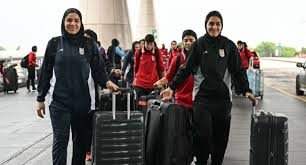



















Iran women’s football team
The Iran women’s football team has arrived in Turkey on the latest leg of a tense journey back toward Iran, after several members who had initially sought asylum in Australia withdrew their requests and rejoined the squad.
Reuters reported on March 17 that five members of the group had pulled back from their asylum claims, reunited with the Iran women’s football team in Kuala Lumpur, Malaysia, and then landed in Istanbul as they continued their return trip. At the time of that report, two individuals from the original group were still in Australia.
The story has drawn international attention because it sits at the crossroads of football, politics and personal safety. Members of the Iran women’s football team had sparked concern after refusing to sing the national anthem during an Asian Cup match, a gesture widely interpreted as political dissent. Reuters said the players had cited fears of persecution after that act, and Australian authorities had granted humanitarian visas to some members of the group.
What makes the latest development especially striking is the reversal. After the asylum bids were first lodged, several of those involved changed course. Reuters reported on March 15 that a fifth member of the group had withdrawn her asylum claim, leaving only two still in Australia. That report also noted that the Iran women’s football team could not return directly to Tehran because of conflict-related disruption and closed or unsafe airspace routes, which forced a more complicated trip through Southeast Asia and then Turkey.
By the time the Iran women’s football team reached Istanbul, the journey had already become about much more than sport. Their appearance at the Women’s Asian Cup in Australia had initially been a football assignment. But events off the pitch transformed it into a global story about dissent, fear and the limits of refuge when family members back home may still be exposed to pressure. Reuters did not independently confirm coercion against relatives, but other outlets reported that fears for family safety were part of the emotional pressure weighing on some players. Because that aspect remains difficult to verify publicly, it should be treated carefully in any responsible account.
https://ogelenews.ng/iran-womens-football-team
That distinction matters. It is confirmed that members of the Iran women’s football team sought humanitarian protection in Australia and that several later withdrew those requests. It is also confirmed that the team regrouped in Kuala Lumpur before flying on to Istanbul. What remains less clear in fully documented public terms is the exact chain of pressure, persuasion or fear that led individual players to abandon the asylum path. Reuters has kept its reporting grounded, saying only that the players had feared persecution and that the return route was unfolding amid regional turmoil.
The atmosphere around the squad has been charged from the start. The refusal by some players to sing the anthem became especially sensitive because it happened during a period of major upheaval linked to military strikes involving Iran. Reuters reported that the team’s tournament coincided with a major geopolitical crisis and that the journey home was complicated by the fallout from that conflict. In that setting, the movements of the Iran women’s football team were no longer simply logistical. They became symbolic.
Turkey’s role in the story is practical but also significant. Reuters said the team had arrived in Istanbul, though it remained unclear how they would proceed from there back to Iran. Another report described the onward trip as potentially involving long road travel because of closed airspace and unstable regional conditions. That means the Iran women’s football team is still in transit, and the journey itself reflects the broader instability surrounding the case.
There is also the unresolved question of those who did not return. Reuters reported that two members of the original group remained in Australia even after the others rejoined the Iran women’s football team. That detail matters because it shows the story did not end with a single uniform decision. Within the same squad, some chose the road home while others stayed behind, suggesting very different calculations about risk, family, identity and future.
For football authorities, the episode is uncomfortable. It raises questions about athlete protection during international tournaments, especially when national teams come from highly restrictive political environments. Reuters said the Asian Football Confederation reported that the players were in high spirits and had not expressed safety concerns directly to its staff, but the wider picture remained far more complicated than that official line suggested. The plight of the Iran women’s football team has exposed the tension between sports governance language and the harder realities athletes may face outside formal competition structures.
For Iran, the story carries reputational consequences. The Iran women’s football team should have been discussed for its performance on the field. Instead, the squad became a global symbol of the pressures that can follow even quiet forms of dissent. A refusal to sing an anthem, in another context, might have passed as a minor controversy. In this case, it became the starting point of an international asylum drama.
For the players themselves, the story is more personal than political theory can capture. Some of them sought protection. Some reversed course. Some continued with the Iran women’s football team toward home. Some stayed behind. Each decision appears to have come under extraordinary emotional weight. That is why the team’s arrival in Turkey matters. It marks movement, but not resolution. It shows that the journey is continuing, while the uncertainty has not lifted.
The best way to understand this moment is not as a clean ending but as a fragile transition. The Iran women’s football team has reached Turkey, but the story remains unfinished. The practical question of how and when they return to Iran is still open. The deeper question, whether those who withdrew their asylum bids are truly safe in the long run, is even harder to answer. Reuters was right to keep that uncertainty in view.
For Ogele News readers, the real significance of this story is not only that the Iran women’s football team arrived in Turkey. It is that their arrival came after a dramatic reversal in an asylum saga that had already exposed fear, division and the vulnerability of athletes caught between national duty and personal safety. That is the frame that gives this development its weight, and that is the frame the story deserves.