


















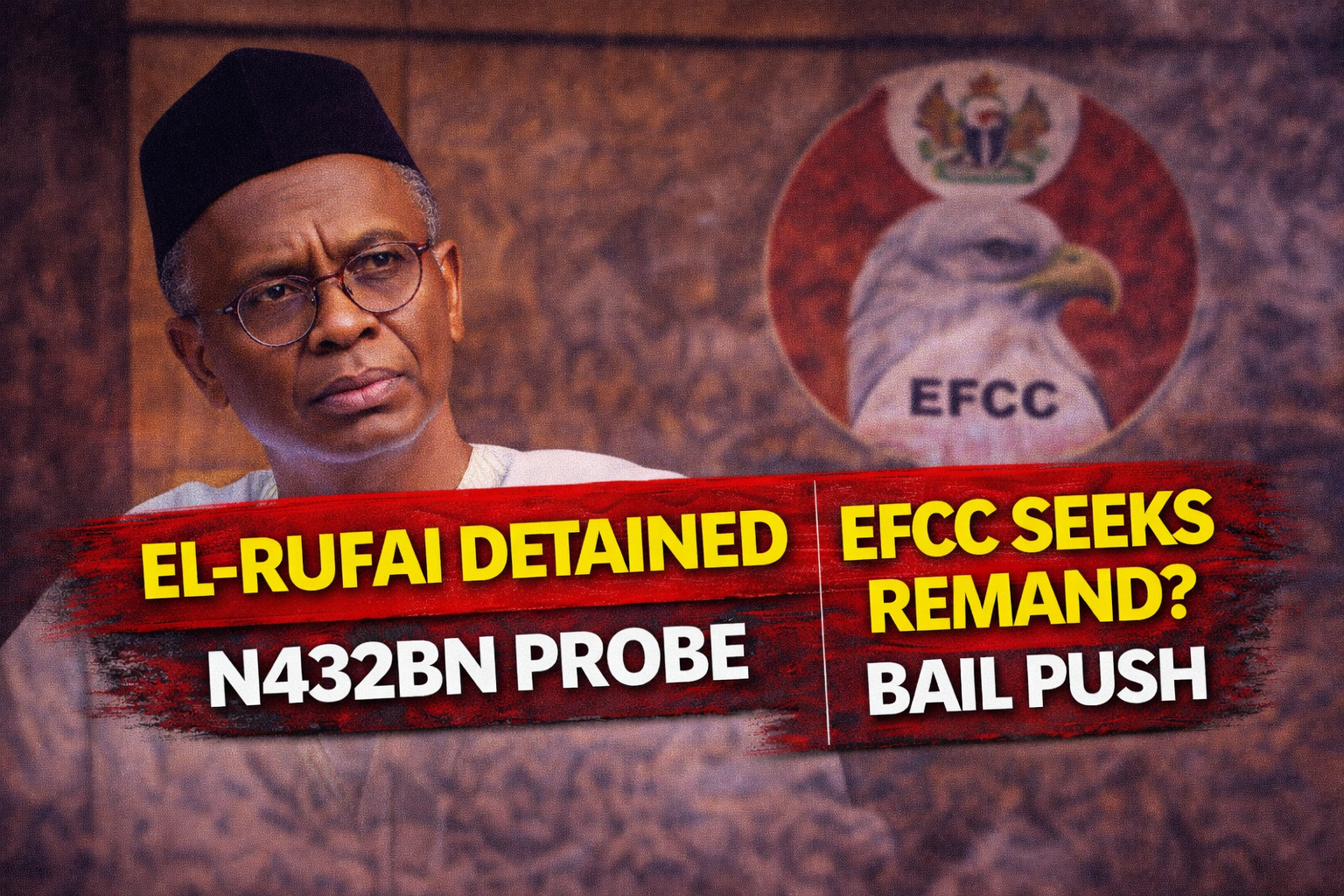
Former Kaduna State Governor, Nasir El-Rufai, spent a second night in the custody of the Economic and Financial Crimes Commission (EFCC) on Tuesday, as his lawyer, A.U. Mustapha (SAN), intensified efforts to secure his release on bail amid an alleged N432bn probe linked to his eight years in office.
Punch reported that El-Rufai arrived at the EFCC headquarters in Abuja on Monday at about 10 a.m. for questioning and was subsequently detained, with investigators continuing interrogation over issues connected to the alleged N432bn corruption probe.
The latest development came as indications emerged that the commission may seek a remand order to extend his stay in custody beyond the initial window, to allow investigators more time to conclude questioning and process the case file.

What we know so far
According to Punch, an EFCC official who spoke on condition of anonymity said the agency was considering approaching a court for a remand order after the expiration of the time permitted for detention without a court order, insisting that El-Rufai had not been released despite claims circulating online.
The Guardian also reported that the former governor was detained by the EFCC over the alleged N432bn Kaduna funds probe, reinforcing the central claim that the anti-graft agency’s investigation is tied to financial dealings during his administration.
While details of the allegations have not been fully laid out in open court, the case has already drawn public attention because it involves a high-profile former governor and a headline figure of N432bn.
Bail push: what the defence is seeking
Punch identified El-Rufai’s lawyer as A.U. Mustapha (SAN) and reported that the senior advocate was pushing for his client’s release on bail as detention continued into a second night.
At this stage, the defence position, as reflected in the reports, is straightforward: El-Rufai honoured the agency’s process by presenting himself for questioning, and his counsel is seeking administrative bail while the inquiry continues.
Why the “48 hours” argument matters
The anonymous EFCC source cited by Punch referenced “48 hours allowed by law.” It’s important to frame that correctly.
Under Nigeria’s constitutional framework, “reasonable time” for bringing an arrested person before a court is commonly treated as 24 hours where a court is within 40 kilometres and 48 hours where it is not. Legal commentary and practice guides often cite this as the operational standard when discussing pre-charge detention and remand procedures.

That is why agencies often move to seek a remand order once detention risks crossing the constitutional boundary, especially where investigators want more time and do not intend to file charges immediately.
What a remand order means in practice
A remand order is not a conviction and not a finding of guilt. It is a court-authorised custody extension used in criminal procedure while investigation continues, typically under ACJA-style remand provisions.
In practical terms, once a remand application is filed, a judge or magistrate considers whether there is sufficient reason to keep the suspect in custody for a limited period while investigators conclude the process. That court step becomes the legal cover for continued custody.
https://ogelenews.ng/n432bn-probe
So, in this N432bn probe, the key issue is whether the EFCC proceeds to court for remand and what the court decides, or whether it grants administrative bail and continues the investigation with reporting conditions.
The wider picture: public scrutiny and political temperature
The N432bn probe has also triggered wider public debate, including protests and commentary around whether the case will be pursued thoroughly and transparently. The Nation reported that protesters gathered at the EFCC headquarters demanding prosecution linked to the alleged N432bn case.
In a climate where high-profile corruption allegations often become political talking points, the EFCC’s next steps will be watched closely: whether it files charges, seeks remand, or grants bail under conditions.
What happens next
Here are the immediate milestones to monitor:
- Bail outcome: Whether the EFCC grants administrative bail or maintains custody pending court action.
- Remand application: Whether the commission seeks a remand order and the terms a court may impose.
- Formal charges: Whether investigators are ready to file charges connected to the alleged N432bn probe, and what specific counts, if any, emerge.
For now, the confirmed position from the published reports is that El-Rufai remains in custody, his lawyer is pressing for bail, and the EFCC is weighing a possible remand request as part of the N432bn probe process.
https://thenationonlineng.net/protesters-storm-efcc-headquarters-demand-el-rufais-prosecution