














NLC Nationwide Protest: What Is Happening, Why It Started, and What Comes Next
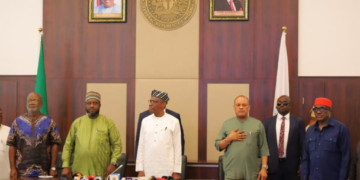
NLC nationwide protest activities began taking shape in Abuja on Wednesday as leaders of the Nigeria Labour Congress, joined by civil activists including Omoyele Sowore, converged on the Labour House to protest worsening insecurity and economic hardship across the country.
The gathering followed days of tension between organised labour and the Federal Government, culminating in a late-night meeting between President Bola Ahmed Tinubu and leaders of the Nigeria Labour Congress on Tuesday. Despite the engagement, labour leaders insisted that no agreement was reached to halt the planned nationwide protest.
As of Wednesday, workers remained mobilised while labour leaders continued talks with government representatives, leaving the country in a state of watchful uncertainty.
What Is This Protest About?
The NLC nationwide protest is primarily a response to prolonged insecurity and governance concerns that labour leaders say have left Nigerian workers exposed and unprotected.
https://ogelenews.ng/nlc-nationwide-protest-insecurity-abuja
Unlike previous labour actions focused mainly on wages or fuel prices, this protest centres on broader national issues. Labour leaders argue that insecurity has disrupted livelihoods, endangered families, and weakened confidence in public institutions.
Workers gathering at the Labour House said the protest is meant to force attention to issues that dialogue alone has failed to resolve.
Why the Protest Is Happening Now
Labour leaders say the timing of the protest reflects accumulated frustration rather than a single event.
According to the NLC, Nigerian workers have endured years of violent crime, kidnapping, policy uncertainty, and rising living costs without sufficient state protection. While successive engagements with government have produced promises, labour leaders insist that implementation has remained weak.
The failure of the late-night meeting with the President to produce concrete commitments became a turning point, prompting labour to proceed with mobilisation.
Labour House as the Protest Centre
From the early hours of Wednesday, workers under the aegis of the Nigeria Labour Congress began assembling at the NLC secretariat in Abuja. The Labour House quickly became the focal point of the protest.
NLC President Joe Ajaero told journalists that while discussions with government had taken place, they did not offer clear assurances capable of addressing labour’s core demands.
Workers at the venue were seen waiting anxiously for updates from ongoing closed-door talks between labour leaders and a joint committee reportedly set up by the Presidency and the Nigeria Governors’ Forum.
Sowore’s Presence and the Debate It Sparked
The presence of Omoyele Sowore, former presidential candidate and convener of the Revolution Now Movement, added a political dimension to the protest.
Some observers questioned whether the involvement of a known politician blurred the line between labour activism and partisan politics. Others argued that insecurity and governance failures affect all citizens, making broader civic participation inevitable.
While the NLC leadership has not formally commented on Sowore’s role, labour sources insist the NLC nationwide protest remains worker-led, issue-driven, and non-partisan.
Key Demands of the NLC Nationwide Protest
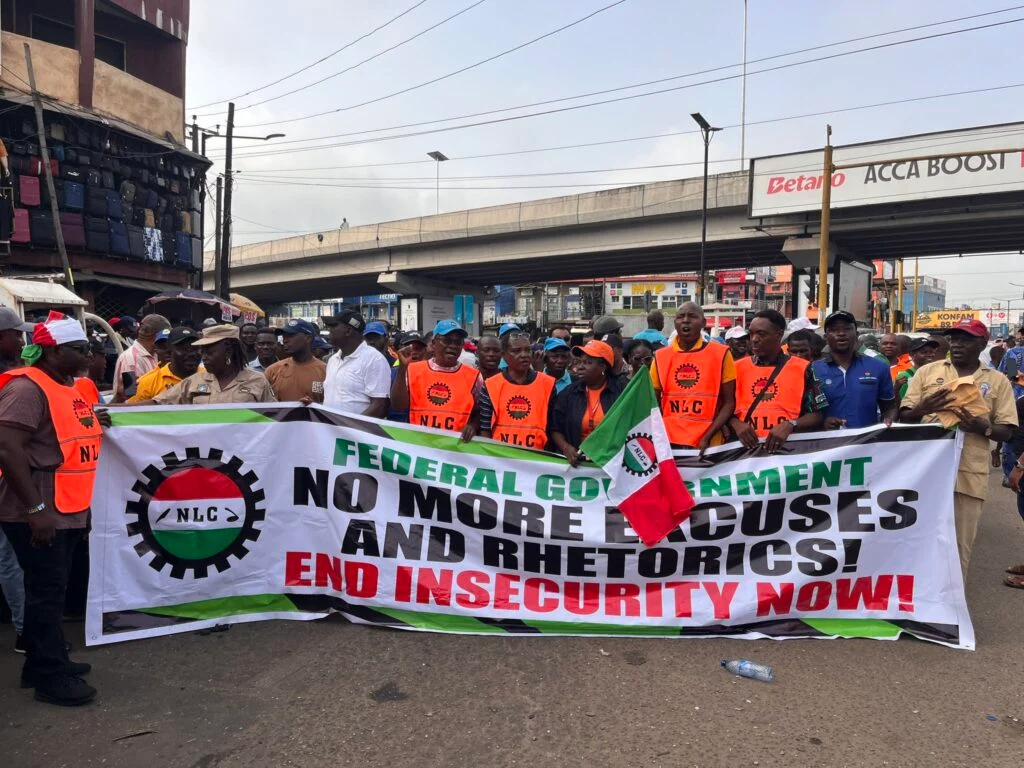
At the heart of the NLC nationwide protest are demands aimed at security, governance accountability, and democratic reform.
The Nigeria Labour Congress is calling for:
• The creation of a dedicated fund to rehabilitate and compensate citizens, including workers, affected by insecurity
• Constitutional reforms to make Section 14(2)(b) of the 1999 Constitution, which assigns responsibility for citizens’ security and welfare to government, justiciable
• Reforms to strengthen a truly independent electoral commission
• Prompt prosecution and punishment of electoral offenders
• An end to the militarisation of elections across Nigeria
Labour leaders argue that insecurity cannot be separated from weak institutions and poor accountability.
What This Means for Ordinary Nigerians
For everyday Nigerians, the NLC nationwide protest carries practical implications.
• Cost of living: Protests can disrupt workdays, transport routes, and informal income activities
• Jobs: Some workers may lose hours or wages if demonstrations spread
• Safety: Large gatherings often increase security presence and tension in city centres
• Business: Markets and offices may slow if protests escalate
• Education: Schools and public services could be affected if labour action widens
• Daily life: Traffic disruptions and uncertainty may affect routines
The protest highlights how insecurity and governance failures translate into daily hardship.
What to Watch Next
As the situation develops, Nigerians should watch:
1. Whether talks between labour and government produce concrete commitments
2. If the protest expands beyond Abuja to other states
3. How security agencies manage public order
4. The response of civil society groups
5. Government action on labour’s constitutional and electoral demands
These signals will determine whether the protest de-escalates or intensifies.
Bottom Line
The NLC nationwide protest is no longer just about labour grievances. It has become a broader test of Nigeria’s ability to confront insecurity, strengthen governance, and rebuild citizens’ trust in the state.
https://www.nigeria-law.org/ConstitutionOfTheFederalRepublicOfNigeria.htm