



















Rotimi Amaechi joins National Assembly protests over electronic transmission of results
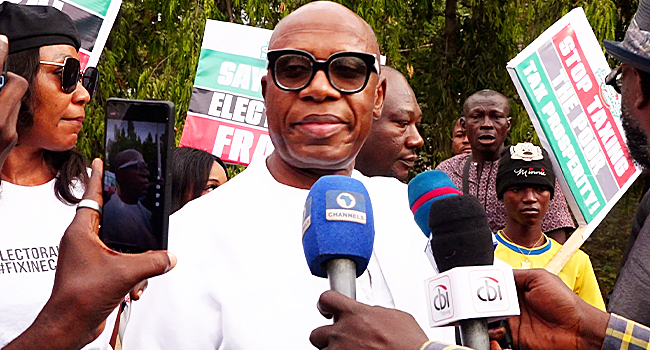
In a striking political development that has drawn intense public attention, Rotimi Amaechi, former Governor of Rivers State and ex-Minister of Transportation, joined demonstrators at the National Assembly Complex in Abuja on Tuesday to protest the Senate’s handling of the Electronic Transmission of Results clause in the ongoing Electoral Act (Amendment) Bill. His participation underscores rising national frustration with how the legislature is addressing real-time electronic transmission of election results, a reform many Nigerians see as vital to credible elections. 
Amaechi’s appearance was unusual and potent: a senior political figure taking to the streets alongside youths, civil society activists and opposition supporters demanding transparency reforms. Witnesses and video clips shared widely on social media and news outlets captured Amaechi — often flanked by his son — at the protest site, affirming his stance that mandating real-time electronic transmission of results remains non-negotiable for free and fair elections. 
The Protest and Its Origins
The protests erupted on Monday under the banner #OccupyNASS, a mass civic action calling on the National Assembly to include mandatory real-time electronic transmission of election results as an explicit requirement in the amended Electoral Act ahead of the 2027 general elections. Demonstrators argue that the absence of a clear, compulsory e-transmission clause could open the door to delayed or manipulated results — a problem that marred past polls. 
Amaechi’s presence on Tuesday — effectively the second day of protests — gave the movement added momentum. The former minister, usually seen in formal political circles, stood side by side with activists and youth groups, reinforcing the call for transparent election result handling and arguing that lawmakers must reflect public demand. 
Amaechi’s Message to Lawmakers and Nigerians
Addressing the press at the protest venue, Amaechi framed his participation as a demonstration of principle rather than partisan positioning. He criticised the ruling All Progressives Congress (APC) and the Senate for resisting what he described as “common-sense democratic reforms.” According to him, the party fears losing elections if a mandatory electronic transmission clause is enshrined in law. 
“I believe that the opposition parties should come out — PDP, ADC, everybody should be out — to protest against the attempt of one party to deny Nigerians their rights,” Amaechi said, emphasising that electronic transmission of results safeguards credibility and confidence in the electoral process. 
He also said he had brought his son along in case the protest turned chaotic, underscoring his belief that leaders should be at the forefront, not behind the scenes, when citizens mobilise around issues critical to the nation’s democratic health. 
https://ogelenews.ng/rotimi-amaechi-joins-national-assembly-protests

Why E-Transmission Matters
At the heart of the protests is a debate over how election results will be transmitted and verified once votes are cast in 2027. Electronic transmission of results refers to the instant upload of polling unit results by the Independent National Electoral Commission (INEC) into a public portal that provides real-time visibility to citizens, political parties and observers.
Supporters of mandatory e-transmission argue that this reduces opportunities for collation manipulations, late alterations, and allegations of impropriety once results leave polling units — issues that plagued previous elections. Critics — including some lawmakers — have cited Nigeria’s infrastructural challenges, such as inconsistent network coverage in rural areas, insisting the clause be worded to allow discretion. 
Protesters have rejected that position, insisting discretionary language weakens the integrity of electoral reforms and leaves room for ambiguity and contested outcomes. The presence of political figures like Amaechi and earlier intervention by former Labour Party presidential candidate Peter Obi signals how the movement is capturing the attention of diverse sectors of the polity. 
National Assembly and Senate Reactions
Despite mounting public pressure, the Senate leadership has maintained that it did not outright abandon electronic transmission mandates and offered clarifications as part of ongoing legislative debate. However, demonstrators perceive these statements as insufficient and fear that the absence of a clear, enforceable e-transmission clause could undermine electoral credibility. 
Security officials have responded by erecting barricades on key access roads to the National Assembly, emphasising crowd control while managing the protests. There have been no major violent confrontations reported, but tensions remain visible as the protests continue into a second day and beyond. 
Political Implications and Public Reception
The participation of a high-profile former governor and federal minister like Amaechi in a street protest highlights the gravity of the issue for many Nigerians. Political analysts note that this represents a widening coalition of civil society, youth, opposition figures and some self-described conscience members of the political class brokered around electronic transmission of results, transparency and electoral credibility.
Public reaction on social media has been mixed — while some applaud Amaechi for aligning with citizens and taking a stand for democratic reforms, others question the coupling of mainstream politicians with what began as a grassroots movement. Nevertheless, the protest has attracted widespread attention, indicating that electronic transmission of results remains a potent rallying point in the lead-up to 2027. 
Looking Ahead
As the National Assembly prepares further debates on the Electoral Act (Amendment) Bill, the protest is expected to continue, with activists and political allies insisting on the inclusion of a mandatory clause on e-transmission. Whether lawmakers will yield to the public pressure — and whether Nigeria’s legislative reforms can accommodate both infrastructure concerns and transparency demands — remains an open question.
Rotimi Amaechi’s decision to join the protest puts additional spotlight on the issue, framing it not just as a technical legal point but as a matter of national interest and democratic accountability. For many Nigerians, the call for electronic transmission of results is about trust in the ballot, visibility of outcomes, and preventing future electoral disputes — and influential figures aligning with that call lend fresh urgency to the debate.
Rotimi Amaechi joins National Assembly protests over electronic transmission of results