
















Why Amaechi attended N’Assembly protest
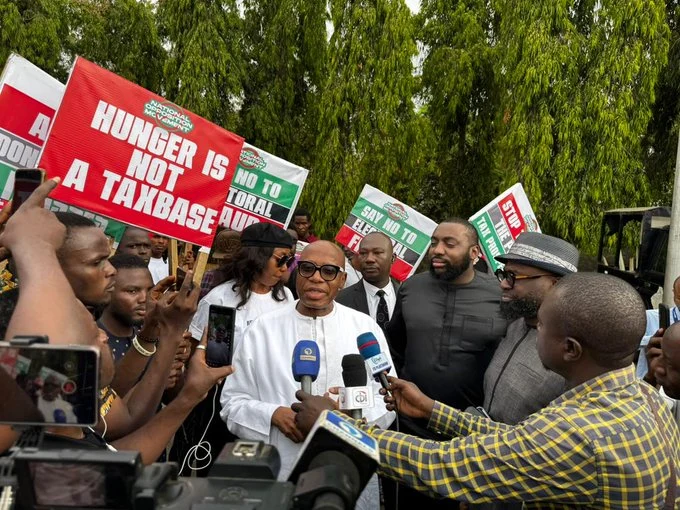
Former Minister of Transportation Rotimi Amaechi has offered a public explanation for his appearance at the “Occupy the National Assembly” protest in Abuja alongside his son, a move that quickly drew national attention and political debate.
Amaechi’s presence at the protest, which targeted the Senate’s position on the electronic transmission of election results, raised questions about motive, symbolism and political intent. This explainer examines why Amaechi attended N’Assembly protest with son, what the protest was about, and why his remarks matter in Nigeria’s evolving democratic conversation.
What Happened at the National Assembly?
The protest took place in Abuja, where demonstrators gathered under the banner “Occupy the National Assembly.” The demonstration was organised by civil society groups and opposition figures opposed to what they described as legislative attempts to weaken electoral transparency.
At the centre of the protest was resistance to decisions and proposals linked to the electronic transmission of election results — a mechanism widely seen by reform advocates as a safeguard against vote manipulation.
Amaechi joined the protesters physically, rather than issuing statements from afar. His appearance, especially with his son, immediately sparked discussion about why Amaechi attended N’Assembly protest with son and what message he intended to send.
Why Did Amaechi Attend With His Son?
Speaking to reporters at the protest ground, Amaechi explained that his son, a medical doctor, accompanied him for practical reasons. According to him, protests can turn violent, and having medical support on hand was a precautionary measure in case demonstrators sustained injuries.
He said the decision was not symbolic theatre, but preparation.
“My son is a medical doctor,” Amaechi said. “I came with him in case something went wrong and people got injured. This is a protest. Anything can happen.”
This explanation forms a key part of why Amaechi attended N’Assembly protest with son, countering claims that the move was staged or purely political.
Amaechi’s View on Leadership and Protest
Beyond the medical explanation, Amaechi framed his presence as a statement on leadership. He argued that leaders should be physically present during moments of civic action instead of watching from the sidelines.
According to him, protests are not events for ordinary citizens alone, but moments when political leaders must share in the risks and responsibility.
This belief further explains why Amaechi attended N’Assembly protest with son, as he positioned his action as leadership by example rather than opportunism.
Why the Protest Targeted Electronic Transmission
Amaechi used the platform to accuse the ruling All Progressives Congress (APC) of opposing electronic transmission of results out of fear of losing elections.
He challenged the logic of resisting transparency, arguing that a party confident in its popularity should welcome any system that reflects the true will of the people.
“What are they afraid of?” Amaechi asked. “If they say they have 31 governors, why fear transparent elections?”
This political accusation elevated the protest from a civil action to a broader debate about democratic integrity, reinforcing why Amaechi attended N’Assembly protest with son as part of a larger ideological battle.
Call for Opposition Unity
Amaechi also called on opposition parties to abandon restraint and join street protests against what he described as attempts to dominate the political space.
He specifically mentioned the need for parties such as the PDP, ADC and others to mobilise publicly rather than limit opposition to press statements.
In his view, silence or caution would only embolden actions perceived as anti-democratic. This appeal further clarifies why Amaechi attended N’Assembly protest with son, as he sought to galvanise wider political resistance.
https://ogelenews.ng/why-amaechi-attended-nassembly-protest
Public Reaction and Political Significance
Reactions to Amaechi’s appearance were mixed. Supporters praised him for showing courage and standing openly with protesters. They argued that his physical presence gave weight to the protest and signalled seriousness.
Critics, however, accused him of politicising a civic demonstration or attempting to reassert relevance in national politics. Some questioned whether former office holders should take such prominent roles in street protests.
Regardless of perspective, there is little doubt that Amaechi’s participation shifted attention toward the protest and intensified national discussion around electoral reforms.
Why This Matters
The broader importance of why Amaechi attended N’Assembly protest with son lies in what it reveals about Nigeria’s political moment.
First, it underscores rising tensions around electoral credibility and legislative authority. Second, it highlights growing impatience among political actors and civil society over perceived democratic backsliding. Third, it reflects a belief that street action remains a legitimate democratic tool.
Finally, Amaechi’s action blurs the traditional line between elite politics and popular protest, raising questions about how political engagement is evolving in Nigeria.
The Bottom Line
Amaechi says he attended the protest with his son for safety, solidarity and principle. But beyond the explanation, the act itself speaks to deeper anxieties about democracy, leadership and accountability.
Whether one agrees with his politics or not, why Amaechi attended N’Assembly protest with son has become a lens through which wider concerns about Nigeria’s democratic future are being debated.
http://www.vanguardngr.com/2026/02/why-i-attended-national-assembly-protest-with-my-son-amaechi