













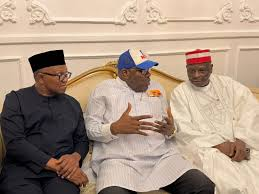
Obi Kwankwaso NDC
Former Anambra State governor, Peter Obi, and former Kano State governor, Rabiu Musa Kwankwaso, have opened a fresh chapter in Nigeria’s 2027 political contest after formally aligning with the Nigeria Democratic Congress, NDC, in what many observers see as one of the most significant opposition realignments ahead of the next general election.
The Obi Kwankwaso NDC move followed high-level political consultations in Abuja, where both former presidential candidates met with key figures of the new platform, including former Bayelsa State governor, Senator Seriake Dickson. Reports indicate that the meeting was held at Dickson’s Abuja residence, with the NDC positioning itself as a fresh political vehicle for opposition forces seeking a more stable structure before 2027.
For Obi, the message was direct: the new party must avoid the culture of endless internal court battles that has weakened several political platforms in Nigeria. He reportedly urged members not to rush to court over internal disputes, warning that litigation could damage party-building efforts before the real electoral contest begins. BusinessDay quoted him as saying members should avoid litigation because they are trying to build a party, not run a legal battlefield.
The Obi Kwankwaso NDC development comes at a sensitive time for Nigeria’s opposition. The African Democratic Congress, ADC, had earlier emerged as a rallying platform for anti-APC forces, but reports suggest that internal leadership disputes and court-related uncertainty created concerns among some major political actors. The Nation reported that some opposition figures were preparing to leave the ADC over litigation affecting its leadership structure.
What makes the Obi Kwankwaso NDC story more politically important is the status of the NDC itself. The Independent National Electoral Commission’s page for the Nigeria Democratic Congress lists the party’s logo and national officers with “By Court Order” annotations. INEC lists Senator Cleopas Moses Zuwoghe as National Chairman and Barr. Ikenna Morgan Enekweizu as National Secretary, with the party address at No. 4 Odenna Close, off Libreville Street, Wuse II, Abuja.
BusinessDay also reported that the NDC was registered by INEC following a court order, adding that checks on INEC’s website showed judicial annotations attached to the party’s listed national officers. This is important because it places Obi’s litigation-free warning in a sharper context: the party may have entered Nigeria’s political field through a court-backed process, but its new leaders appear determined not to allow internal litigation define its future.
https://ogelenews.ng/2027-obi-kwankwaso-ndc-move-reshapes-opposition-pol…
The Obi Kwankwaso NDC alliance also carries electoral weight because both men came into the 2027 conversation with strong political identities. Obi built a large youth-driven following during the 2023 presidential election, while Kwankwaso retained deep political influence in Kano and parts of the North-West through the Kwankwasiyya movement. Their combined presence in one political platform could reshape calculations, especially if the NDC succeeds in managing ambition, zoning, structure, and candidate selection without crisis.
However, the biggest challenge before the Obi Kwankwaso NDC project is not popularity. It is discipline. Nigeria’s opposition history is filled with coalitions that began with energy but collapsed under the weight of ego, unclear leadership, legal disputes, and poor grassroots coordination. A political platform built around major names must quickly move beyond symbolism and show voters that it has polling-unit structures, state chapters, a clear ideology, and a credible internal dispute-resolution system.
For the ruling APC, the development will be watched closely. A united opposition ticket involving strong southern and northern figures could change the mood of the 2027 race. But if the Obi Kwankwaso NDC arrangement becomes another elite negotiation without a clear programme for citizens, it may struggle to move beyond headlines.
There is also the question of who leads the ticket. Obi and Kwankwaso both ran for president in 2023 under different platforms, and both command loyal political bases. The NDC will have to decide whether it wants a competitive primary, a consensus arrangement, or a broader coalition formula that brings in other opposition actors. Any mismanagement of that process could trigger the very litigation Obi is warning against.
The Obi Kwankwaso NDC move is therefore both an opportunity and a test. It gives the opposition a fresh platform at a time many Nigerians are watching the 2027 race with growing interest. But it also puts pressure on Obi, Kwankwaso, Dickson, and other NDC leaders to prove that their politics can rise above the familiar cycle of defections, court cases, and post-primary bitterness.
In the final analysis, the Obi Kwankwaso NDC alliance may become a major turning point in Nigeria’s 2027 election build-up, but only if it is backed by discipline, sacrifice, and a serious national message. The demand for litigation-free politics is a good opening statement. The harder task is building a party strong enough to survive ambition.
https://www.thecable.ng/obi-kwankwaso-formally-join-ndc