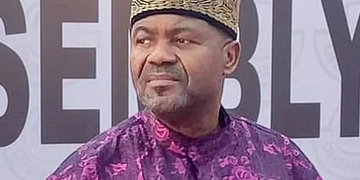














Odii Ebonyi economic agenda
The Peoples Democratic Party governorship candidate in Ebonyi State, Ifeanyi Chukwuma Odii, has outlined an economic and social development programme centred on agriculture, healthcare, education, human capital and private-sector investment as campaigning intensifies ahead of the February 6, 2027 governorship election.
Speaking to party supporters at a meeting in Abakaliki on Thursday, Odii said the Odii Ebonyi economic agenda would seek to expand economic opportunities while repositioning critical public services if he is elected governor.
The PDP candidate said his campaign would be issues-based and promised an inclusive administration in which residents would have greater participation in decisions affecting the state.
His latest declarations build on policy proposals he has presented in recent months covering infrastructure, technology, industrialisation, youth employment, investment promotion and institutional reform.
However, with the election still months away, the proposals remain campaign commitments rather than implemented policies.
Odii Ebonyi economic agenda targets three critical sectors
Healthcare, education and agriculture feature prominently in Odii’s latest campaign message.
The PDP candidate argues that investment in these sectors could improve living standards while expanding Ebonyi’s productive capacity.
Agriculture is particularly significant to the state’s economic structure.
Odii has repeatedly argued that Ebonyi should move beyond primary agricultural production by creating stronger links between farming, processing, manufacturing and markets.
Such an approach would require more than increasing crop production.
It would involve rural roads, storage facilities, processing capacity, access to finance, reliable energy and stronger connections between farmers and buyers.
The Odii Ebonyi economic agenda therefore presents agriculture as both a livelihood issue and a potential foundation for wider economic activity.
Education placed at centre of economic plan
Education is another major component of Odii’s proposals.
In previous campaign engagements, the PDP candidate said he would declare what he described as a state of emergency in education if elected.
His proposals have included modernising public schools, improving teacher recruitment and training, expanding science, technology, engineering and mathematics education, introducing technology-driven learning and strengthening tertiary education.
He has also spoken about scholarships and innovation hubs.
The argument behind the Odii Ebonyi economic agenda is that economic development cannot be sustained without a workforce equipped for a changing labour market.
Odii has specifically highlighted artificial intelligence, robotics, software development, data analytics, renewable energy and mechanised agriculture among areas in which he wants young people trained.
Those proposals represent an attempt to connect education policy with employment and enterprise.
The challenge, if he wins the election, would be converting broad campaign objectives into funded programmes with measurable outcomes.
Healthcare reform features in campaign promises
Odii has also promised to strengthen healthcare delivery.
His earlier policy statements have emphasised primary healthcare and improved health infrastructure.
Healthcare can have economic consequences beyond hospitals and clinics.
Poor access to medical services can reduce household income, increase out-of-pocket expenditure and affect worker productivity.
For rural communities, distance from functional healthcare facilities can further increase the cost of treatment.
The Odii Ebonyi economic agenda therefore treats healthcare as part of a broader human-capital strategy rather than an isolated social programme.
The PDP candidate has yet to publicly provide every financial and implementation detail required to assess the full cost of his proposed reforms.
Those details will become increasingly important as the campaign develops.
Private investment central to Odii’s strategy
Perhaps the most ambitious element of Odii’s economic message concerns private investment.
In a recent campaign engagement, he said he would seek to attract more than N2 trillion in private investment into Ebonyi within six months of assuming office.
Odii said he had access to a network of more than 2,000 prospective investors who, according to him, could potentially commit about N1 billion each.
He identified mining, hospitality, real estate and manufacturing among the sectors that could benefit.
That N2 trillion figure is a campaign pledge and should be treated as such.
It has not yet been converted into completed investments, and the eventual amount would depend on investors actually committing capital, projects reaching financial close and businesses proceeding with implementation.
For the Odii Ebonyi economic agenda, this is an area where voters will need considerably more detail.
Questions include who the prospective investors are, what projects they would finance, whether commitments already exist, how much investment would be foreign or domestic and what incentives a future administration would offer.
Ebonyi already pursuing investment strategy
Odii’s campaign proposals are also entering an environment in which the incumbent Ebonyi State Government already has an investment-development framework.
The state’s Investment Promotion Agency corporate plan for 2024 to 2028 identifies institutional reform, infrastructure development, investment promotion and capacity building as strategic pillars.
That means the 2027 policy debate should go beyond whether Ebonyi needs investment.
The more useful question is how competing approaches would attract capital, reduce barriers to business and translate investment into jobs and household income.
The Odii Ebonyi economic agenda will therefore need to demonstrate how its proposed approach differs from, expands or replaces existing state initiatives.
That comparison is important because campaign promises are most useful to voters when they can be measured against existing policies rather than considered in isolation.
Odii promises inclusive government
Beyond economic policy, Odii has framed his campaign around inclusive governance.
Speaking in Abakaliki, he argued that government should be accountable to the wider population rather than controlled by a small group of political actors.
He said his campaign would focus on issues affecting residents and promised to involve citizens more directly in governance.
These statements form part of a wider political message in which the PDP candidate has criticised the current administration and argued that Ebonyi needs a different development direction.
Those criticisms are political claims made by an opposition candidate.
They should not be presented as independently established conclusions about the performance of Governor Francis Nwifuru’s administration.
The incumbent government has its own development and investment programmes and would be entitled to defend its record against the opposition’s criticisms.
https://ogelenews.ng/ebonyi-2027-pdp-candidate-odii-unveils-economic-age…
Human capital becomes major campaign theme
One of the clearest themes running through the Odii Ebonyi economic agenda is human capital development.
Odii has argued that Ebonyi’s greatest economic asset is its people rather than its mineral or agricultural resources alone.
His proposed programmes include vocational education, entrepreneurship support, technology training, women’s empowerment and skills development.
He has also criticised excessive dependence on political appointments as a route to economic advancement for young people.
His alternative is a private-sector-oriented economy in which more residents build businesses, acquire technical skills and participate in productive industries.
That objective is broad.
Its success would depend on issues ranging from electricity and internet access to education quality, finance, security and the cost of doing business.
Infrastructure must support production, Odii says
Infrastructure also features prominently in the candidate’s development proposals.
Odii has previously promised investment in rural and urban roads, water systems, health facilities, agricultural infrastructure, industrial parks, digital connectivity and energy.
The important distinction in his campaign message is his argument that infrastructure should be tied directly to economic productivity.
A rural road, for example, becomes economically valuable when it allows farmers to transport produce more cheaply.
Reliable electricity can lower production costs for small businesses.
Digital infrastructure can expand access to online services and remote employment.
Industrial parks can attract manufacturers if electricity, transportation, regulation and market access make production commercially viable.
The Odii Ebonyi economic agenda will ultimately be judged on whether these different components can operate as one coherent development strategy rather than as separate campaign promises.
Zoning debate shadows Ebonyi contest
Economic policy is not the only issue shaping the 2027 governorship race.
Odii’s candidacy has also generated debate over zoning.
Some political groups have argued that existing rotational arrangements favour the incumbent governor’s re-election and have urged Odii to respect what they describe as Ebonyi’s established zoning convention.
Odii has rejected the argument that zoning should determine the contest.
He has instead argued that competence, capacity and commitment should guide voters.
The disagreement adds a political dimension to a race in which candidates are also attempting to focus attention on economic performance and public services.
For voters, the campaign is therefore developing around both questions of political representation and competing claims about development.
From promises to measurable targets
The next stage of the campaign should bring greater scrutiny of the numbers behind the Odii Ebonyi economic agenda.
Economic transformation is an attractive phrase.
Delivering it requires measurable policies.
How much would the proposed education reforms cost?
How would expanded healthcare be funded?
What agricultural value chains would receive priority?
What incentives would investors receive?
How many jobs would proposed investments be expected to create?
What proportion of the state budget would be devoted to human capital?
And how would progress be independently measured?
These are the questions that can move the governorship debate from political rhetoric towards policy comparison.
Odii Ebonyi economic agenda faces electoral test
Odii enters the 2027 race presenting himself as an alternative economic manager with private-sector experience and an emphasis on investment, human capital and productivity.
His promises are ambitious.
He wants stronger schools, better healthcare, modern agriculture, expanded infrastructure, technology-driven skills and substantially higher private investment.
But elections are contests between competing records and proposals.
The incumbent administration will have its own programmes and achievements to present to voters, while other candidates may offer different priorities.
The Odii Ebonyi economic agenda should therefore be assessed on its details, financing, feasibility and eventual implementation plan rather than campaign language alone.
For now, Odii has made his central argument clear.
He believes Ebonyi possesses sufficient human and natural resources to build a larger and more productive economy and says his administration would attempt to unlock those resources through private investment and human-capital development.
Whether that argument persuades voters will be determined at the ballot box.
Between now and then, the more important task for the campaign will be turning the promise of “economic transformation” into specific commitments that Ebonyi residents can examine, compare and eventually hold their next government accountable for delivering.
https://punchng.com/ebony-pdp-gov-candidate-promises-economic-transformation/?utm_source=chatgpt.com