








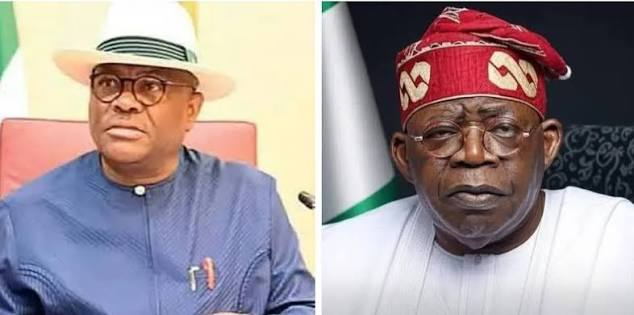
President Bola Tinubu is expected to intervene in the escalating political disagreement between the Minister of the Federal Capital Territory, Nyesom Wike, and governors elected on the platform of the All Progressives Congress as competing strategies for the 2027 general elections deepen tensions within the President’s political camp.
The expected intervention comes amid reports that discussions aimed at resolving the Wike APC governors rift could take place abroad, with France emerging as a possible venue while Tinubu is completing his European holiday.
The disagreement centres largely on Wike’s proposed political arrangement for 2027.
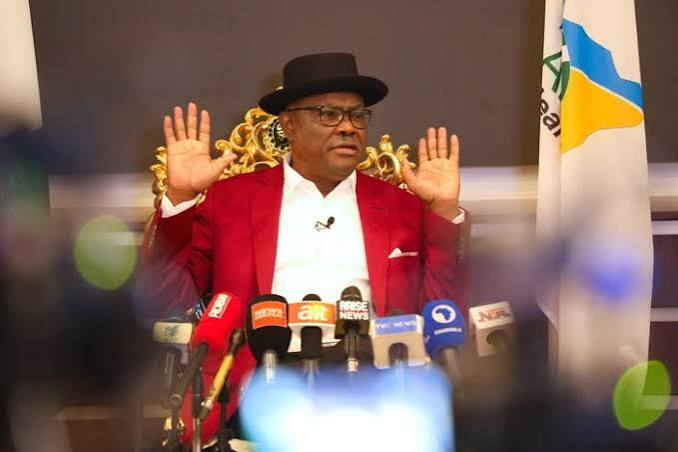
The former Rivers State governor, although still a prominent member of the opposition Peoples Democratic Party, serves as FCT minister in the APC-led Federal Government and has repeatedly declared his support for Tinubu’s re-election.
But Wike’s political strategy goes beyond conventional party lines.
He has promoted what has been described as a Rainbow Coalition, under which political actors from different parties could support Tinubu for president while remaining free to back candidates from their respective parties in governorship, National Assembly and state legislative elections.
That approach has brought him into disagreement with APC governors.
Tinubu expected to intervene in Wike APC governors rift
A senior presidential aide said Tinubu was expected to intervene to prevent the disagreement from developing into a wider confrontation among political actors supporting his administration.
The President’s intervention is expected to focus on resolving differences between Wike and the governors and establishing a framework under which both sides can pursue their political objectives without working at cross-purposes.
Reports indicate that the discussions could take place abroad before Tinubu returns to Nigeria.
The President has been in France as part of his annual leave in Europe.
Wike has also reportedly been outside Nigeria.
However, no formal announcement from the Presidency had, at the time of reporting, confirmed the exact date, venue or participants in any proposed peace meeting.
That distinction is important.
Talks are being contemplated, but a truce has not yet been announced.
Rainbow Coalition at heart of disagreement
The immediate cause of the Wike APC governors rift is the disagreement over the political implications of Wike’s Rainbow Coalition.
Wike has argued that supporting Tinubu’s presidential ambition does not require him to abandon the PDP or support APC candidates in every election.
His position is straightforward: support Tinubu for president while allowing different political parties to compete for other offices.
That arrangement could have particularly significant consequences in Rivers State, where Wike retains considerable political influence.
APC governors see the issue differently.
Following a meeting of the Progressive Governors’ Forum in Abuja, its chairman and Imo State Governor, Hope Uzodimma, said APC governors would not support any political alliance or arrangement that could undermine the ruling party or its candidates.
The governors’ position is that their political responsibility extends beyond supporting Tinubu.
They are also expected to campaign for APC candidates contesting governorship, National Assembly and state House of Assembly elections.
The disagreement therefore concerns not simply personalities but competing approaches to coalition politics.
Wike insists support is for Tinubu
Wike has repeatedly maintained that his political commitment to Tinubu should not automatically be interpreted as support for the APC as a whole.
He remains a PDP member despite serving in Tinubu’s cabinet.
The FCT minister has said the PDP remains entitled to present candidates against the APC in elections below the presidential level.
That distinction became increasingly important as preparations for the 2027 elections gathered momentum.
For Wike, cross-party support for Tinubu can coexist with competition between the PDP and APC elsewhere.
For APC governors, such an arrangement raises concerns that a coalition designed to strengthen Tinubu at the presidential level could simultaneously weaken APC candidates further down the ballot.
That contradiction lies at the centre of the Wike APC governors rift.
Uzodimma draws APC line
Uzodimma, speaking in his capacity as chairman of the Progressive Governors’ Forum, made the governors’ position clear after their Abuja meeting.
APC governors, he said, would support the party’s candidates across the electoral ballot.
Their concern is institutional as much as electoral.
A ruling party ordinarily seeks not only to retain the presidency but also to maximise its representation in governorships, the National Assembly and state legislatures.
A political coalition that encourages voters to support an APC presidential candidate while choosing opposition candidates for other positions therefore creates an unusual situation.
The Wike APC governors rift reflects that tension.
Wike’s model prioritises a broad presidential coalition.
The governors’ position prioritises the electoral interests of the APC as an organisation alongside Tinubu’s presidential campaign.
Wike names Uzodimma, AbdulRazaq
The dispute had already become personal before the latest intervention efforts.
During a recent media engagement, Wike accused Imo State Governor Hope Uzodimma and Kwara State Governor AbdulRahman AbdulRazaq of being involved in political efforts against him.
Both governors are influential within the APC.
Uzodimma leads the Progressive Governors’ Forum, while AbdulRazaq previously chaired the body.
Wike subsequently criticised APC governors following their rejection of the Rainbow Coalition approach.
He argued that he had never approached the governors to seek their participation in such a coalition and questioned why they were publicly opposing an arrangement he said had not been presented to them for approval.
The public exchanges transformed what might otherwise have remained an internal strategic disagreement into a visible political confrontation.
Rivers politics adds another layer
Any examination of the Wike APC governors rift must also consider Rivers State.
Wike served as governor of the oil-rich state for eight years before joining Tinubu’s cabinet in 2023.
His political organisation has remained influential in Rivers despite his move to Abuja.
The state has also experienced prolonged political tensions involving Governor Siminalayi Fubara, Wike and competing political blocs.
For the APC, Rivers represents an important electoral battleground.
For Wike, it remains the centre of his political base.
That creates an obvious question ahead of 2027: what happens when Wike’s preferred candidates for state offices are not APC candidates?
His Rainbow Coalition concept attempts to answer that question by separating presidential support from other electoral contests.
APC governors are resisting precisely that separation.
https://ogelenews.ng/wike-apc-governors-rift-tinubu-truce
South-East APC leaders enter dispute
The confrontation has attracted reactions beyond the governors directly involved.
Some APC stakeholders in the South-East have defended the Progressive Governors’ Forum and rejected suggestions that individual political actors should determine the electoral fortunes of serving APC governors.
Their position is that the APC remains larger than any individual and that members should work for the party’s candidates at every level.
Other party figures have called for restraint, warning that continued public exchanges could distract from political organisation ahead of the election cycle.
The growing number of voices entering the dispute helps explain why presidential intervention is now being discussed.
What began as disagreement over electoral strategy risks becoming a broader argument over authority, loyalty and political influence.
Why Tinubu’s intervention matters
Tinubu occupies an unusual position in the Wike APC governors rift.
Both sides publicly support him.
Wike has repeatedly declared his intention to work for Tinubu’s re-election.
APC governors are among the President’s most important institutional political allies and have likewise committed themselves to supporting the APC ticket.
The disagreement is therefore not presently about whether to support Tinubu.
It is about what that support should mean for every other contest taking place on the same ballot.
That is why presidential intervention could be important.
A prolonged confrontation could force political actors who currently claim the same presidential objective into increasingly hostile camps.
But any settlement would have to address the underlying political question rather than merely stop the public exchanges.
2027 calculations come into sharper focus
The dispute also illustrates how early positioning for the 2027 elections is reshaping Nigerian politics.
Coalitions, defections, endorsements and negotiations are already changing relationships across party lines.
Wike’s position is particularly unusual because he occupies a senior position in an APC-led administration while retaining membership of the PDP.
That arrangement has survived since 2023 partly because of his support for Tinubu.
But presidential and state elections taking place simultaneously create more complicated choices.
A voter can support one party for president and another for governor.
Political leaders can attempt to mobilise the same kind of split-ticket voting.
The question is whether the ruling APC is prepared to accommodate such an arrangement when it could cost its candidates seats elsewhere.
France talks remain prospective
Reports of a possible meeting in France should therefore be treated carefully.
The Wike APC governors rift has reached a point where presidential intervention is being contemplated, but reports of a truce should not be confused with confirmation that one has already been reached.
The exact format of Tinubu’s intervention also remains unclear.
It could involve separate consultations with Wike and the governors or a broader meeting involving representatives of both camps.
Until the Presidency formally provides details, those elements remain prospective.
What is established is that the disagreement has attracted sufficient concern for presidential intervention to be discussed.
Political disagreement bigger than personalities
It would be easy to reduce the controversy to another personal confrontation involving Wike.
That would miss the deeper political issue.
The Wike APC governors rift concerns how a governing party manages cross-party support for its presidential candidate without undermining its own candidates elsewhere.
Wike’s political usefulness to Tinubu partly comes from his ability to mobilise support beyond the traditional boundaries of the APC.
The governors, meanwhile, have an institutional interest in protecting their party structures and candidates.
Those interests can coexist when everyone is campaigning for the same presidential candidate.
They become much harder to reconcile when governorship and legislative contests begin.
Tinubu faces delicate reconciliation task
Tinubu’s expected intervention will therefore involve more than persuading political figures to stop attacking one another publicly.
Any durable understanding would need to clarify the political space available to Wike’s cross-party mobilisation while addressing APC governors’ insistence that their party’s candidates cannot be sacrificed in the process.
Whether such an understanding emerges remains to be seen.
For now, Wike continues to publicly support Tinubu while maintaining his PDP identity.
The APC governors continue to insist that their loyalty extends to all candidates flying the party’s flag.
And the President sits at the centre of both political calculations.
The next development in the Wike APC governors rift will therefore be watched not simply for evidence of reconciliation, but for what it reveals about the political architecture being assembled ahead of Nigeria’s 2027 general elections.
https://punchng.com/wike-vs-apc-govs-tinubu-may-broker-truce-in-france-2/?utm_source=chatgpt.com