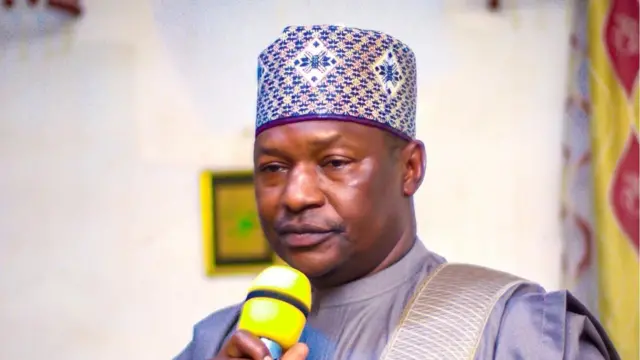



















Court orders forfeiture of 48 Malami properties

The Federal High Court in Abuja has ordered the final forfeiture of 48 properties linked to former Attorney-General of the Federation and Minister of Justice, Abubakar Malami, to the Federal Government.
Justice Joyce Abdulmalik delivered the judgment on Wednesday, July 15, 2026, after ruling that the Economic and Financial Crimes Commission established the reasonable suspicion required under the law to justify the permanent seizure of the assets.
The decision in which the court orders forfeiture of 48 Malami properties followed months of litigation over 57 assets originally targeted by the anti-graft commission.
The properties are situated in Abuja, Kano, Kebbi and Kaduna states and were initially valued collectively at approximately ₦212.8 billion.
However, the court did not grant the EFCC’s entire application. Justice Abdulmalik released nine of the 57 properties after finding that the commission failed to provide sufficient evidence linking those assets to unlawful activities.
The ruling therefore transferred 48 properties to the Federal Government while discharging the interim forfeiture order affecting the remaining nine. (Businessday NG)
Judge focuses on legitimacy of acquisition funds
In her judgment, Justice Abdulmalik held that the principal issue before the court was not simply the identity of the registered owners but whether the money used to acquire the properties came from legitimate sources.
The judge dismissed several motions, objections and applications to show cause filed by Malami, members of his family and companies linked to the assets.
She found that the respondents did not sufficiently rebut the EFCC’s suspicion that the 48 properties were acquired through unlawful activities.
The ruling that the court orders forfeiture of 48 Malami properties was made under Section 17 of the Advance Fee Fraud and Other Fraud Related Offences Act.
The provision allows a court to order the forfeiture of assets reasonably suspected to be proceeds of unlawful activity where those claiming an interest in the property fail to satisfy the court that the assets were acquired lawfully.
Justice Abdulmalik said the respondents failed to dislodge the reasonable suspicion raised by the commission regarding the source of the acquisition funds. (Businessday NG)
Nine properties spared from forfeiture
Although the judgment represented a major victory for the EFCC, the court rejected part of the commission’s case.
Justice Abdulmalik declined to order the permanent forfeiture of nine properties located in Kebbi and Kaduna states.
The court ruled that the evidence presented by the EFCC was not sufficient to maintain the allegation that those particular assets were connected to unlawful activity.
The interim order previously placed on the nine properties was consequently discharged.
This distinction is important when reporting that the court orders forfeiture of 48 Malami properties.
The EFCC did not obtain all 57 assets originally listed in its application, and the court’s refusal to forfeit nine of them demonstrates that each property had to be considered on the evidence placed before the judge.
The final decision means that the Federal Government takes ownership of 48 assets, while the interests claimed in the other nine are no longer restrained under the forfeiture order. (Businessday NG)
EFCC began proceedings in January
The forfeiture process began in January 2026 when the EFCC approached the Federal High Court for an interim order preserving the 57 properties.
Justice Emeka Nwite, sitting as a vacation judge, granted the interim forfeiture order after hearing an ex parte application presented by EFCC counsel Ekele Iheanacho, a Senior Advocate of Nigeria.
The court directed the commission to publish the order in a national newspaper. The publication was intended to notify individuals and companies claiming an interest in the properties and allow them to explain why the assets should not be permanently forfeited.
The legal process that ended with the court orders forfeiture of 48 Malami properties was therefore not completed through a single hearing.
Following the publication, Malami, his wife Nana Hadiza Malami, his son Abdulaziz Abubakar Malami and several companies connected to the assets appeared before the court to challenge the EFCC’s claims.
https://ogelenews.ng/court-orders-forfeiture-of-48-malami-properties
They asked the court to set aside the interim order and reject the request for permanent forfeiture. (Businessday NG)
Malami and respondents deny unlawful acquisition
Malami and the other respondents argued that the properties were purchased through lawful means.
They maintained that the EFCC relied on speculation rather than credible evidence and failed to establish a direct link between the assets and any specific unlawful activity.
The respondents also argued that the commission did not identify the precise offence from which the alleged proceeds originated.
Their position was that mere suspicion could not justify the permanent seizure of valuable property, particularly where ownership documents and explanations had been presented before the court.
However, the EFCC told the court that civil forfeiture proceedings operate under a different evidential threshold from a conventional criminal trial.
The commission argued that it was required to establish reasonable suspicion concerning the assets rather than prove a criminal charge beyond reasonable doubt.
That legal distinction was central to the judgment in which the court orders forfeiture of 48 Malami properties.
Justice Abdulmalik ultimately accepted the EFCC’s case concerning 48 assets but found the evidence inadequate in relation to nine others. (Businessday NG)
Case reassigned to Justice Abdulmalik
After the Federal High Court resumed from its annual vacation, the case was reassigned to Justice Abdulmalik for hearing and determination.
The parties adopted their final written addresses in May, after which the court reserved judgment.
The ruling was initially expected on July 6 but was postponed more than once before being delivered on July 15.
In announcing that the court orders forfeiture of 48 Malami properties, the judge resolved the substantive civil forfeiture application filed by the EFCC.
The judgment did not amount to a fresh criminal conviction of Malami. It was an asset forfeiture decision based on the court’s assessment of whether the respondents successfully explained the legitimate origins of the funds used to acquire the properties.
This distinction should be clearly maintained in responsible reporting.
Civil forfeiture proceedings focus on the property and the source of the acquisition funds, while a criminal prosecution determines whether an individual committed a particular offence and may result in imprisonment or other criminal penalties. (Businessday NG)
Properties valued at about ₦212.8bn
The 57 properties covered by the original EFCC application were valued at approximately ₦212.8 billion.
The available judgment reports did not provide a separate total valuation for only the 48 properties finally forfeited.
News organisations should therefore avoid reporting that the Federal Government recovered precisely ₦212.8 billion in assets through Wednesday’s judgment.
That figure represented the reported collective value of all 57 assets at the beginning of the proceedings, including the nine properties eventually released by the court.
The ruling that the court orders forfeiture of 48 Malami properties is nevertheless one of the EFCC’s most significant recent civil asset recovery decisions because of the number and reported scale of the assets involved.
The commission said its investigation connected the properties to Malami, relatives and associated companies.
The anti-graft agency alleged that some of the properties were held in the names of individuals or corporate entities acting as fronts for the former minister.
The respondents disputed those allegations and insisted that the EFCC had not shown that the assets were proceeds of crime. (Businessday NG)
Malami served under Buhari administration
Malami served as Attorney-General of the Federation and Minister of Justice from 2015 until 2023 under former President Muhammadu Buhari.
As the country’s chief law officer during that period, he was responsible for providing legal advice to the Federal Government, overseeing federal prosecutions and representing the government in major legal disputes.
His former position gives the forfeiture decision exceptional public significance.
An order involving a former chief law officer raises questions about accountability, asset declaration, the monitoring of public officials’ wealth and the effectiveness of Nigeria’s anti-corruption institutions.
The judgment that the court orders forfeiture of 48 Malami properties will also be closely examined for its potential effect on other asset recovery cases.
The EFCC frequently relies on civil forfeiture proceedings to preserve and recover assets it believes are connected to unlawful activity.
Supporters of the process argue that it prevents suspected proceeds from being hidden, transferred or dissipated while investigations continue.
Critics maintain that courts must apply the procedure carefully because property can be permanently taken without a prior criminal conviction. (Businessday NG)
Judgment may still face appeal
A final forfeiture order by the Federal High Court does not necessarily end every legal avenue available to the affected parties.
Malami, members of his family or companies claiming an interest in the assets may challenge the judgment before the Court of Appeal.
The available reports had not confirmed whether an appeal had been filed immediately after the ruling.
Until the respondents announce their next legal step, it would be premature to state that the litigation has been completely concluded.
The immediate legal position, however, is that the 48 properties are forfeited to the Federal Government in accordance with Justice Abdulmalik’s order.
The fact that the court orders forfeiture of 48 Malami properties also places responsibility on the government and the EFCC to manage the recovered assets transparently.
Forfeited properties should be properly documented, valued, secured and administered in accordance with Nigeria’s asset recovery rules.
The public should be informed whether the properties will be retained for government use, transferred to another agency or disposed of through a lawful and transparent process.
Decision underscores need for transparent asset recovery
The judgment represents a major enforcement success for the EFCC, but public confidence will depend on what happens after the courtroom victory.
Nigeria has previously faced controversy over the management, valuation and sale of recovered assets.
Every forfeited property should therefore be listed in an auditable register showing its location, condition, legal status and eventual use.
Transparency is particularly important where the assets are valuable and spread across several states.
The ruling that the court orders forfeiture of 48 Malami properties should not be treated merely as a dramatic headline.
It is a test of whether Nigeria can move from obtaining forfeiture orders to ensuring that recovered assets are protected and used in the public interest.
The court has determined that the respondents failed to provide a satisfactory lawful explanation for the acquisition of 48 properties.
At the same time, it rejected the EFCC’s case against nine others, showing that the anti-graft agency’s allegations were not accepted without scrutiny.
That balance is central to the rule of law.
Anti-corruption institutions must pursue assets suspected to be unlawfully acquired, but courts must also protect property where the legal threshold for forfeiture has not been met.
Wednesday’s judgment delivered both outcomes: 48 properties went to the Federal Government, while nine were released for lack of sufficient evidence.