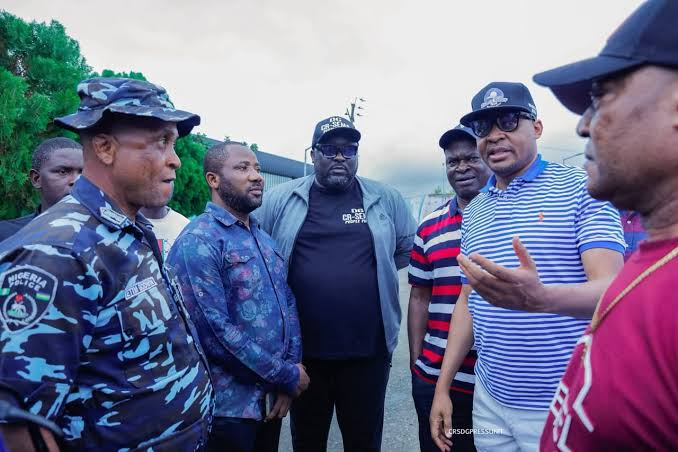


















The Cross River State Government has commenced professional oil and gas training for 2,000 young people as part of a broader effort to build a skilled workforce capable of competing for jobs, contracts and business opportunities in Nigeria’s energy industry.
The programme, launched in Calabar under the theme “Skill Up in the Season of Sweetness,” will provide beneficiaries with CPD-accredited certificate and diploma training covering technical and professional areas extending beyond conventional crude oil exploration and production.
Governor Bassey Otu, represented at the launch by Speaker of the Cross River State House of Assembly Elvert Ayambem, said the initiative was designed to give young people practical skills and professional qualifications relevant to a changing energy industry.
The Cross River oil and gas training programme is expected to reach beneficiaries from all 18 local government areas, with further zonal sessions planned as the state seeks to strengthen its human capital base.
The initiative comes at an important moment for Cross River, which is simultaneously pursuing renewed efforts over disputed oil and gas wells and attempting to position its young population for future opportunities in the energy economy.
Training targets more than crude oil production
One of the central messages from the programme is that employment in the oil and gas industry extends far beyond drilling for crude oil.
Officials identified engineering, logistics, marine services, health and safety, environmental management, procurement, maintenance, technology and data services among areas where trained young people could find opportunities.
That distinction matters.
Oil-producing economies require large networks of contractors, engineers, environmental specialists, technicians, logistics companies, safety professionals and service providers.
The Cross River oil and gas training programme is therefore being presented as an attempt to prepare beneficiaries for this wider value chain rather than simply promising jobs in exploration and production.
Governor Otu said government had a responsibility to ensure young people acquired the knowledge, technical competence and professional credentials necessary to compete for opportunities in the evolving energy sector.
For the 2,000 beneficiaries, however, the real test will be whether the training produces skills that employers and contractors genuinely demand.
Programme to cover Cross River’s 18 LGAs
The training is not intended to remain a Calabar-based programme.
Director of Research Gateway Professional Institute, ThankGod Arong Onda, said beneficiaries would be drawn from all 18 local government areas of Cross River.
Following the initial orientation in Calabar, zonal training sessions are expected to be organised in Ogoja for participants from the Northern Senatorial District and Ikom for the Central Senatorial District.
Other sessions will eventually lead to a final graduation ceremony.
This geographical spread could become one of the important features of the Cross River oil and gas training programme.
Skills programmes concentrated exclusively in state capitals can exclude young people in rural areas because of transportation and accommodation costs.
Taking the programme closer to beneficiaries could broaden participation.
But geographical coverage alone will not determine success.
https://ogelenews.ng/cross-river-oil-and-gas-training
The quality of instruction, practical exposure, certification and access to employment or entrepreneurship opportunities after graduation will matter more.
Government investment exceeds ₦700m, organiser says
Programme organisers say the Cross River State Government has committed more than ₦700 million to the initiative.
Onda also said each beneficiary was receiving a scholarship valued at ₦500,000.
Those figures indicate substantial public investment, but they also require transparency.
If 2,000 beneficiaries each receive training valued at ₦500,000, the headline value would mathematically reach ₦1 billion.
Reports, however, quote organisers as placing the government’s commitment at more than ₦700 million.
The figures may represent different components or valuations of the programme, but no detailed financial breakdown was provided in the reports reviewed.
For accountability, the government and programme organisers should eventually publish clearer information on training costs, scholarship valuation, certification fees and other expenditure.
That would allow the public to assess the actual investment behind the Cross River oil and gas training initiative.
Training linked to Cross River’s oil ambitions
The programme also has a wider economic backdrop.
Cross River has renewed efforts to establish its claims regarding disputed and newly identified oil and gas wells.
The Revenue Mobilisation Allocation and Fiscal Commission recently reopened verification of disputed and newly discovered wells, giving Cross River another opportunity to present technical evidence supporting its claims.
State officials have described the development as potentially significant for Cross River’s attempt to re-establish itself within Nigeria’s oil-producing landscape.
Some officials involved in the youth training have directly connected the skills programme with those ambitions.
The argument is simple: if new oil and gas opportunities emerge, Cross River should already have residents with relevant technical and professional skills.
Preparing workers after investment arrives would mean starting late.
The Cross River oil and gas training programme is therefore being framed partly as workforce preparation ahead of possible expansion in the state’s energy sector.
But oil-well outcome is not guaranteed
That connection needs an important qualification.
Cross River’s efforts concerning disputed oil wells remain subject to technical verification and institutional processes.
Training 2,000 youths does not mean the state has already recovered disputed wells, nor does it guarantee that thousands of oil-sector jobs will immediately become available.
Those are separate issues.
The skills programme exists now.
The future status of disputed oil and gas assets depends on processes involving the appropriate federal institutions.
Ogele News therefore avoids presenting the Cross River oil and gas training initiative as evidence that Cross River has already reclaimed oil wells.
The stronger interpretation is that the state is attempting to prepare workers in advance of opportunities it hopes will emerge.
From certificates to competence
Special Adviser to the Governor on Oil and Gas Ukpong Umoh stressed that the initiative should not become another certificate-distribution exercise.
That is perhaps the most important standard against which the programme should eventually be judged.
Nigeria has implemented numerous youth empowerment and skills programmes over the years.
The challenge is often what happens after graduation.
A certificate can demonstrate completion of training.
It does not automatically demonstrate competence.
Oil and gas operations are particularly sensitive because technical mistakes can result in injuries, environmental damage, equipment failure and financial losses.
Employers therefore place considerable importance on practical competence, safety standards and industry-recognised qualifications.
For the Cross River oil and gas training programme to create lasting value, beneficiaries will need more than classroom instruction.
Practical exposure, assessment, mentoring and links to employers and service companies will be important.
Youths challenged to become service providers
Government officials also want participants to think beyond salaried employment.
Umoh challenged beneficiaries to consider entrepreneurship and service provision within the oil and gas value chain.
That could be significant.
Not every beneficiary can become an employee of an oil company.
But energy projects require supporting businesses.
Transportation, equipment maintenance, environmental services, fabrication, catering, data management, safety services, procurement and other activities can create opportunities for smaller companies.
If beneficiaries can establish credible businesses capable of meeting industry standards, the programme could produce economic value beyond direct employment.
But entrepreneurship in oil and gas also requires capital, certification, market access and compliance with industry regulations.
Training alone will not solve those barriers.
That means any serious follow-up to the Cross River oil and gas training initiative should consider how qualified participants can access financing, internships, apprenticeships, contracts and business-development support.
Environmental management deserves attention
Environmental management is among the areas identified for training.
That is particularly important.
Oil and gas development can create economic opportunities, but poor environmental management can impose significant costs on host communities.
Pollution can affect farmland, water bodies and livelihoods.
Preparing young professionals for environmental monitoring, remediation, waste management and regulatory compliance could therefore have benefits beyond employment.
Cross River is also environmentally significant because of its forests, biodiversity and coastal ecosystems.
Any expansion of extractive activity requires strong environmental safeguards.
The state’s skills programme should therefore treat environmental management as a professional discipline rather than an additional certificate course.
A modern energy workforce needs professionals capable of understanding both production and environmental responsibility.
Energy sector itself is changing
The programme is also being introduced while the global energy industry is changing.
Oil and gas remain economically important to Nigeria, but investment in cleaner energy technologies, emissions reduction and energy efficiency continues to reshape the sector.
That means young people entering the industry need adaptable skills.
Engineering, environmental management, safety, digital systems, data analysis and project management can have applications beyond traditional petroleum operations.
This strengthens the case for designing the Cross River oil and gas training programme around transferable skills.
Young people trained today may work in oil and gas, renewable energy, industrial services or other technical sectors during their careers.
The stronger the underlying competencies, the more adaptable the beneficiaries will be.
Employment outcomes should be tracked
The biggest question comes after graduation.
How many of the 2,000 beneficiaries will secure employment?
How many will obtain internships or apprenticeships?
How many will establish businesses?
How many will obtain additional professional qualifications?
How many will still be using their new skills one year after completing the programme?
Those are the figures that should eventually determine whether the programme succeeded.
Government should therefore consider establishing a public outcome-tracking system.
Instead of reporting only that 2,000 people were trained, officials could publish six-month and 12-month employment and entrepreneurship outcomes.
Such information would allow taxpayers to measure the return on public investment.
It would also help government identify which parts of the Cross River oil and gas training programme produce the strongest employment results.
Human capital can strengthen local participation
One longstanding challenge surrounding major industrial projects is ensuring that host communities and local residents benefit from economic activity.
Investment may occur in a state without creating enough skilled employment for residents if companies cannot find workers with the required qualifications.
Skills development can help close that gap.
If Cross River produces technicians, engineers, environmental professionals, logistics specialists and safety personnel who meet industry standards, companies operating in or around the state will have a stronger local talent pool from which to recruit.
That does not guarantee employment.
But it removes one important barrier.
The same applies to local businesses hoping to provide services to energy companies.
Technical competence and professional standards can improve their ability to compete for opportunities.
Cross River oil and gas training faces the real test
Launching the programme is the easiest stage.
Two thousand beneficiaries have been selected.
Training has begun.
Government officials have made commitments.
Professional certifications have been promised.
The next stage will determine whether the programme becomes a meaningful human-capital investment or another empowerment initiative remembered mainly for its launch ceremony.
The Cross River oil and gas training programme should ultimately be measured by competence, certification quality, employment, entrepreneurship and the economic value created by its graduates.
Cross River’s renewed oil ambitions provide an important backdrop.
But the programme can still create value even if the state’s oil-well claims take longer than expected to resolve.
Engineering, logistics, safety, environmental management, maintenance and data skills are useful across multiple sectors.
That may ultimately be the initiative’s greatest opportunity.
Rather than training 2,000 young people simply to wait for oil jobs, Cross River has the chance to develop a technically capable workforce able to compete wherever those skills are needed.
If that happens, the programme will have achieved something more durable than handing out 2,000 certificates.