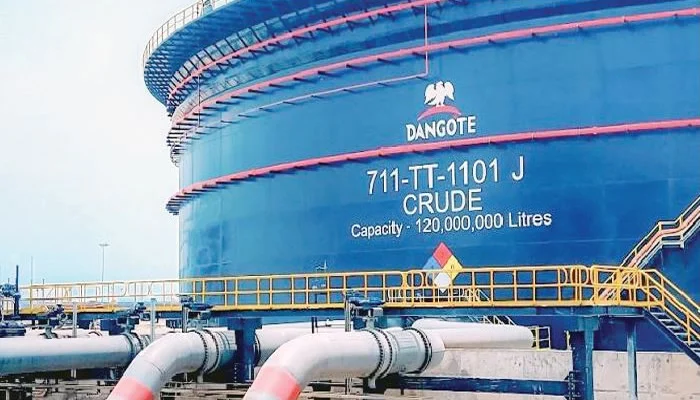
















Dangote dumps naira, begins petrol sales in dollars
Dangote Petroleum Refinery has introduced dollar-denominated sales for petrol and selected refined petroleum products, marking a major change in the commercial pricing system used by Africa’s largest refinery.
Under the new pricing template, Premium Motor Spirit, commonly called petrol, is priced at $0.779 per litre for gantry sales. Automotive Gas Oil, also known as diesel, is fixed at $1.087 per litre, while aviation turbine kerosene will sell at $0.942 per litre.
Coastal supplies of petrol were placed at $1,044.62 per metric tonne. The revised rates took effect on Monday, July 13, 2026, according to a notice reportedly circulated to petroleum marketers and customers.
The announcement that Dangote dumps naira, begins petrol sales in dollars represents a significant development in Nigeria’s deregulated downstream petroleum market, where changes in crude prices, foreign-exchange rates and logistics costs increasingly influence retail fuel prices.
Dangote invalidates earlier naira invoices
In the notice issued through its Group Commercial Operations, the refinery informed customers that previously issued naira-denominated pro forma invoices and deal recaps for gantry and coastal transactions were no longer valid.
Marketers were instructed not to make payments against the affected naira invoices. The refinery said the new dollar prices would serve as the applicable benchmarks for the affected products from July 13.
However, the transition does not apply to Liquefied Petroleum Gas. LPG transactions will continue outside the new dollar-pricing arrangement, according to the refinery’s notice.
The decision that Dangote dumps naira, begins petrol sales in dollars effectively ends the naira-pricing arrangement for the specified refined products, at least under the latest commercial template.
The change comes less than two weeks after the refinery reduced its petrol price from ₦1,125 to ₦1,075 per litre and opened product loading to qualified marketers beyond its earlier consortium arrangement.
Currency mismatch behind decision
Sources familiar with the refinery’s operations attributed the transition to a mismatch between the currency used to purchase crude oil and the currency received from domestic refined-product sales.
The refinery reportedly obtains a growing proportion of its crude supplies through dollar-denominated transactions while selling substantial volumes of refined products to Nigerian marketers in naira.
That structure exposes the business to foreign-exchange risks. A refinery buying crude in dollars but receiving most of its revenue in naira could record losses when the local currency weakens before it converts its sales proceeds into dollars.
The report that Dangote dumps naira, begins petrol sales in dollars therefore appears linked to the company’s effort to align the currency of its product sales with the currency of its crude-purchase obligations.
It is not the first time the refinery has raised concerns about such a mismatch. In March 2025, Dangote temporarily suspended naira sales, saying its crude purchases were denominated in dollars while its petroleum products were being sold in the local currency.
In September 2025, it again halted domestic petrol sales in naira, saying the volume of products sold in the local currency had exceeded its allocation of naira-priced crude.
What happened to the naira-for-crude policy?
The Federal Government approved the sale of crude oil to Dangote Refinery and other domestic refiners in naira in 2024. The arrangement was designed to reduce demand for foreign exchange, support local refining and lower the currency risk attached to petroleum-product transactions.
Government officials initially projected that the scheme could reduce monthly foreign-exchange demand associated with crude purchases from about $660 million to approximately $50 million.
The commercial change under which Dangote dumps naira, begins petrol sales in dollars raises questions about how much crude the refinery is still receiving through the naira arrangement and whether the initiative can continue at the scale originally proposed.
The refinery has sought more locally priced crude. In April 2026, Aliko Dangote said the facility wanted additional naira-denominated crude supplies to help moderate domestic fuel costs. At that time, the refinery was operating at its 650,000-barrel-per-day capacity and increasing petroleum-product exports to other African countries.
The latest development suggests that the quantity of naira-priced crude may not be sufficient to support continued naira sales across the refinery’s domestic operations.
Implications for petroleum marketers
The dollar-pricing system means marketers purchasing petrol directly from the refinery must now consider exchange-rate movements when determining their costs.
A marketer may calculate the naira value of the refinery’s $0.779-per-litre petrol price using the exchange rate available at the point of payment. The final cost will also include transportation, financing, depot charges, distribution expenses and the marketer’s margin.
For that reason, the announcement that Dangote dumps naira, begins petrol sales in dollars does not automatically establish one national pump price.
Retail prices could vary depending on where marketers obtain dollars, how far products are transported and the level of competition in each location.
A stronger naira could reduce the local-currency equivalent of the dollar price, while depreciation could increase it. Marketers may also face higher financing costs if they must obtain foreign exchange from banks or other authorised sources before lifting products.
Fresh pressure on dollar demand
One of the main objectives of the naira-for-crude policy was to reduce the petroleum sector’s dependence on foreign currency.
Requiring marketers to pay for refined products in dollars could increase foreign-exchange demand, particularly because petrol is purchased and consumed in large quantities across Nigeria.
The shift under which Dangote dumps naira, begins petrol sales in dollars could therefore have consequences beyond filling stations. Increased demand for dollars from petroleum marketers may affect liquidity in the official foreign-exchange market.
However, the overall impact will depend on the volume of domestic sales covered by the new arrangement, the availability of dollars and whether the government expands naira-denominated crude supplies.
Nigeria previously relied heavily on imported petrol, requiring importers to obtain foreign exchange to purchase fuel abroad. Local refining was expected to reduce that dependence by eliminating some shipping, insurance and foreign refining costs.
Dollar pricing at a Nigerian refinery does not erase the benefits of local production, but it reduces one of the expected advantages of conducting transactions entirely in naira.
Will petrol prices rise?
There is no certainty that the new pricing template will immediately produce a sharp increase at filling stations.
The refinery’s price is only one component of the final pump price. Global crude prices, the naira-dollar exchange rate, transportation costs, depot competition and marketers’ margins will influence what consumers eventually pay.
The declaration that Dangote dumps naira, begins petrol sales in dollars nevertheless introduces greater exposure to currency volatility.
Where marketers previously received naira prices directly from the refinery, they must now translate a dollar benchmark into naira. This makes daily exchange-rate movements more important in downstream petroleum pricing.
The development may also create frequent price adjustments if the naira changes significantly against the dollar or if global crude prices remain unstable.
https://ogelenews.ng/dangote-dumps-naira
Dangote’s influence on Nigeria’s fuel market
The refinery has become a dominant force in Nigeria’s petroleum market since beginning operations. Its 650,000-barrel-per-day capacity gives it the potential to meet domestic demand while supplying neighbouring African markets.
Its decisions on production, loading arrangements and pricing therefore carry significant consequences for independent marketers, major distributors and consumers.
The decision that Dangote dumps naira, begins petrol sales in dollars also demonstrates the difficulties facing even a local refinery in an industry where crude oil and refined petroleum products are internationally traded in dollars.
Nigeria may produce crude oil domestically, but the opportunity cost and commercial price of that crude are still influenced by the global market.
Government and regulators face fresh questions
The Federal Government, the Nigerian National Petroleum Company Limited and downstream regulators may now face pressure to explain the current status of the naira-for-crude arrangement.
Important questions remain about the quantity of crude allocated to local refineries in naira, the percentage supplied in dollars and whether the government intends to revise the programme.
Transparency will be essential. Market participants require reliable information to plan purchases, manage foreign-exchange exposure and avoid sudden disruptions in fuel supply.
The announcement that Dangote dumps naira, begins petrol sales in dollars should therefore prompt structured engagement among the refinery, NNPC, petroleum marketers and government authorities.
The road ahead
Dangote Refinery’s decision is commercially understandable if most of its crude obligations are denominated in dollars. A business cannot indefinitely purchase its main raw material in one currency while selling its products in another without adequate protection against exchange-rate risk.
Yet the policy implications are serious. Nigeria introduced the naira-for-crude arrangement to reduce dollar demand and provide greater stability in the domestic petroleum market.
The development that Dangote dumps naira, begins petrol sales in dollars suggests that the success of that policy depends on consistent access to sufficient naira-denominated crude.
The immediate concern for Nigerians will be the impact on pump prices. The broader issue is whether a country that produces crude oil and refines petrol locally can build a pricing system that reduces rather than reproduces its exposure to foreign-exchange volatility.
For now, marketers will adjust to the new dollar benchmarks, while consumers, regulators and government officials watch closely for the effect on the naira and petrol prices.