















Kano out of school children survey
Kano out of school children surveyKano State has an estimated 875,593 children between the ages of five and 18 who are currently out of school, according to a new statewide survey that provides one of the clearest recent pictures of the education challenge confronting Nigeria’s most populous northern state.
The Kano out-of-school children survey estimates that 13.34 per cent of the state’s approximately 6.56 million children within the five-to-18 age bracket are outside school, while 86.67 per cent are enrolled.
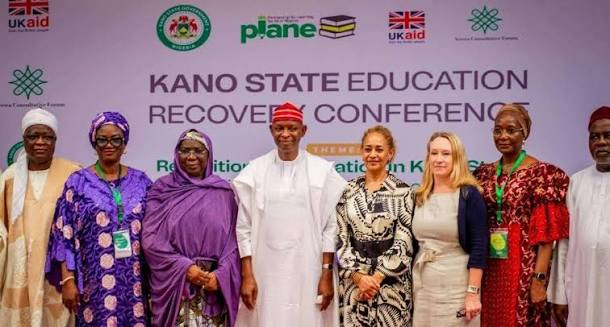
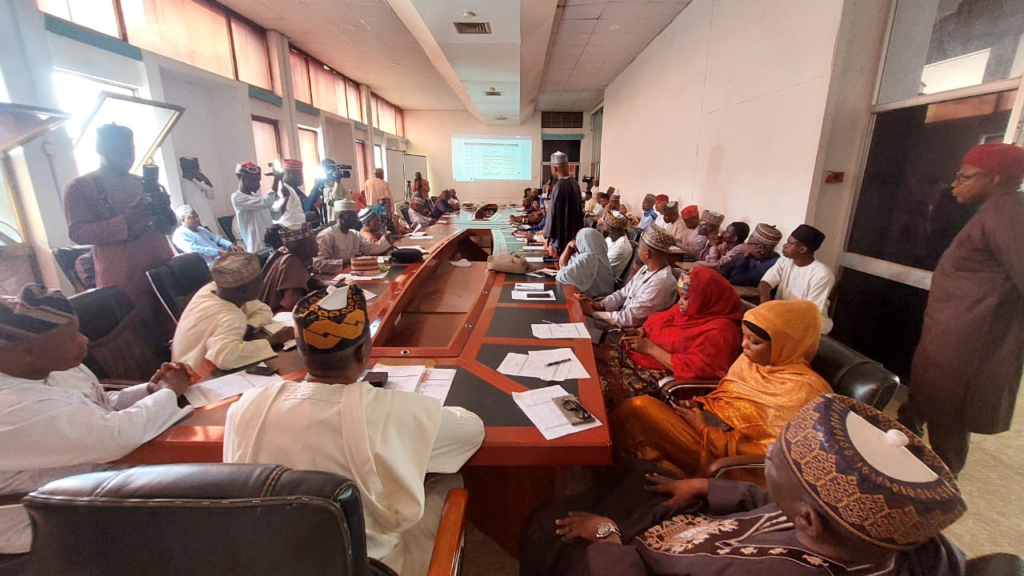
Kano State Commissioner for Education, Dr Ali Haruna Makoda, presented the findings on Thursday during a dissemination meeting attended by government officials, development partners, civil society organisations, traditional leaders and education stakeholders.
The survey was conducted across Kano’s 44 local government areas and is being presented by the government as a more reliable baseline for determining where out-of-school children live, why they are not attending school and what interventions are required to bring them into the education system.
Survey covers Kano’s 44 LGAs
The Kano out-of-school children survey was conducted in March 2026 by the Kano State Ministry of Education in collaboration with the Partnership for Learning for All in Nigeria, known as PLANE, and the Kano State Bureau of Statistics.
The exercise received funding from the United Kingdom’s Foreign, Commonwealth and Development Office.
The survey is described as Kano’s first statistically representative assessment of its out-of-school population in more than a decade.
According to the detailed report, researchers surveyed 7,192 children.
Of that number, 6,233, representing 86.67 per cent, were enrolled in school, while 959, or 13.34 per cent, were outside the education system.
Those findings were then used to estimate the statewide figure of 875,593 out-of-school children.
This methodology is important because the headline figure should not be interpreted as officials physically identifying and counting 875,593 individual children.
Figure shows improvement, government says
The government says the latest Kano out-of-school children survey represents an improvement on earlier estimates.
Makoda compared the new figure with 989,234 out-of-school children contained in 2023 UNICEF-linked data.
That would represent a reduction of approximately 113,641 children, or 11.5 per cent, according to the state government.
The commissioner described the decline as encouraging evidence that investments and interventions in education were beginning to produce results.
But he also acknowledged that 875,593 children remaining outside school means the challenge is far from resolved.
That is the more important perspective.
A reduction should be recognised, but nearly 900,000 children outside formal education remains an enormous social and economic problem.
Doguwa records highest rate
One of the strongest aspects of the Kano out-of-school children survey is that it exposes major differences between local government areas.
Doguwa recorded the highest out-of-school rate at 40 per cent.
It was followed by Warawa at 34.69 per cent and Gaya at 33.86 per cent.
Some other LGAs recorded rates below five per cent.
The report described conditions in the three worst-affected local governments as an education exclusion crisis requiring urgent intervention.
This geographical breakdown matters because Kano cannot solve the problem effectively with one statewide policy applied equally everywhere.
A local government where four in every 10 children are out of school requires a different level of intervention from one where the rate is below five per cent.
Boys account for larger share
The survey also provides an important gender breakdown.
Boys accounted for 54.2 per cent of the estimated out-of-school population, compared with 45.8 per cent for girls.
The report linked the higher proportion among boys partly to the Almajiri or Qur’anic education system and casual labour.
That finding deserves careful interpretation.
Islamic education itself should not automatically be equated with educational exclusion.
The policy challenge is how to ensure children receiving Qur’anic education also have access to literacy, numeracy and other skills required for participation in the modern economy.
The Kano out-of-school children survey gives policymakers an opportunity to develop interventions that recognise local realities rather than simply imposing conventional solutions.
More than half have attended school before
Another revealing finding is that not every out-of-school child has never entered a classroom.
Among the 959 out-of-school children identified in the survey sample, 501 had never attended school, while 458 had previously attended but subsequently dropped out.
That distinction is critical.
Enrolment campaigns alone cannot solve the problem if children enter school and later leave.
Government must therefore focus on two objectives simultaneously: getting excluded children into school and keeping enrolled children there.
The Kano out-of-school children survey shows that retention deserves almost as much attention as initial enrolment.
A child who attends school for two or three years and then drops out remains educationally vulnerable.
Parents overwhelmingly support education
Perhaps the most surprising finding challenges a common assumption about northern Nigeria’s out-of-school crisis.
The survey found that 99.6 per cent of caregivers considered children’s education important or very important. Only eight respondents expressed a negative view of education.
This finding suggests that simply blaming parents or culture misses much of the problem.
The report instead characterises the crisis substantially as one involving access, affordability, service delivery and the quality required to keep children enrolled.
That should influence government policy.
If parents overwhelmingly want their children educated, then the solution cannot simply be public campaigns telling families that schooling is important.
Authorities must address the practical barriers preventing willing families from keeping children in classrooms.
Why are children outside school?
The Kano out-of-school children survey identified several categories of barriers.
Family and cultural factors accounted for 24.2 per cent of responses.
School-related problems accounted for 23.6 per cent, while child-related factors represented 21.6 per cent.
Other reasons accounted for 21.4 per cent, while financial or economic constraints represented 12.6 per cent.
The spread across different categories demonstrates why no single programme will eliminate the problem.
Building classrooms alone will not be enough.
Cash support alone will not be enough.
Community campaigns alone will not be enough.
A successful response will need to combine infrastructure, teachers, household support, school quality, community engagement and targeted programmes for children in particularly vulnerable circumstances.
https://ogelenews.ng/kano-out-of-school-children-survey
Government points to education investment
Makoda attributed some of the reported improvement to policies implemented under Governor Abba Kabir Yusuf.
According to the commissioner, these include increased education spending, rehabilitation and construction of schools and classrooms, distribution of teaching and learning materials, provision of free uniforms and enrolment campaigns.
The government also says it has strengthened education data systems and worked with UNICEF and other development partners.
The Kano out-of-school children survey should now provide a baseline against which those interventions can be measured.
Government should publish comparable data regularly so residents can determine whether the number is actually falling.
Better data can change policy
For years, Nigeria’s out-of-school children figures have generated controversy because different surveys use different age ranges, methodologies and definitions.
Makoda said previous Kano figures were largely based on national samples and other estimates, while the 2026 exercise provides disaggregated information by local government, age and gender.
That makes the new Kano out-of-school children survey potentially more useful for state-level planning.
Instead of allocating resources broadly, officials can identify communities where exclusion is highest.
They can also determine whether a particular intervention should target boys, girls, dropouts, children who have never enrolled or specific geographical areas.
Good data does not solve an education crisis by itself.
But poor data makes solving it considerably harder.
The economic consequences are enormous
The consequences of leaving hundreds of thousands of children outside education extend far beyond the classroom.
Children who lack basic literacy and numeracy enter adulthood with fewer employment opportunities.
That can deepen poverty and increase dependence on informal and low-productivity work.
At a statewide level, the loss of human capital can constrain economic development for decades.
The Kano out-of-school children survey should therefore be viewed as an economic warning as much as an education statistic.
Today’s five-year-old outside school could still be economically disadvantaged 20 years from now if nothing changes.
That is why investment in basic education produces benefits far beyond the education ministry.
Accountability must follow the survey
The danger with major surveys is that governments launch them publicly, discuss the figures for several days and then move on.
That cannot happen here.
The Kano out-of-school children survey should lead directly to measurable targets for the worst-affected local governments.
If Doguwa is at 40 per cent today, what should the rate be in 2027?
How many children will be returned to school?
How many additional teachers are needed?
How many classrooms?
How much will it cost?
Who is responsible?
Those questions turn data into policy.
Without them, 875,593 becomes merely another alarming number.
Ogele News perspective
The reduction reported by the Kano State Government deserves acknowledgement.
If the new and earlier figures are sufficiently comparable, moving from roughly 989,000 to 875,593 out-of-school children represents progress.
But Kano should resist celebrating too early.
The Kano out-of-school children survey still estimates that almost one in seven children aged five to 18 is outside school.
In Doguwa, the situation is dramatically worse, with the survey putting the rate at 40 per cent.
Perhaps the most important finding is that parents overwhelmingly value education.
That changes the conversation.
It suggests that policymakers should spend less time assuming families simply reject formal education and more time understanding why children cannot access school or why they drop out after enrolling.
The new data gives Governor Abba Kabir Yusuf’s administration something previous governments have often lacked: a more detailed map of the problem.
Now comes the harder part.
The Kano out-of-school children survey must become a roadmap for action.
Government should set annual reduction targets, concentrate resources in high-burden LGAs, improve school quality and address the different reasons boys and girls remain outside education.
The figure 875,593 is not simply a statistic.
It represents hundreds of thousands of individual children whose future prospects will be shaped by what Kano does next.
The success of the survey will therefore not be measured by how accurately the state counted the problem.