













military retirees pension protest
ABUJA, Nigeria — Security was tightened around key government offices in Abuja on Wednesday as retired Nigerian military personnel mobilised to protest what they described as the failure of authorities to implement consequential adjustments to their pensions following salary increases approved for serving members of the Armed Forces.
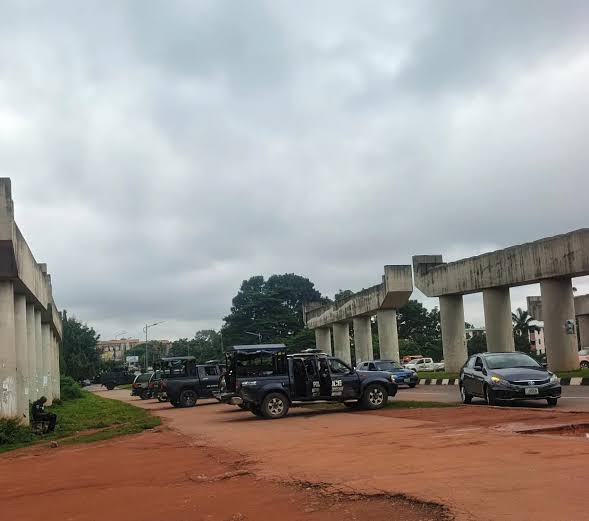
The military retirees pension protest drew a substantial security deployment around the Ministry of Defence, with personnel of the Nigeria Police Force, Nigerian Army, Nigeria Immigration Service and Vehicle Inspection Office positioned around roads leading to the area.
At least two armoured personnel carriers and more than 15 operational vehicles belonging to different security agencies were observed around the protest area by Wednesday morning.
Armed soldiers were also seen patrolling while security personnel took positions along access roads.
The retirees say their demand centres on pension adjustments they believe should follow salary increases granted to serving military personnel.
One of their leaders, retired Col. Innocent Azubike, said President Bola Tinubu approved an increase in military salaries in November 2025 and argued that the adjustment should have produced a corresponding increase in the pensions of retired personnel.
Military Retirees Pension Protest Draws Heavy Security
The scale of the security presence was one of the most striking features of Wednesday’s demonstration.
Security operatives positioned vehicles at both ends of roads around the Ministry of Defence, while armed personnel maintained a visible presence.
The military retirees pension protest had been announced in advance, giving security agencies time to prepare for possible disruptions around the ministry.
The retirees described the demonstration as peaceful and said their objective was to compel the authorities to address their pension demands.
No violence had been reported in the early accounts reviewed by Ogele News.
The security deployment nevertheless reflected official concern over the possibility of disruption around sensitive government facilities.
A day before the protest, the United States Embassy in Abuja had also issued a security advisory to American citizens, warning that the demonstration could lead to traffic congestion and road restrictions around Olusegun Obasanjo Way and adjoining routes.
Retirees Demand Consequential Pension Adjustment
At the heart of the military retirees pension protest is the principle of consequential adjustment.
The pensioners argue that when salaries of serving military personnel are increased, the pensions of retired personnel in corresponding categories should also be reviewed where applicable under Nigeria’s pension framework.
Azubike said the retirees were demanding what they regarded as their constitutional pension rights.
According to him, the November 2025 military pay increase was initially understood to include consequential adjustments for pensioners.
The retirees allege that those adjustments have not been implemented.
They say the issue has become more urgent following another salary increase announced for serving military personnel in August 2026 and expected to take effect from September.
Their concern is that retired personnel could again be excluded when the financial requirements for the latest increase are calculated.
Retirees Say Pension Adjustment Is a Right, Not Favour
The protesters have framed their demand in legal rather than humanitarian terms.
They argue that corresponding pension adjustments following applicable salary reviews are not discretionary benefits granted by government as acts of goodwill.
A statement associated with the pensioners cited the Nigerian Constitution, the Armed Forces Act and military financial regulations in support of their position.
The military retirees pension protest is therefore being presented by organisers as a demand for implementation of existing obligations rather than a request for an entirely new benefit.
Whether the exact adjustment claimed by the retirees is legally due in the manner and amount they demand is ultimately a matter for the relevant authorities and, if contested, legal interpretation.
What is clear is that the veterans believe previous salary increases should have translated into corresponding pension reviews.
November 2025 Pay Increase at Centre of Dispute
The disagreement can be traced directly to the military remuneration changes announced last year.
According to Azubike, President Tinubu approved a military pay increase in November 2025.
The retired officer said senior military authorities publicly welcomed the decision at the time.
The pensioners say they expected their own benefits to be adjusted accordingly.
But according to their representatives, that did not happen.
The military retirees pension protest is consequently aimed at forcing the government to explain why the anticipated pension adjustment has not been implemented.
The retirees also want clarity about how subsequent military pay reviews will affect pensioners.
That distinction is important.
Their complaint is not simply that pensions are generally inadequate. Their immediate demand concerns the relationship between changes in serving personnel’s remuneration and the pensions of retired personnel.
August Salary Review Raises Fresh Concern
The latest salary development appears to have intensified the dispute.
Azubike said another pay increase for serving military personnel had been announced in August 2026 and was expected to become effective in September.
The retirees allege that calculations relating to that adjustment excluded pensioners.
That claim has become a central motivation for the military retirees pension protest.
From the pensioners’ perspective, allowing another salary adjustment to proceed without resolving their existing complaint could deepen the disparity between serving and retired personnel.
The government and relevant military authorities will therefore need to clarify precisely what was approved, which categories are covered and whether consequential pension adjustments are due.
Clear communication is essential because pension disputes involving veterans have surfaced before.
Military Pensioners Have Protested Before
Wednesday’s action is not the first time retired military personnel have taken their grievances to government offices.
In August 2025, military pensioners protested at the Federal Ministry of Finance over unpaid entitlements.
The Military Pensions Board subsequently attributed that protest partly to a communication gap.
That history gives the current military retirees pension protest additional significance.
When the same category of pensioners repeatedly resorts to demonstrations, authorities should examine whether the problem extends beyond payment itself to communication and administration.
Retirees should not have to depend on rumours to understand changes to their pensions.
Likewise, government should be able to explain what has been approved, when it will be implemented and which categories of retirees qualify.
A predictable pension system requires both timely payment and transparent information.
Military Pensions Board Has Key Role
The Military Pensions Board is the institution responsible for administering pensions and other benefits for eligible military retirees.
According to the board’s official history, military pension administration was previously handled by the Federal Ministry of Establishment before responsibility evolved into the specialised institutional arrangement that exists today.
The board therefore occupies an important position in resolving disputes involving veterans’ pension entitlements.
But the current issue may require coordination beyond the board.
Salary and pension adjustments can involve approvals, budgeting, financial releases and implementation by several government institutions.
That makes coordination between defence authorities, pension administrators and financial agencies essential.
The military retirees pension protest should therefore produce a clear institutional response explaining both the government’s position and the implementation process.
Defence Ministry Has Recognised Importance of Timely Pensions
The dispute is particularly noteworthy because the Ministry of Defence has previously acknowledged the importance of prompt pension administration.
In March 2026, the ministry said timely and accurate pension administration was both a moral obligation and national responsibility, describing veterans as an important national asset.
Those words set a standard against which the handling of the current military retirees pension protest will inevitably be judged.
Military service involves unusual sacrifices.
Personnel can spend years away from their families, operate in dangerous environments and suffer injuries in the course of duty.
Retirement benefits therefore represent more than routine government expenditure.
They form part of the social contract between the state and those who served in its armed forces.
That does not mean every demand made by retirees must automatically be accepted.
It means disputes should be resolved quickly, transparently and respectfully.
https://ogelenews.ng/military-retirees-pension-protest
Heavy Security Raises Questions
The large security presence surrounding Wednesday’s protest inevitably attracts attention.
Authorities have a legitimate responsibility to protect government buildings, protesters, road users and members of the public.
But security deployment around peaceful demonstrations must also remain proportionate.
The presence of two armoured personnel carriers and more than 15 security vehicles underscores the seriousness with which authorities treated the planned gathering.
For the veterans, many of whom spent their careers wearing the uniform now worn by some of the personnel monitoring them, the scene carries unusual symbolism.
Former servicemen were gathering to demand pension adjustments while serving security personnel stood around the protest area.
That image should encourage dialogue rather than confrontation.
The military retirees pension protest is fundamentally an administrative and financial dispute.
It should be resolved as one.
Protest Could Affect Movement Around Defence Ministry
The security operation also had implications for ordinary road users.
Ahead of the demonstration, the U.S. Embassy warned that the gathering could create congestion and road restrictions along Olusegun Obasanjo Way and nearby roads.
The embassy advised its citizens to avoid the area, use alternative routes and exercise caution around large gatherings.
Such advisories do not mean violence is inevitable.
They are precautionary measures associated with demonstrations that could affect movement.
The early reports on the military retirees pension protest did not indicate violent confrontation.
That distinction is important.
Heavy security should not automatically be interpreted as evidence that the protest itself was violent.
Government Needs Clear Response
Beyond Wednesday’s demonstration lies a relatively straightforward policy question.
Were consequential pension adjustments approved for the affected military retirees?
If they were, why have they not been implemented?
If they were not, authorities should clearly explain the legal and administrative basis for excluding the retirees.
If implementation is delayed because of funding, government should provide a credible timetable.
This would help prevent the military retirees pension protest from becoming another prolonged dispute between veterans and the institutions responsible for their welfare.
Silence creates uncertainty.
Uncertainty creates frustration.
And when frustrated retirees believe ordinary administrative channels have failed, protests become more likely.
Veterans’ Welfare Has National Security Dimension
There is also a broader institutional issue.
How a country treats retired military personnel can influence morale among those still serving.
Young soldiers, sailors and airmen inevitably observe what happens to colleagues after retirement.
If pension administration is seen as unreliable, that perception can affect confidence in the system.
Veterans’ welfare should therefore not be treated solely as a social-policy matter.
It has implications for institutional morale and the credibility of military service as a career.
Resolving the military retirees pension protest fairly and transparently could consequently have benefits beyond the pensioners demonstrating in Abuja.
Ogele News Analysis: The Real Story Is Not the Armoured Vehicles
The original headline, “Heavy security as military retirees protest pension adjustment,” is visually powerful, but it risks allowing the security deployment to overshadow the substance of the dispute.
The two armoured personnel carriers and more than 15 security vehicles are newsworthy.
But they are not the reason retired servicemen mobilised.
The real story is the allegation that military pensioners have been waiting for a consequential adjustment they believe should have followed a salary increase approved for serving personnel in November 2025.
The latest military retirees pension protest therefore presents government with an opportunity to resolve the issue through facts.
The authorities should publish a clear explanation of what President Tinubu approved.
They should state whether retired personnel were covered.
They should explain how any consequential adjustment was calculated.
And if money is outstanding, they should provide an implementation timetable.
That is more useful than allowing uncertainty to continue until former servicemen return to the streets.
The retirees, for their part, should continue to pursue their demands peacefully and through lawful channels.
Security agencies should equally ensure that peaceful protest is protected while public order is maintained.
Nigeria owes its veterans respect, but responsible journalism should go further than sentiment.
If the retirees are legally entitled to the adjustment they claim, it should be implemented.
If the government’s interpretation differs, that position should be explained publicly and supported with the relevant approvals and rules.
The military retirees pension protest should ultimately be resolved around documents, figures and law, not barricades.
That would be a more fitting outcome for men and women who spent their working lives serving the country.