















Ogun prison drug smuggling
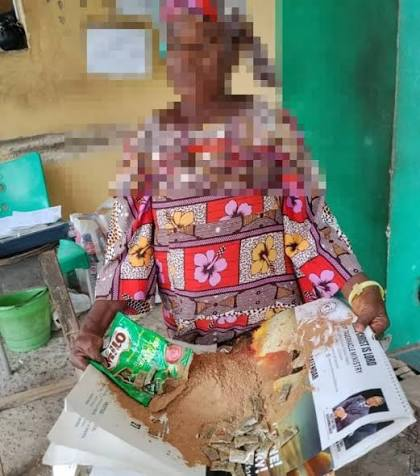
A woman has been arrested at the Medium Security Custodial Centre, Ibara, Abeokuta, after correctional officers allegedly discovered suspected illicit drugs concealed in a beverage sachet and intended for her son, who is currently on death row.
The Ogun State Command of the Nigerian Correctional Service identified the suspect as Mrs Iyabo Sowunmi and the inmate as her son, Dare Sowunmi.
According to the Correctional Service, the latest Ogun prison drug smuggling incident occurred at about 1:33 p.m. on Friday, August 28, 2026, when officers conducting routine screening at the main entrance of the facility discovered a suspicious substance hidden inside a sachet of beverage powder.
The substance was described by the authorities as suspected “Colos,” a term commonly associated with psychoactive synthetic substances.
Following the discovery, correctional officers detained Mrs Sowunmi before handing her over to the National Drug Law Enforcement Agency for further investigation and possible prosecution.
Routine Search Uncovers Suspected Drugs
The circumstances of the arrest demonstrate why security screening remains one of the most important lines of defence against contraband entering correctional facilities.
Mrs Sowunmi had reportedly arrived at the Ibara custodial centre to visit her son when officers examined the package she was carrying.
During the screening, the suspicious substance was allegedly found concealed inside what appeared to be an ordinary beverage sachet.
The Ogun prison drug smuggling case could therefore have ended differently if officers at the gate had treated the package as an ordinary food or beverage item.
Instead, the suspicious material was detected before it could reach the inmate population.
Olayinka Odukoya, spokesperson for the Ogun State Command of the Nigerian Correctional Service, said officers immediately detained the woman after discovering the substance.
Death-Row Son Identified as Dare Sowunmi
The Correctional Service identified the intended recipient as Dare Sowunmi.
He is currently an inmate on death row at the Ibara facility and, according to the command, is Mrs Sowunmi’s son.
That detail gives the Ogun prison drug smuggling story its unusual human dimension.
A mother visiting her incarcerated son would ordinarily attract little attention.
But authorities allege that this particular visit involved an attempt to introduce a prohibited substance into a secured correctional environment.
Investigators must now establish precisely what happened, including whether the inmate knew beforehand that the suspected substance was being brought to him.
At this stage, there is no basis for assuming the son participated in the alleged smuggling attempt unless investigators establish evidence to that effect.
Suspect Handed Over to NDLEA
Following the interception, Mrs Sowunmi was transferred to the National Drug Law Enforcement Agency.
That is an important next step.
The Correctional Service has responsibility for securing the custodial facility and preventing prohibited items from reaching inmates.
The NDLEA has the specialised responsibility to investigate suspected drug offences.
In the Ogun prison drug smuggling investigation, one of the first questions should therefore be straightforward: what exactly was recovered?
Authorities currently describe the substance as suspected “Colos.”
That description should remain qualified until the relevant forensic or laboratory examination confirms the nature of the substance.
The investigation should also establish where it came from, how it was obtained and whether other people were involved.
NCoS Praises Vigilant Officers
Controller of Corrections in Ogun State, Abioye Adesina, commended personnel at the Ibara facility for their vigilance and adherence to security procedures.
The command also restated its zero-tolerance position against the introduction of prohibited items into custodial centres.
That position must be backed by consistent enforcement.
The Ogun prison drug smuggling incident shows how easily apparently innocent consumer products can potentially become concealment devices.
A beverage sachet would normally attract less suspicion than a package openly containing pills, powder or other questionable substances.
That is precisely why effective searches cannot rely merely on appearances.
Why Contraband in Prison Is a Serious Security Problem
The problem is bigger than one woman, one inmate or one sachet.
Drugs inside a correctional facility can undermine security and rehabilitation.
They can create underground markets among inmates.
They can lead to debts, intimidation and violence.
They can also worsen substance dependence among people whom the correctional system is expected to rehabilitate.
Mobile phones and other prohibited items present their own risks, including unauthorised communications with people outside custody.
This is why Ogun prison drug smuggling should not be treated merely as a sensational story about a mother and her son.
The fundamental issue is whether Nigeria’s correctional facilities can effectively control what enters their walls.
Every Entry Point Matters
Correctional security is only as strong as its weakest entry point.
Visitors must be screened.
Food and packages must be examined.
Vehicles entering secure areas require appropriate checks.
Staff movements must also be subject to accountability.
Intelligence gathering inside custodial facilities is equally important.
The authorities cannot assume that contraband enters only through visitors.
Any serious campaign against Ogun prison drug smuggling and prison contraband generally must examine every possible route, including the possibility of internal compromise.
https://ogelenews.ng/ogun-prison-drug-smuggling-mother-arrested-over-sus…
The same rules should apply regardless of who is responsible.
If a visitor attempts to introduce drugs, the law should take its course.
If an inmate organises the delivery of prohibited materials, investigators should establish the evidence.
And if any correctional employee facilitates contraband movement, disciplinary and criminal consequences should follow where appropriate.
Mother-Son Relationship Does Not Change the Law
There is also a difficult human issue surrounding the case.
A mother can continue loving her child regardless of the circumstances that brought that child into prison.
That is understandable.
The law, however, does not permit family relationships to override custodial security.
Visitors have responsibilities when entering correctional facilities.
Being the parent, spouse, sibling or friend of an inmate does not provide permission to carry prohibited substances into custody.
That is why the alleged Ogun prison drug smuggling attempt will now be investigated as a law-enforcement matter rather than simply a family visit that went wrong.
At the same time, Mrs Sowunmi remains a suspect.
Her arrest is not a conviction.
The NDLEA investigation and any subsequent judicial proceedings will determine criminal responsibility.
Questions NDLEA Must Answer
Several important questions remain unanswered.
Was the recovered substance actually an illicit psychoactive drug?
How much was recovered?
Where was it obtained?
Was Dare Sowunmi expecting the package?
Had Mrs Sowunmi previously visited the facility?
Was this an isolated incident?
Did anyone else participate in arranging the alleged delivery?
These questions should form part of the investigation into the Ogun prison drug smuggling case.
Until answers emerge, speculation should not be presented as fact.
Security Success, But Also a Warning
The Nigerian Correctional Service can reasonably regard the interception as evidence that its screening procedure worked.
The package did not reach the intended inmate.
The suspect was detained.
The suspected substance was recovered.
And the matter was transferred to the specialised drug enforcement agency.
But every successful interception also provides intelligence about the methods people may use to defeat security.
In this instance, the alleged concealment inside an everyday beverage package should encourage correctional authorities to review screening procedures across facilities.
The lesson from Ogun prison drug smuggling should not remain in Abeokuta.
Other correctional centres can study the method of concealment and adjust their procedures accordingly.
Correctional Centres Must Remain Drug-Free
Nigeria changed the nomenclature from prisons to correctional centres for a reason.
The objective is not merely to lock people behind walls.
The correctional philosophy also emphasises rehabilitation, reformation and eventual reintegration where applicable.
That objective becomes much harder if illicit drugs circulate within custody.
A correctional centre cannot effectively address substance abuse while allowing prohibited psychoactive substances to find their way to inmates.
This is why the latest Ogun prison drug smuggling incident deserves serious attention despite the relatively small physical package involved.
Mrs Iyabo Sowunmi has been arrested.
Her son, Dare Sowunmi, remains on death row at the Ibara custodial facility.
The suspected substance did not reach him.
The NDLEA now has responsibility for investigating the alleged offence.
What follows should be evidence, due process and, if investigators establish an offence, prosecution according to law.
The most important lesson is simple.
A correctional facility must control what enters its gates.
At Ibara on Friday, according to the Correctional Service, routine screening did exactly that.