















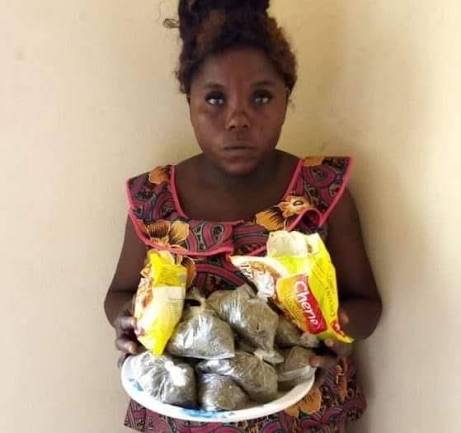
A female visitor has been arrested after correctional officers allegedly discovered substances suspected to be psychoactive drugs concealed inside a Milo beverage sachet as she attempted to enter the Medium Security Custodial Centre, Ibara, Abeokuta, Ogun State.
The Ogun State Command of the Nigerian Correctional Service said the woman was arrested at about 1:33 p.m. on Friday, August 28, 2026, during routine security screening at the entrance to the facility.
The suspect, identified in reports as Mrs Iyabo Sowunmi, had arrived at the custodial centre to visit an inmate classified as being on death row when officers allegedly discovered the suspicious substance.
The latest Ogun prison drug smuggling case has again brought attention to the difficult task of preventing drugs, mobile phones and other prohibited materials from entering Nigerian custodial facilities.
According to the Correctional Service, the substance discovered inside the beverage sachet was suspected to be “colos,” a street term associated with psychoactive substances.
The material has not, at this stage, been publicly confirmed through laboratory analysis to be an illicit drug. That distinction is important as investigation continues.
Routine Search Exposes Suspected Drugs
The arrest did not follow an elaborate intelligence operation.
It came during routine screening at the main gate.
That fact makes the Ogun prison drug smuggling incident particularly instructive.
Every visitor entering a correctional centre represents a potential security concern, not necessarily because visitors are criminals, but because prohibited materials can be concealed inside apparently harmless items.
Food, beverages, clothing and personal effects therefore require careful examination before being allowed into secure areas.
In this case, what appeared to be an ordinary Milo sachet allegedly contained the suspicious substance.
The Nigerian Correctional Service said the discovery demonstrated the vigilance of personnel responsible for screening visitors and materials entering the facility.
Suspect Handed Over to NDLEA
Following the arrest, the woman was handed over to the National Drug Law Enforcement Agency for further investigation and possible prosecution.
That transfer is significant.
Correctional officers detected the suspected contraband, but determining precisely what the substance is and whether an offence under Nigeria’s drug laws has been committed requires further investigation.
The NDLEA is now expected to investigate the circumstances surrounding the alleged Ogun prison drug smuggling attempt.
Investigators will need to determine what substance was recovered, where it originated and whether other individuals were involved.
They will also need to establish whether the intended recipient knew about the substance allegedly being brought into the facility.
Until those questions are answered, allegations against the arrested woman remain allegations.
Correctional Service Declares Zero Tolerance
Controller of Corrections for the Ogun State Command, Kamoru Adesina, commended the officers involved in the interception for their alertness and professionalism.
The Command also restated its zero-tolerance position on drug trafficking and other criminal activities within correctional facilities.
Adesina stressed that correctional centres exist for the reformation and rehabilitation of inmates and should not be transformed into channels for illicit substances.
That point goes to the heart of the Ogun prison drug smuggling controversy.
A correctional institution cannot realistically rehabilitate inmates if drugs and other prohibited materials circulate freely within its walls.
Security at the gate is therefore not merely about preventing escape or protecting officers.
The Ogun Command warned visitors and other members of the public against attempting to introduce prohibited items into correctional centres.
Anyone caught engaging in such activities, the Service said, would be dealt with according to law.
The warning is necessary because contraband inside a custodial centre creates problems far beyond the individual inmate receiving it.
Drugs can create underground markets.
Mobile phones can facilitate unauthorised communication.
Money and prohibited materials can generate disputes and strengthen informal power structures among inmates.
Contraband can also undermine discipline and complicate rehabilitation programmes.
Preventing Ogun prison drug smuggling and similar breaches must therefore involve visitors, correctional personnel and inmates themselves.
https://ogelenews.ng/ogun-prison-drug-smuggling
Ibara Facility Recently Faced Another Security Breach
There is a wider context that should not be ignored.
The Ibara Medium Security Custodial Centre was already under scrutiny earlier in August following a completely different security breach involving an inmate on death row.
A death-row inmate was found to have unlawfully possessed a mobile telephone which he reportedly used to access social media and participate in TikTok Live sessions from custody.
The Nigerian Correctional Service subsequently removed the Officer-in-Charge of the Ibara facility and two other principal officers pending investigation.
The prohibited device was recovered and secured as an exhibit, while the inmate was transferred to another facility under enhanced security.
That earlier incident and the latest Ogun prison drug smuggling case are separate matters and should not be presented as connected without evidence.
But taken together, they underline the importance of effective contraband control at correctional facilities.
One case involved a prohibited communication device already inside custody.
The latest involves suspected psychoactive substances allegedly intercepted before they could enter.
Both raise the same fundamental question: how secure are the systems designed to prevent prohibited materials from reaching inmates?
Security Must Extend Beyond Visitors
There is another uncomfortable issue Nigerian correctional authorities must confront.
Stopping visitors at the gate is essential, but effective contraband prevention cannot end there.
Security systems must also examine possible internal routes through which prohibited items could enter facilities.
That means proper searches, surveillance, intelligence gathering, staff accountability, visitor controls and routine inspection of cells and other areas.
The earlier mobile-phone incident at Ibara illustrates why internal controls matter.
The NCoS said investigations into that case would examine whether officers, inmates or external collaborators played any role in facilitating the security breach.
The same institutional seriousness should accompany investigations into Ogun prison drug smuggling.
Where a visitor is responsible, the evidence should establish it.
Where an inmate is involved, investigators should establish that too.
And where any correctional officer facilitates the entry of contraband, the law and disciplinary procedures should apply with equal force.
Rehabilitation Becomes Difficult When Drugs Enter Custody
Nigeria officially operates a correctional system, not merely a prison system.
That distinction was reinforced by the Nigerian Correctional Service Act, 2019, which places emphasis not only on safe custody but also on rehabilitation and reintegration.
The logic is straightforward.
Society expects correctional institutions to keep offenders securely in custody while providing an environment capable of changing behaviour where possible.
Uncontrolled access to illicit drugs undermines that objective.
An inmate struggling with substance dependence cannot be effectively rehabilitated if psychoactive substances remain readily available.
Drug circulation can also fuel violence, debt, intimidation and other criminal behaviour within custodial facilities.
The Ogun prison drug smuggling case should therefore be treated as more than an unusual story about something allegedly hidden inside a beverage sachet.
It concerns the integrity of the correctional system itself.
Questions Investigation Must Answer
Several questions remain unanswered.
What exactly was contained inside the Milo sachet?
Laboratory examination should settle that question.
Where was the substance obtained?
Was it specifically requested by anyone inside the correctional facility?
Was this the suspect’s first visit?
Did anyone else know about the alleged attempt?
And was there any expectation that the package could pass through security?
These are matters for investigators, not social-media speculation.
The arrested woman is a suspect and should be described as such unless and until a competent court determines otherwise.
Likewise, the substance should remain described as “suspected” until properly identified.
That is particularly important in reporting Ogun prison drug smuggling, where an arrest can easily be mistaken for proof of guilt.
A Milo Sachet and a Bigger Security Question
On the surface, the incident is straightforward.
A woman arrived at a correctional facility. Officers searched what she was carrying. A suspicious substance was allegedly discovered inside a Milo sachet. She was arrested and transferred to the NDLEA.
But beneath those facts lies a larger question.
How do Nigerian correctional facilities keep drugs, phones and other prohibited items outside their walls?
The officers at Ibara appear to have succeeded in this particular case because the suspicious package was detected at the gate.
The greater challenge is ensuring that the same vigilance operates every day, at every entrance and against every possible route through which contraband might enter.
For the Nigerian Correctional Service, the Ogun prison drug smuggling incident should therefore be both an enforcement success and a reminder.
The gate worked this time.
The task is to make sure the entire system works every time.