






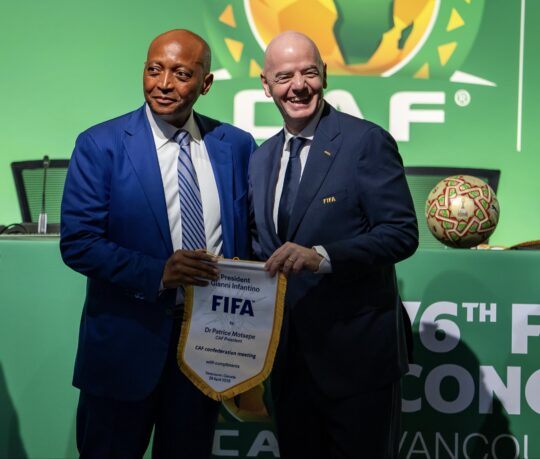
The Confederation of African Football has thrown its weight behind FIFA President Gianni Infantino following a major governance controversy that has deepened divisions within world football and raised fresh questions over the direction of the global governing body.
The latest intervention means CAF backs Infantino at one of the most difficult moments of his decade-long leadership of FIFA, reinforcing Africa’s position as one of his strongest political bases ahead of the 2027 FIFA presidential election.
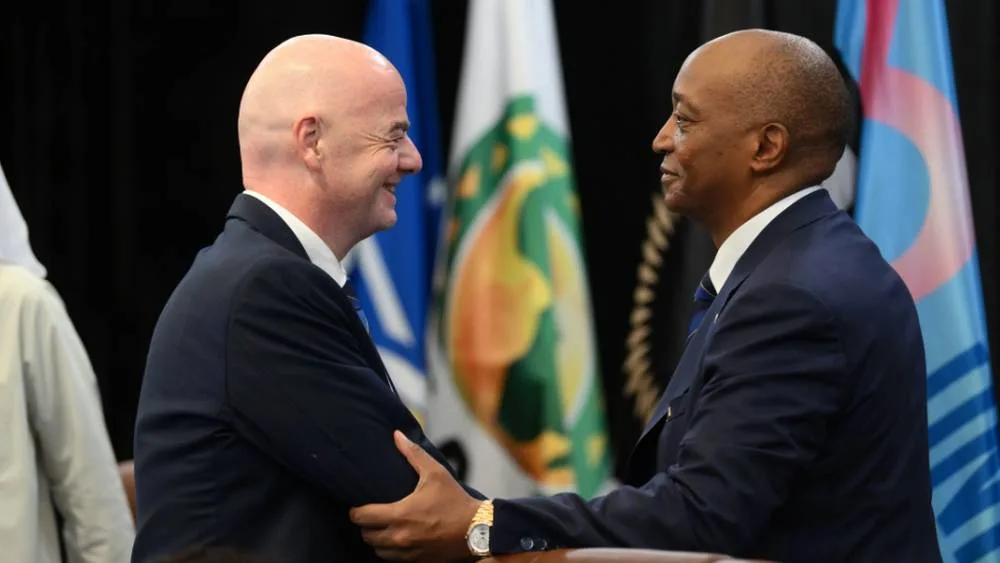
CAF President Patrice Motsepe and senior African football officials have publicly defended the FIFA president after he apologised over the handling of a controversial proposal linked to FIFA’s commercial operations and development funding.
The African governing body has welcomed FIFA’s decision to review the process surrounding the proposal, while insisting that concerns over governance should be addressed through dialogue, transparency and established institutional procedures rather than a wider rupture within world football.
The development comes amid growing opposition to Infantino from sections of European football and other critics who have questioned how FIFA handled plans to restructure part of its commercial business.
CAF backs Infantino as governance dispute widens
The latest declaration that CAF backs Infantino is particularly significant because Africa controls 54 votes within FIFA’s 211-member association structure.
That makes the continent one of the largest and most influential voting blocs in any FIFA presidential contest.
CAF had already taken a clear position months before the latest controversy.
At a meeting in Vancouver, Canada, on April 29, 2026, all CAF member associations unanimously agreed to support Infantino for another term as FIFA president covering the 2027 to 2031 period.
The decision came on the eve of the 76th FIFA Congress and established Africa’s political position well before the governance dispute erupted.
CAF’s renewed support therefore represents continuity rather than an unexpected reversal.
The message is clear: CAF backs Infantino despite criticism surrounding FIFA’s recent decision-making process and despite growing pressure from some of football’s other power centres.
https://ogelenews.ng/caf-backs-infantino-fifa-governance-row
What triggered the FIFA governance controversy?
The dispute centres on FIFA Forward Enterprise, commonly known as FFE, a proposed FIFA-controlled subsidiary designed to bring together parts of the governing body’s commercial and event operations.
FIFA initially said the structure could raise as much as $4.2 billion through the sale of minority, non-controlling stakes to long-term investors.
The organisation said the money would allow it to substantially expand football development funding around the world.
Under the proposal, FIFA Forward funding for each member association could rise from the currently budgeted $8 million to $20 million for the 2027-2030 cycle, with further increases planned in later cycles.
FIFA maintained that it would retain control of the proposed enterprise, as well as exclusive authority over football governance, competitions, the international match calendar and sporting regulations.
But the plan attracted serious criticism over governance, consultation and the manner in which the proposal had been developed.
Opponents raised questions about whether member associations and football stakeholders had been given enough opportunity to scrutinise a decision involving some of FIFA’s most valuable commercial assets.
The controversy eventually forced FIFA into damage-control mode.
Infantino acknowledged mistakes in the process and apologised to the organisation’s 211 member associations as FIFA reviewed the proposal and the procedures surrounding it.
CAF chooses dialogue over confrontation
While some football organisations responded aggressively to the controversy, the African position has been markedly different.
The fact that CAF backs Infantino does not mean its leadership has dismissed governance concerns entirely.
Motsepe has emphasised the need for proper governance, transparency and due process while at the same time defending Africa’s working relationship with FIFA.
For CAF, the preferred approach appears to be institutional engagement rather than open confrontation.
That distinction matters.
Football governance regularly involves competing interests between FIFA, continental confederations, national federations, leagues, clubs and players.
When those interests collide, political alliances can become as important as the technical details of the dispute.
Africa’s decision to stand firmly behind Infantino therefore strengthens his position at a time when his authority is facing unusually public scrutiny.
Why CAF backs Infantino
There are clear reasons why CAF backs Infantino.
African football officials have repeatedly credited the FIFA president with increasing investment in football development across the continent.
FIFA’s Forward programme has funded infrastructure, technical development and federation projects in countries that often lack the commercial revenues available to major European football nations.
Africa has also benefited from the expansion of the FIFA World Cup.
The move from 32 to 48 teams increased the number of guaranteed African places at the World Cup, giving more countries a realistic opportunity to compete on football’s biggest stage.
CAF leaders have consequently viewed their relationship with Infantino through a different lens from some of his strongest European critics.
Motsepe has described the FIFA president as a loyal friend of African football, reflecting the close institutional relationship that has developed between FIFA and CAF under their respective leaderships.
That does not settle the governance argument, but it helps explain why the continent has remained firmly in Infantino’s corner.
Africa could prove decisive in 2027 election
The declaration that CAF backs Infantino also carries significant electoral consequences.
FIFA presidential elections operate on a one-association, one-vote system.
Nigeria’s vote therefore carries the same formal weight as those of Germany, Brazil, Argentina or England.
Collectively, Africa’s 54 member associations form an enormous voting bloc.
CAF’s unanimous endorsement gives Infantino a powerful foundation ahead of the next election.
His political strength is further reinforced by support from other influential national federations and football leaders outside Europe.
The 2027 FIFA Congress is expected to become an important test of how much the recent governance dispute has damaged Infantino’s support across world football.
For now, Africa appears unlikely to abandon him.
FIFA faces wider credibility questions
The controversy is nevertheless unlikely to disappear simply because CAF backs Infantino.
Questions remain over FIFA’s internal decision-making, commercial strategy and the safeguards surrounding proposals that could have long-term implications for world football.
FIFA’s original announcement said any new commercial structure would be subject to majority support from its member associations and the relevant approval of the FIFA Council.
That requirement was intended to demonstrate that the proposal would ultimately pass through FIFA’s established governance structures.
Critics, however, have argued that consultation should have taken place earlier and more extensively.
The dispute therefore goes beyond whether the commercial proposal itself was financially attractive.
At its heart is a question about how power should be exercised inside FIFA and how much influence national associations should have before major structural decisions reach an advanced stage.
Infantino’s apology acknowledged that mistakes had been made.
Whether that apology is sufficient for his critics remains another matter.
CAF support strengthens Infantino’s position
For the FIFA president, Africa’s support could not have arrived at a more important moment.
The announcement that CAF backs Infantino provides him with both political cover and a substantial electoral base as pressure continues elsewhere.
It also highlights an increasingly visible divide in international football.
Some officials see Infantino as a leader who has expanded FIFA’s revenues, increased development funding and shifted more resources towards countries outside football’s traditional European centres.
Others believe FIFA has become too centralised under his leadership and argue that major decisions require stronger consultation and accountability.
CAF has made its choice.
Its leaders believe that the benefits African football has received under the current administration, combined with FIFA’s willingness to review the disputed commercial proposal, justify continued support for Infantino.
Governance will remain the real test
The bigger issue now is whether FIFA can turn its apology into meaningful institutional reform.
The fact that CAF backs Infantino should not remove the need for transparency.
Indeed, continued support from Africa could give CAF an opportunity to demand stronger governance from within FIFA rather than simply defend the organisation from outside criticism.
African football has a direct interest in a strong FIFA because development funding remains vital to many national federations across the continent.
But Africa also has an interest in ensuring that decisions involving billions of dollars and some of football’s most valuable commercial assets are subjected to proper scrutiny.
Those two objectives are not mutually exclusive.
CAF can support Infantino while still insisting that FIFA learns from the controversy.
For now, the African confederation has chosen stability and continued partnership.
That support substantially strengthens Infantino’s position, but the wider debate over accountability, commercial power and governance inside FIFA is far from over.