
















Tinubu Jigawa women mobilisation

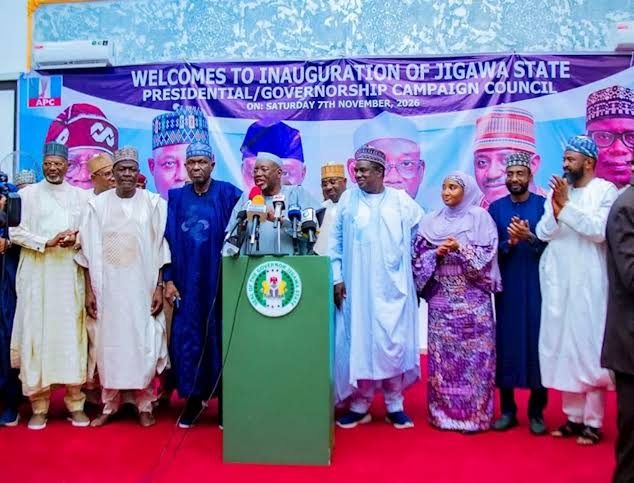
The All Progressives Congress Presidential Campaign Council has intensified grassroots mobilisation for President Bola Ahmed Tinubu’s 2027 re-election bid in Jigawa State, with women leaders taking political engagement and empowerment programmes into markets, hospitals and communities across the state.
The latest Tinubu Jigawa women mobilisation drive is being coordinated by the APC Presidential Campaign Council Directorate of Women Mobilisation as part of a wider nationwide strategy aimed at strengthening support for the President ahead of the 2027 general elections.
The outreach combines political mobilisation with economic empowerment, humanitarian intervention and direct engagement with women traders, vulnerable residents and community leaders.
At the centre of the exercise is an effort to build grassroots structures across Jigawa’s 27 local government areas, 287 political wards and 4,522 polling units.
According to figures provided by the campaign, Jigawa currently has 2,867,176 registered and newly captured voters in the provisional combined register.
The APC has set a target of securing two million votes for President Tinubu in the state, placing women and community-based mobilisation at the heart of its strategy.
The Tinubu Jigawa women mobilisation exercise therefore carries significance beyond the empowerment events themselves.
It reflects the ruling party’s attempt to build an election structure early, connect political messaging with economic intervention and establish direct relationships with women who represent an important voting bloc in northern Nigeria.
Tinubu Jigawa women mobilisation moves to grassroots
The APC Women Mobilisation Directorate took its campaign directly to locations where women live, work and trade.
The delegation visited markets, hospitals and communities, engaging women on economic opportunities, political participation and national development.
During the exercise, women traders received information on livelihood support and economic empowerment opportunities.
The campaign team also visited hospitals, where members interacted with patients and healthcare workers.
The outreach later culminated in an empowerment programme attended by women beneficiaries and grassroots stakeholders.
Some beneficiaries pledged support for President Tinubu, the Jigawa State Government and other APC candidates ahead of the 2027 elections.
The structure of the programme demonstrates an important shift in modern political mobilisation.
Rather than depending entirely on large rallies, political parties are increasingly using smaller community engagements to build relationships with voters.
Markets offer access to traders and businesswomen.
Hospitals provide opportunities for humanitarian engagement.
Community meetings allow party organisers to interact directly with local leaders and residents.
https://ogelenews.ng/tinubu-jigawa-women-mobilisation-27-lgas
For the Tinubu Jigawa women mobilisation campaign, these spaces also allow organisers to present the administration’s political message alongside programmes designed to address everyday economic concerns.
Women’s economic concerns take centre stage
The mobilisation effort has placed particular emphasis on women’s economic wellbeing.
Organisers argue that women play a central role in household survival and local economic activity.
Across Jigawa and other parts of Nigeria, women participate extensively in petty trading, agriculture, food processing, small-scale manufacturing, services and other informal economic activities.
For many of these women, access to affordable finance remains difficult.
The APC’s mobilisation strategy is therefore linking political engagement with empowerment initiatives intended to support women-owned businesses and vulnerable groups.
During similar engagements connected with the Women Mobilisation Directorate’s nationwide programme, organisers announced cash support for women entrepreneurs and assistance for pregnant women, nursing mothers and other vulnerable residents.
This economic dimension is central to the Tinubu Jigawa women mobilisation campaign.
Campaign organisers understand that voters are likely to judge political messages against their daily economic experiences.
Food prices, transportation costs, healthcare, access to credit and household income are likely to remain major issues in the 2027 campaign.
A mobilisation strategy that ignores those concerns would therefore struggle to connect with many grassroots voters.
Betta Edu leads Jigawa outreach
The Jigawa exercise was led by Dr Betta Edu, who addressed women during the engagements.
Edu said the programme was designed to bring empowerment opportunities closer to women at the grassroots and ensure they understood their importance in national development.
She also stressed that strengthening women economically could have wider benefits for families and communities.
The argument reflects a broader political calculation.
Women do not participate in elections simply as individual voters.
They also influence households, market associations, religious groups, professional networks and community organisations.
That makes them important actors in grassroots mobilisation.
The Tinubu Jigawa women mobilisation strategy appears designed to take advantage of those social networks.
Instead of seeing women only as beneficiaries of government programmes, the campaign is treating them as organisers capable of expanding the ruling party’s political reach.
First Lady’s empowerment programme linked to campaign
A significant aspect of the Jigawa exercise is its connection to the empowerment initiatives associated with First Lady Senator Oluremi Tinubu.
Campaign organisers have been using those programmes as part of their engagement with women across the country.
The APC says the objective is to take economic support and humanitarian interventions closer to women while strengthening their participation in national development.
The approach also carries an obvious political dimension.
The programmes are being implemented at the same time that the ruling party is building structures for the President’s re-election.
This means the distinction between social intervention and campaign mobilisation becomes particularly important.
Public confidence will depend on transparency around the source of funding, selection of beneficiaries and whether access to empowerment programmes is connected in any way to political loyalty.
The Tinubu Jigawa women mobilisation drive would gain greater credibility if beneficiaries are selected using clear, transparent criteria that do not discriminate on the basis of party affiliation.
Political parties are entitled to mobilise voters.
Government-backed empowerment programmes must, however, remain open and accountable.
Jigawa women positioned as electoral force
The wife of the Jigawa State Governor, Ambassador Hajiya Namadi, welcomed the outreach and described grassroots women as important contributors to their families and communities.
She called for greater participation by women in community development and governance.
Her remarks underline one of the central themes of the Tinubu Jigawa women mobilisation campaign: women are being positioned not merely as recipients of assistance but as active participants in electoral politics.
That is significant in a state with nearly 2.9 million registered and newly captured voters in the provisional figures being cited by campaign organisers.
Political mobilisation at that scale requires more than speeches from national leaders.
It requires ward-level structures.
Party agents.
Community organisers.
Market contacts.
Youth and women leaders.
Polling-unit coordinators.
The decision to activate structures across all 27 local government areas suggests the APC is moving early to establish that network.
Two million votes becomes APC target
Perhaps the most politically important figure associated with the exercise is the APC’s stated target of two million votes for President Tinubu in Jigawa.
That is an ambitious objective.
Securing two million votes would require exceptionally high voter turnout and overwhelming support for the APC candidate.
The Tinubu Jigawa women mobilisation campaign is expected to contribute to that goal through voter sensitisation, community engagement and expansion of grassroots structures.
Whether the target is realistic will depend on several factors.
These include voter registration, turnout, the strength of opposition parties, the performance of the state APC structure and how voters assess the Tinubu administration by election day.
Economic conditions are also likely to matter.
Political mobilisation can bring voters to campaign meetings.
It cannot entirely separate their electoral choices from inflation, jobs, food prices, security and household welfare.
This is why the campaign’s economic empowerment component may be strategically important.
The APC appears to understand that the political argument for 2027 must be connected with the material concerns of voters.
Jigawa remains important in northern politics
Jigawa may not receive the same national political attention as neighbouring Kano, but it remains strategically important in northern electoral calculations.
Its large voting population gives it considerable weight in presidential elections.
A strong result in Jigawa can contribute significantly to a candidate’s overall performance in the North-West.
The ruling APC is therefore unlikely to leave mobilisation in the state until the final months of the campaign.
The current Tinubu Jigawa women mobilisation drive indicates an early attempt to establish contact with voters and strengthen local networks.
Women’s organisations are particularly useful in this regard because they often operate through established community structures.
Market women’s associations, cooperative societies, religious networks and grassroots organisations can reach voters that conventional rallies may not.
This gives women organisers a potentially important role in voter turnout operations.
Campaign goes beyond Jigawa
The Jigawa exercise is part of a broader nationwide mobilisation programme.
The APC Women’s Directorate has also taken similar empowerment and political engagement activities to other states, including Ebonyi.
In those engagements, women entrepreneurs received financial support while campaign officials visited hospitals and interacted with vulnerable residents.
The Women’s Directorate had earlier pledged to mobilise women across all 36 states and the Federal Capital Territory ahead of the 2027 elections.
This indicates that the Tinubu Jigawa women mobilisation campaign is one component of a national strategy.
The broader objective is to build a coordinated female political network capable of operating across states, local governments, wards and polling units.
Such a structure could become an important part of the APC’s election-day machinery.
Empowerment and politics become intertwined
One of the most interesting elements of the Jigawa programme is the deliberate combination of empowerment and politics.
The campaign is not merely asking women to support the President.
It is trying to connect political support with questions of livelihood and welfare.
This approach has advantages.
Voters are more likely to engage with political organisations that address issues affecting their daily lives.
But it also creates a responsibility.
Empowerment programmes should be transparent and measurable.
Beneficiaries should know whether money comes from a political party, a private initiative, a government programme or another source.
That distinction matters because public funds cannot ethically be treated as campaign resources.
The Tinubu Jigawa women mobilisation campaign would therefore benefit from clear disclosure about the financing and administration of empowerment activities.
That would help separate legitimate political mobilisation from concerns about inducement.
Women could determine turnout
Women represent a crucial segment of Nigeria’s voting population.
Their importance becomes even greater when campaigns move from broad popularity to actual voter turnout.
Elections are not won simply because supporters express approval.
They are won when registered voters collect their voter cards, appear at polling units and cast valid ballots.
The APC’s decision to organise women at grassroots level therefore has a practical electoral purpose.
Women organisers can help with voter education.
They can identify supporters.
They can encourage participation.
They can communicate campaign messages through trusted community networks.
The Tinubu Jigawa women mobilisation campaign is therefore as much about organisation as it is about public endorsement.
Economic performance will test campaign message
Despite the scale of mobilisation, the APC’s biggest challenge may still be national economic conditions.
Women traders and low-income households have been among those most affected by rising food prices, transport costs and other living expenses.
That means campaign officials cannot rely solely on empowerment ceremonies.
Voters will judge the administration on broader economic performance.
They will ask whether inflation is falling.
Whether businesses are improving.
Whether food is more affordable.
Whether security is better.
Whether household incomes are recovering.
These questions will shape how the Tinubu Jigawa women mobilisation campaign is received.
If voters believe economic conditions are improving, grassroots mobilisation could reinforce support.
If hardship remains severe, the same communities being mobilised may become places where difficult questions are asked.
APC tests early grassroots strategy
The Jigawa outreach offers an early picture of how the APC may approach the 2027 presidential campaign.
The party appears determined to combine national messaging with small-scale community mobilisation.
Rather than waiting for campaign rallies, organisers are already entering markets, hospitals and neighbourhoods.
That approach can produce stronger political networks because it creates repeated contact with voters.
The Tinubu Jigawa women mobilisation strategy also places women at the centre of the campaign rather than treating them as an auxiliary structure.
That could become particularly important in northern states where grassroots women’s networks are extensive but sometimes receive less attention than major political blocs dominated by men.
Results will determine effectiveness
The true effectiveness of the mobilisation will not be measured by the size of empowerment events or the number of political statements issued.
It will be measured by organisation and ultimately by votes.
The APC has set itself a clear benchmark in Jigawa: two million votes for Tinubu.
That figure will make the state one of the places where the performance of the campaign can later be assessed.
For now, the Tinubu Jigawa women mobilisation drive shows that the ruling party is moving early.
Structures are being activated.
Women are being engaged.
Economic empowerment is being linked with political messaging.
And the campaign is extending into markets, hospitals, communities and polling-unit networks.
The bigger question is whether that organisation will survive beyond campaign events and translate into sustained voter support.
As the 2027 election approaches, Jigawa will provide one of the clearest tests of the APC’s strategy of combining women’s empowerment, grassroots organisation and political mobilisation in support of President Tinubu.
https://punchng.com/apc-women-mobilise-support-for-tinubu-in-jigawa/?utm_source=chatgpt.com