












Foreign debt servicing gulps almost $1bn
Nigeria spent $920 million servicing foreign loans in the first two months of 2026, underlining the growing pressure that debt obligations continue to place on the country’s finances.
Figures drawn from the Central Bank of Nigeria’s February 2026 Economic Report showed that foreign loan repayments stood at $440 million in January before rising to $480 million in February. Taken together, the payments brought the two-month total close to the $1 billion mark.
The disclosure that foreign debt servicing gulps almost $1bn in two months comes at a delicate time for Africa’s most populous country, where the government is attempting to expand public investment, stabilise the economy and meet rising expenditure commitments while carrying a heavy debt-service burden.
Although debt repayment is a normal responsibility of every borrowing government, the scale and speed of the payments have revived concerns about how much fiscal room remains for roads, schools, hospitals, security and other essential services.
Capital outflows rise sharply
The CBN report showed that Nigeria’s total capital outflows climbed from $1.63 billion in January to $2.75 billion in February 2026.
According to the bank, the increase was driven principally by capital transfers, which rose by 91.53 per cent to $2.26 billion. Loan repayments also increased from $440 million to $480 million during the period.
Capital transfers accounted for 82.18 per cent of February’s outflows, while loan repayments represented 17.45 per cent. Dividend repatriation accounted for the remaining share.
This means that the report that foreign debt servicing gulps almost $1bn in two months should be understood within a wider movement of funds out of the economy. Debt repayments were not the largest component of the February outflow, but they remained a significant and unavoidable obligation.
The banking sector accounted for the highest share of capital outflows at 45.96 per cent, followed by the financing sector at 26.10 per cent. Oil and gas contributed 15.72 per cent, while telecommunications and manufacturing accounted for smaller portions.
External position records some improvement
Despite the increase in repayments and capital outflows, the CBN said Nigeria’s external sector maintained a relatively strong position during the review period.
The country’s foreign reserves rose from $48.88 billion in January to $50.12 billion in February, providing an estimated 9.61 months of import cover. That level remained comfortably above the widely used minimum benchmark of three months.
The apex bank also reported a higher trade surplus and improved capital inflows, supported by lower import bills and stronger capital transfers.
These buffers offer some reassurance. However, the fact that foreign debt servicing gulps almost $1bn in two months still raises questions about sustainability, particularly if borrowing continues to grow faster than revenue and export earnings.
Strong reserves can help Nigeria meet external obligations and defend confidence in the foreign-exchange market. They do not, however, remove the need for the government to scrutinise the cost, purpose and repayment structure of every new loan.
Nigeria’s annual external repayments are rising
The two-month figure follows a year in which Nigeria reportedly spent about $5.21 billion servicing external obligations, up from approximately $4.66 billion in 2024. The increase amounted to about $552 million, or 11.9 per cent.
The Debt Management Office has also published its official record of Nigeria’s actual external debt-service payments for January to December 2025, providing a formal basis for public scrutiny of the country’s repayment obligations.
The pattern suggests that the headline foreign debt servicing gulps almost $1bn in two months is not an isolated event. It forms part of a longer trend in which both domestic and foreign debt costs are taking an increasingly large share of public resources.
The broader challenge is not simply the existence of debt. Countries borrow to finance infrastructure, support economic reforms and respond to emergencies. The real test is whether borrowed money produces enough economic value and government revenue to justify its cost.
https://ogelenews.ng/foreign-debt-servicing-gulps-almost-1bn
Debt costs compete with development spending
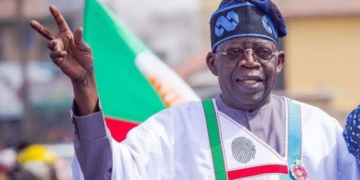
President Bola Tinubu said in May that Nigeria was expected to spend about $11.6 billion servicing its total debt in 2026, an amount described as nearly half of projected government revenue. He warned that expensive borrowing was diverting resources from infrastructure, healthcare, education and industrial development.
That statement captures the central concern surrounding the report that foreign debt servicing gulps almost $1bn in two months.
Every dollar used to meet a loan obligation is a dollar that cannot be used immediately for another public purpose. Debt service must therefore be weighed against the quality of the projects financed by the original borrowing.
Nigeria’s fiscal pressure was already evident in the first nine months of 2025, when total debt-related payments reached N12.63 trillion and exceeded the prorated budget provision by N1.90 trillion. Debt service alone consumed about 67.2 per cent of retained government revenue during that period.
Capital expenditure, by comparison, stood at N3.10 trillion during the same nine months, showing how debt obligations can crowd out development spending when revenue falls below expectations.
External debt projected to increase
The International Monetary Fund has projected that Nigeria’s public external debt could rise from about $51.9 billion in 2025 to $66.5 billion in 2026, before reaching $72.6 billion in 2027.
The projection would represent an increase of nearly 40 per cent within two years. Interest payments on public debt were also projected to rise from $2 billion in 2025 to $3 billion by 2027.
Against that background, the revelation that foreign debt servicing gulps almost $1bn in two months will likely strengthen calls for tighter borrowing controls, stronger revenue mobilisation and clearer public disclosure of how loans are used.
Fiscal experts have repeatedly argued that the government must borrow mainly for projects capable of expanding production, generating employment and improving revenue. Borrowing to finance recurring expenses or poorly implemented projects can leave future governments with repayments but little economic value.
Government faces difficult choices
Nigeria’s policymakers must now balance three competing demands: meeting existing debt obligations, funding essential public services and financing long-term development.
Defaulting on legitimate obligations is not a realistic option because it would damage Nigeria’s creditworthiness and raise future borrowing costs. The more sustainable response is to expand revenue without imposing excessive pressure on households and businesses, reduce waste and direct loans towards projects with measurable returns.
Improving crude oil production, widening the tax base, blocking revenue leakages and strengthening public financial management could help create more room in the budget.
The government must also favour concessional loans, which generally carry lower interest rates and longer repayment periods, over expensive commercial borrowing whenever such financing is available.
Transparency remains essential
The CBN and the Debt Management Office deserve continued scrutiny over the publication of debt and external-sector figures. Regular disclosure allows citizens, investors and lawmakers to understand the country’s financial position.
However, headline figures must be accompanied by details showing who the creditors are, the interest rates attached to the loans, repayment dates and the projects for which the money was borrowed.
The report that foreign debt servicing gulps almost $1bn in two months should therefore prompt more than alarm. It should trigger a serious public conversation about the quality of Nigeria’s borrowing and whether debt-funded projects are delivering sufficient economic and social returns.
The road ahead
Nigeria still possesses important financial buffers, including improved foreign reserves and export earnings. Yet the country cannot afford to treat rising debt-service costs casually.
A responsible debt strategy must link every major loan to identifiable development outcomes, realistic repayment plans and transparent legislative oversight.
The fact that foreign debt servicing gulps almost $1bn in two months is a warning that the cost of yesterday’s borrowing is becoming a major part of today’s economic reality.
The government’s task is not merely to keep paying its debts. It must ensure that borrowing supports growth, protects essential services and leaves future generations with productive assets rather than a mounting repayment burden.
https://www.imf.org/en/Countries/NGA