


















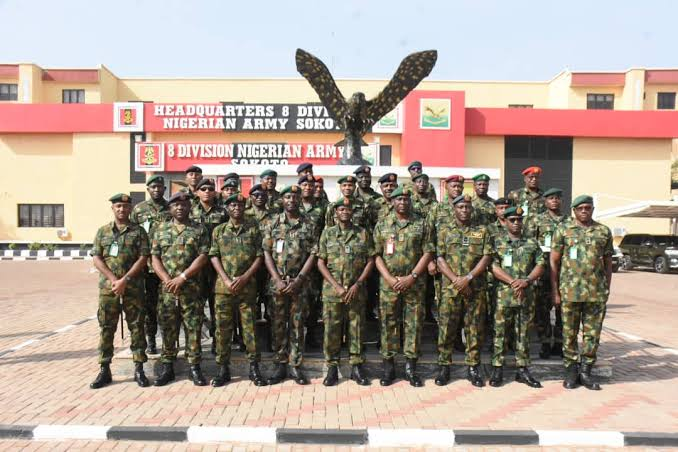
The Nigerian Army has directed troops operating in Kebbi State and other parts of the North-West to intensify offensive operations against bandits and other armed groups threatening communities across the region.
The directive comes as security forces sustain Kebbi banditry operations aimed at dismantling criminal hideouts, disrupting kidnapping networks and preventing armed groups from establishing safe havens along vulnerable communities and border corridors.
The Theatre Commander of Operation FANSAN YAMMA, Major General Warrah Idris, charged soldiers to maintain pressure on criminal elements and prepare for a more aggressive phase of military operations across the North-West.
Idris said the military’s objective goes beyond containing the activities of armed groups, stressing that troops must continue to pursue and dismantle the networks responsible for killings, kidnappings, cattle rustling and attacks on rural communities.
The commander also emphasised discipline, operational readiness and effective leadership as troops confront increasingly mobile criminal groups operating across state boundaries.
Army intensifies Kebbi banditry operations
The renewed Kebbi banditry operations come amid continuing security concerns across communities in Kebbi and neighbouring states.
Kebbi’s geographical position makes security operations particularly important. The state shares boundaries with Zamfara, Sokoto and Niger states, while also sitting close to international border routes that have become important in discussions surrounding the movement of armed groups.
Security authorities have consequently placed increased emphasis on intelligence gathering, rapid troop deployment and cooperation between military formations operating across the North-West.
The challenge facing troops is not merely to respond after attacks occur, but to identify criminal movements early enough to prevent attacks on villages, highways, farms and other vulnerable locations.
That requires soldiers to maintain a strong presence while intelligence units work with communities and other security agencies.
The military believes sustained Kebbi banditry operations can deny armed groups the freedom to regroup after being driven from established camps.
Operation FANSAN YAMMA remains central to campaign
Operation FANSAN YAMMA has become a major component of Nigeria’s military response to banditry, kidnapping and terrorism across the North-West.
The joint operation coordinates security efforts across several states where criminal gangs have exploited forests, difficult terrain and state boundaries to evade security forces.
Rather than viewing attacks in Kebbi, Zamfara or Sokoto as isolated incidents, the military’s approach increasingly recognises the interconnected nature of insecurity across the region.
https://ogelenews.ng/kebbi-banditry-operations
Armed groups can move from one state to another when military pressure increases in a particular location. This makes coordination between formations, intelligence units and other security agencies essential.
The latest directive therefore places renewed attention on sustained offensive action rather than temporary deployments following attacks.
For Kebbi banditry operations to achieve lasting results, troops must not only clear criminal camps but prevent fleeing fighters from establishing new bases elsewhere.
Recent operations show continuing security pressure
The military has recorded a number of operational successes in Kebbi in recent months.
On September 2, troops of Sector 2, Joint Task Force North-West, Operation FANSAN YAMMA, responded to intelligence about suspected terrorists around Mehinua Village along the Wasagu-Ayu Road in Wasagu Local Government Area.
The troops engaged the armed men and forced them to flee, leaving behind six kidnapped victims who were subsequently rescued unharmed.
The incident demonstrated the importance of intelligence-led operations and rapid military response in communities exposed to kidnapping and bandit attacks.
Earlier operations in Kebbi also resulted in the recovery of weapons and explosive devices from suspected Lakurawa fighters.
These developments show why the Army is seeking to sustain pressure rather than allow armed groups time to reorganise.
Lakurawa adds another dimension to Kebbi insecurity
The emergence of Lakurawa has added another dimension to the security situation around Kebbi and parts of the wider North-West.
Unlike ordinary criminal gangs primarily associated with kidnapping for ransom, cattle rustling and village raids, Lakurawa has been treated by Nigerian authorities as a terrorist organisation.
Military operations against the group have therefore become an important part of Kebbi banditry operations and the broader campaign to secure border communities.
In June, Nigerian Army troops reported recovering rocket-propelled grenade equipment, improvised explosive devices, motorcycles and other materials following an encounter with Lakurawa fighters around the Dogon Daji area of Dandi Local Government Area.
The ability of armed groups to operate across remote settlements and border corridors presents a difficult challenge for conventional security operations.
Military commanders are consequently placing greater emphasis on mobility, intelligence and cooperation with residents.
Intelligence from communities remains crucial
One recurring message from security commanders is that soldiers cannot defeat banditry through firepower alone.
Information from residents can determine how quickly troops identify suspicious movements, kidnapping camps or planned attacks.
Communities often understand local terrain better than outsiders and may notice unfamiliar motorcycles, movements through forests or sudden gatherings before security personnel do.
Timely intelligence can therefore help troops move from reacting to attacks to preventing them.
This community dimension will remain important as Kebbi banditry operations expand.
Residents, however, also require confidence that information supplied to security agencies will be protected and acted upon responsibly. Where communities fear retaliation from criminal groups, intelligence gathering becomes more difficult.
Building trust between residents and security forces must therefore accompany military operations.
Security remains vital to farming and rural livelihoods
Beyond casualty figures and military operations, banditry has serious economic consequences for communities.
Many affected areas depend heavily on agriculture, livestock and local commerce.
When farmers are afraid to reach their farmlands or traders cannot travel safely between communities, insecurity quickly becomes an economic problem.
Families lose income, agricultural production suffers and local food supplies can be disrupted.
This makes successful Kebbi banditry operations important not only for security but also for the economic survival of rural communities.
Restoring security means creating conditions in which farmers can cultivate their land, children can attend school, traders can travel and families can live without constantly fearing attacks or abductions.
Military pressure must produce lasting security
The Army commander’s directive signals determination, but the ultimate test will be what changes on the ground.
Military operations can destroy camps, recover weapons and rescue kidnapped victims. Lasting security, however, requires armed groups to be denied the opportunity to return after troops leave.
That means maintaining intelligence networks, securing vulnerable routes and improving coordination among the Army, Police, Department of State Services, local authorities and communities.
Security forces must also continue tracking the financial, logistical and weapons networks that allow criminal groups to survive.
The success of Kebbi banditry operations will therefore depend not simply on the number of raids conducted, but on whether residents experience a sustained reduction in kidnappings, killings and attacks.
For soldiers on the frontline, the latest directive is clear: maintain pressure.
For communities that have endured years of insecurity, the expectation is equally clear. They want that pressure to translate into roads they can travel safely, farms they can cultivate without fear and homes where families can sleep without listening for the sound of approaching motorcycles.
As Kebbi banditry operations enter another intensive phase, those everyday measures of security will ultimately determine whether the campaign is succeeding.