












Nnamdi Kanu’s Lawyer Threatens Legal Action
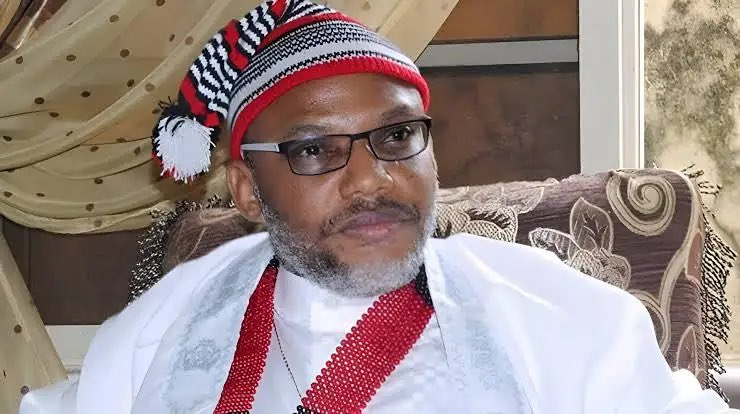
The legal team representing the detained leader of the Indigenous People of Biafra, Nnamdi Kanu, has threatened legal action over a televised statement allegedly calling on the Federal Government to kill him.
Kanu’s Special Counsel, Aloy Ejimakor, condemned the remarks attributed to Chigozie Nnabugwu, describing them as reckless, unlawful and capable of threatening public peace. The lawyer demanded an immediate public retraction from Nnabugwu and an unqualified televised apology from the media organisation that aired the interview.
The controversy surrounding the Nnamdi Kanu death call followed comments reportedly made during a live television programme on Monday. Nnabugwu was quoted as saying that normalcy would begin to return to the South-East if the Federal Government killed Kanu.
The remarks immediately drew criticism from Kanu’s supporters and other Nigerians who argued that no individual should be subjected to unlawful execution, irrespective of the allegations or convictions against him.
In a statement issued on Tuesday, Ejimakor said Kanu’s legal team viewed the comments as a call for extrajudicial killing and a direct threat to the life of its client. He warned that the team was reviewing available legal remedies and could commence proceedings unless the demanded corrective measures were taken.
Legal team issues pre-action notice
Ejimakor described the statement as irresponsible and capable of encouraging violence. He said the legal team had issued what amounted to a pre-action notice to Nnabugwu and the television station.
According to the lawyer, the Nnamdi Kanu death call crossed the boundary of legitimate political commentary because it allegedly urged the state to take a life outside the lawful judicial process.
The team demanded that Nnabugwu publicly withdraw the statement. It also asked the broadcaster to apologise for providing a platform on which the controversial remark was made.
Ejimakor warned that failure to comply could result in civil or criminal proceedings. However, no court has yet ruled on whether the statement violated any law, and the allegations remain subject to legal interpretation and possible judicial determination.
The distinction is important. Lawyers are entitled to raise legal objections and issue warnings, but the final determination of liability belongs to the courts and relevant regulatory authorities.
Lawyer cites Cybercrimes Act
Ejimakor argued that the alleged Nnamdi Kanu death call could fall within the provisions of Section 24(1) of the Cybercrimes Act, which deals with certain electronic communications considered threatening or capable of causing a breakdown of law and order.
He claimed that the provision could apply because the statement was transmitted through broadcast and online platforms. The lawyer also suggested that other liabilities might arise under criminal laws dealing with incitement to violence.
According to the statement, an offence under the provision cited by the legal team may attract a fine, imprisonment or both. That position, however, would have to be tested against the exact words used, their context, the applicable version of the law and the constitutional protection of freedom of expression.
Nigeria’s courts have repeatedly had to balance freedom of speech against public safety, reputation, national security and the protection of individual rights. Political speech may be robust and even offensive, but direct threats or incitement can attract legal consequences where the required elements of an offence are established.
The controversy therefore raises an important question: when does provocative political commentary become an unlawful threat?
Broadcaster may face regulatory scrutiny
Kanu’s legal team also criticised the television station for airing the interview. Ejimakor argued that broadcasters have a duty to prevent their platforms from being used to promote violence or unlawful conduct.
The lawyer warned that the station could face regulatory sanctions if the broadcast was found to violate rules governing incitement, public order and responsible programming.
Under Nigerian broadcasting standards, media organisations are generally expected to exercise editorial judgment, especially when programmes involve highly sensitive political, ethnic or security issues.
However, a broadcaster’s liability may depend on several factors. These include whether the interview was live, whether the presenter challenged the comment, whether the statement was repeated after the broadcast and what steps the station took once controversy arose.
The Nnamdi Kanu death call controversy therefore places attention not only on the person who made the remark but also on the responsibility of media houses when guests make inflammatory statements.
A professional broadcaster is not required to agree with every opinion expressed by a guest. But it is expected to provide context, challenge dangerous claims and avoid presenting unlawful violence as a legitimate solution to political disagreement.
https://ogelenews.ng/nnamdi-kanu-death-call
Ejimakor alleges interference with judicial process
The legal team further argued that calling for Kanu’s killing while legal proceedings connected with his case remain active could amount to interference with the judicial process.
Ejimakor said disputes involving Kanu must be resolved through the courts rather than through calls for violence. He described the Nnamdi Kanu death call as an attempt to bypass lawful judicial procedures.
Kanu was convicted in November 2025 on terrorism-related charges and sentenced to life imprisonment by a Federal High Court in Abuja. Prosecutors had sought the death penalty, but the trial judge imposed life sentences instead. Kanu has continued to challenge the legal basis of the proceedings and his conviction.
His case has remained one of Nigeria’s most politically sensitive legal disputes. It has generated strong reactions across the South-East, among supporters of Biafran separatism and within national political circles.
Before his conviction, Kanu had denied wrongdoing and challenged the jurisdiction of the court. He also refused to present a conventional defence at one stage of the trial, insisting that the charges lacked a valid legal foundation.
Whatever the public’s view of Kanu, punishment for a criminal offence must follow a lawful conviction, sentence and appeal process. No citizen or public commentator has the authority to impose or demand an extrajudicial punishment.
Social media reactions deepen controversy
The interview generated widespread reactions on social media, with many users rejecting the suggestion that Kanu should be killed.
Some commentators argued that such a development would worsen political tension in the South-East rather than restore peace. Others maintained that the underlying causes of separatist agitation should be addressed through justice, dialogue, security reform and economic development.
There were also calls for the Federal Government and security agencies to take the alleged Nnamdi Kanu death call seriously because of the political tension surrounding Kanu’s detention and conviction.
Social media reactions, however, must also remain within lawful limits. Condemning an alleged threat should not become an excuse for counter-threats, harassment or attacks against the person accused of making the statement.
The appropriate response is for the relevant institutions to review the broadcast, preserve the recording and determine whether any law or professional rule was breached.
A sensitive debate requiring restraint
The latest controversy illustrates the danger of using inflammatory language in discussions about insecurity and separatist agitation.
The South-East has faced years of violence, attacks on security personnel, disruption of commercial activities and enforcement of sit-at-home directives. Kanu and IPOB have remained central to political debates over the region, although responsibility for individual acts of violence must always be established through evidence and lawful investigation.
The Nnamdi Kanu death call does not contribute to a serious examination of these challenges. Calls for unlawful killing can deepen resentment, encourage retaliation and undermine confidence in the courts.
A democratic society must permit disagreement. Nigerians are free to support or oppose Kanu’s political ideas, criticise his conduct, question the government’s handling of his case or demand accountability for violence in the South-East.
What democracy does not permit is the substitution of mob judgment for due process.
Authorities urged to review broadcast
The legal team’s threat of legal action means attention may now shift to the National Broadcasting Commission, law enforcement agencies and the courts.
The broadcasting regulator may examine whether the station complied with professional standards. Security agencies may also determine whether the remarks amounted to a credible threat or unlawful incitement.
For its part, the television station should make the full recording available and clarify the circumstances in which the statement was made. A short online clip may not always provide the complete context of a live interview.
Nnabugwu should also be given an opportunity to explain or clarify his remarks. Fair reporting requires that allegations against him be presented as claims rather than established findings.
The Nnamdi Kanu death call controversy must therefore be handled carefully. The rights of Kanu, the speaker and the broadcaster must all be protected while the facts are examined.
Rule of law must remain central
The most important principle arising from the controversy is that the rule of law must apply to everyone.
Kanu’s conviction does not remove his right to life, legal representation and access to the appellate process. Equally, criticism of Kanu or IPOB should not automatically be treated as a crime unless it crosses a legally defined boundary.
Ejimakor’s threatened action will ultimately depend on the evidence, the wording of the broadcast and the interpretation of relevant laws.
The legal team has made its demands clear: a retraction from Nnabugwu and an apology from the broadcaster. Whether those demands will be met, rejected or tested in court remains uncertain.
What is already clear is that the Nnamdi Kanu death call has reopened debate over responsible speech, media ethics and the dangers of advocating violence in a politically divided society.
Nigeria’s democratic institutions will be judged by their ability to address the controversy lawfully, impartially and without allowing public anger to replace evidence.
The path to peace in the South-East cannot be built on threats of killing. It must rest on justice, accountability, dialogue and respect for the constitutional rights of every Nigerian.