
















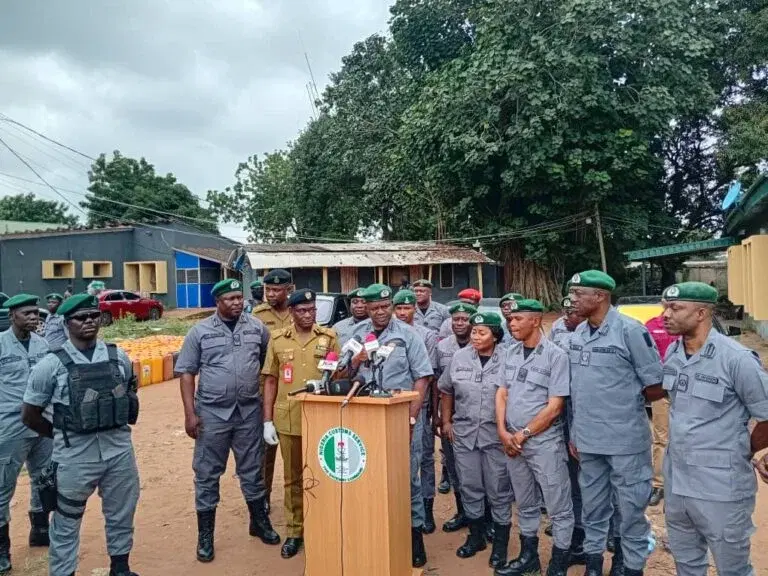
Ogun Customs contraband seizure
The Nigeria Customs Service, Ogun Area I Command, has announced the interception of contraband with an estimated duty-paid value of ₦3.57 billion, as officers intensify operations against smuggling networks operating across the state’s border communities.
The latest Ogun Customs contraband seizure forms part of sustained enforcement activities aimed at curbing the illegal movement of prohibited and improperly imported goods through routes linking Ogun State with neighbouring Benin Republic.
Customs officials said the seizures resulted from intelligence-led patrols, surveillance and targeted operations across identified smuggling corridors.
The Command also warned smugglers that enforcement would become more aggressive, stressing that officers were determined to protect the Nigerian economy, legitimate businesses and government revenue.
Contraband valued at ₦3.57bn
The scale of the Ogun Customs contraband seizure is significant because the duty-paid value represents the estimated financial worth of the intercepted goods after applicable Customs duties and charges are taken into account.
Such calculations are commonly used by the Nigeria Customs Service to quantify the value of seizures.
The latest operation included different categories of goods suspected to have entered or moved through the country contrary to Customs regulations.
Ogun State remains one of Nigeria’s most closely watched border states because of its long and complex boundary with Benin Republic.
That geography creates legitimate trade opportunities but also presents enforcement challenges.
Smugglers can exploit rural roads, forest routes and unofficial crossings to move goods while attempting to avoid Customs checks.
Customs intensifies anti-smuggling campaign
The Ogun Customs contraband seizure reflects the Command’s broader effort to disrupt illegal trade networks rather than merely intercept isolated consignments.
Customs operations in border states normally combine patrols, intelligence gathering and cooperation with other security agencies.
Officers monitor known routes, warehouses and movement patterns associated with suspected smuggling.
The aim is not only to seize goods but also to identify those financing, transporting and receiving contraband.
That distinction matters.
A successful anti-smuggling operation should eventually lead investigators beyond the driver or carrier towards the wider commercial network behind the illegal movement of goods.
https://ogelenews.ng/ogun-customs-contraband-seizure-n3-57bn
Rice remains major smuggling target
Foreign parboiled rice has historically been one of the most frequently seized commodities along Nigeria’s southwestern borders.
Government restrictions on rice importation through land borders were introduced partly to support domestic production and protect local farmers.
The Ogun Customs contraband seizure therefore has an agricultural-policy dimension as well as a law-enforcement one.
Supporters of the restrictions argue that uncontrolled importation of cheaper foreign rice can undermine Nigerian farmers and domestic processors.
Critics, however, often point to food prices and argue that restrictions can create incentives for smuggling where local supply remains insufficient or more expensive.
That broader economic debate does not change the legal responsibility of Customs officers to enforce existing import rules.
Petroleum products and border controls
Petroleum products are another commodity frequently associated with border enforcement.
Nigeria’s fuel-pricing history has at different times created incentives for illegal movement of petrol into neighbouring countries.
Where significant price differences exist across borders, smugglers may attempt to profit by moving products illegally.
The Ogun Customs contraband seizure highlights why border enforcement must continually adjust to changing economic conditions.
Smuggling patterns can change quickly depending on exchange rates, fuel prices, import restrictions and market demand.
Customs therefore needs current intelligence rather than relying only on traditional checkpoints.
Vehicles used in smuggling face seizure
Another important feature of Customs enforcement is the seizure of vehicles suspected to have been used to transport contraband.
Transport equipment can form part of the evidence in smuggling investigations.
Where vehicles are specially modified to conceal goods, investigators may examine whether the owners knew how the vehicles were being used.
The latest Ogun Customs contraband seizure again underlines the commercial risks facing transporters who participate in illegal cross-border trade.
Drivers and vehicle owners should verify the nature of goods they are contracted to transport.
Accepting unusually lucrative transport jobs without proper documentation can expose individuals and assets to serious legal consequences.
Smuggling damages legitimate businesses
The economic impact of smuggling extends beyond government revenue.
Businesses that import goods lawfully pay Customs duties, taxes and other charges.
Smugglers attempt to bypass those costs.
That allows illegally imported products to compete unfairly with goods brought into the country through legitimate channels.
The Ogun Customs contraband seizure therefore has implications for honest traders as well as government agencies.
Where illegal goods dominate markets, businesses that follow regulations may find themselves at a competitive disadvantage.
Effective enforcement can help restore a more level commercial environment.
Revenue protection remains central
The Nigeria Customs Service performs both enforcement and revenue functions.
Its officers are responsible for facilitating legitimate trade while ensuring importers comply with Customs requirements.
Smuggling directly undermines that revenue mandate.
Goods that enter without proper declaration can deprive the government of duties and taxes.
The Ogun Customs contraband seizure should therefore be understood as part of a wider effort to protect public revenue.
However, revenue protection must not become an excuse for unnecessary harassment of legitimate businesses.
Customs procedures should remain clear, predictable and efficient.
The best border system is one that is strict against illegal trade while making lawful trade easier.
Border communities caught in the middle
Residents of border communities often experience Customs enforcement differently from people living in major cities.
Many communities have long-standing economic and social relationships that cross international boundaries.
People may farm, trade or visit relatives on both sides of the border.
The Ogun Customs contraband seizure therefore highlights the importance of distinguishing normal local activity from organised commercial smuggling.
Security officers must enforce the law professionally and avoid treating every resident of a border community as a suspect.
At the same time, communities should not provide protection or intelligence to organised smuggling networks.
Successful border management depends partly on cooperation between residents and enforcement agencies.
Customs warns smugglers
The Command said it would not relent in its operations.
Its warning that smugglers should expect a tougher response signals an intention to increase enforcement pressure.
But statements alone will not dismantle smuggling networks.
The Ogun Customs contraband seizure will have greater significance if authorities identify major financiers and receivers of illegal goods.
Smuggling is profitable because there is a market.
If enforcement focuses only on drivers and small-scale carriers while larger financiers remain untouched, illegal trade can quickly regenerate.
Financial investigations should therefore accompany physical seizures where appropriate.
Intelligence is key
Ogun’s long border makes it impossible for Customs officers to place personnel at every unofficial crossing.
Intelligence is therefore critical.
Community information, surveillance, vehicle tracking and cooperation with other agencies can help officers identify suspicious movement.
The Ogun Customs contraband seizure demonstrates the value of targeting operations based on information rather than depending exclusively on permanent checkpoints.
Technology could further strengthen this approach.
Drones, electronic cargo tracking and improved communication systems can help officers monitor difficult terrain.
However, technology must be accompanied by trained personnel and strong internal controls.
Fighting corruption within enforcement
Any serious campaign against smuggling must also address corruption.
Smuggling networks sometimes survive because they receive assistance from compromised officials.
Customs authorities must therefore enforce discipline internally as firmly as they enforce border regulations externally.
The Ogun Customs contraband seizure will strengthen public confidence if the Service demonstrates that officers found collaborating with smugglers face serious consequences.
Internal accountability is essential because a single compromised officer can undermine the work of an entire enforcement team.
Ogele News perspective
The interception of contraband worth ₦3.57 billion is a substantial enforcement achievement.
But seizures should not become the only measure of success.
A border enforcement system that announces increasingly large seizures every month may also be revealing how large the illegal trade remains.
The real objective should be to reduce smuggling itself.
That requires Customs to identify the economic and criminal networks behind illegal imports, improve intelligence, strengthen cooperation with communities and make lawful trade more attractive than illegal routes.
The Ogun Customs contraband seizure also carries a warning for policymakers.
Where legitimate import processes are excessively complicated or expensive, incentives for smuggling can increase.
Government must therefore combine strong enforcement with sensible trade policies and efficient Customs procedures.
Businesses that comply with the law deserve protection from unfair competition.
Border residents deserve professional treatment.
Customs officers deserve the equipment and intelligence required to do their jobs safely.
And smugglers should understand that illegal trade carries consequences.
The latest Ogun Customs contraband seizure is significant because of its value.
Its lasting importance, however, will depend on whether it contributes to breaking the networks that make large-scale smuggling possible.