

















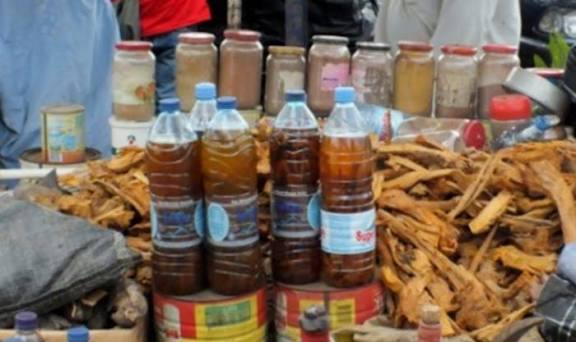
Ondo herbal drink deaths
The Ondo State Police Command has arrested a man identified as Oloruntoba Babatunde over his alleged connection with a herbal liquid substance being investigated following the deaths of dozens of residents in communities across Odigbo Local Government Area, Ondo herbal drink deaths
The arrest marks a major development in the investigation into the Ondo herbal drink deaths, which have triggered fear across affected communities and prompted the state government to clamp down on unverified alcoholic and herbal beverages.
Ondo State Government has officially confirmed 29 deaths from 60 suspected cases.
Health authorities, however, have stressed that laboratory investigations have not yet conclusively established the substance responsible for the deaths.
The distinction is crucial as police continue their investigation.
Babatunde is a suspect and has not been convicted of any offence. Likewise, although health officials have established a strong epidemiological suspicion of exposure to a toxic alcoholic substance, the final laboratory evidence determining the precise cause of the deaths is still being awaited.
Police arrest suspect over Ondo herbal drink deaths
The Ondo State Police Command confirmed Babatunde’s arrest as investigations intensified into the substance allegedly consumed by some of the victims.
Police said the suspect was allegedly involved in producing the herbal liquid under investigation.
The Ondo herbal drink deaths have affected communities including Araromi-Obu and Odigbo, with cases also reported around Orita Odigbo, Newtown, Odole, Okele and Oniparaga.
Initial reports placed the death toll at 24 before subsequent updates showed the number increasing.
There have been conflicting casualty figures from different sources, with some local reports citing more than 30 deaths.
For publication purposes, however, the Ondo State Government’s latest confirmed figure of 29 deaths provides the strongest official benchmark pending further updates, Ondo herbal drink deaths
60 suspected cases recorded
Ondo State Commissioner for Health, Dr Banji Awolowo-Ajaka, said 60 suspected cases had been recorded in connection with the incident.
Of that number, the government confirmed 29 deaths.
Three people were receiving treatment in hospitals when the official update was issued, while 27 others remained under medical observation.
The commissioner said approximately 95 per cent of those affected were males between the ages of 16 and 55.
That demographic pattern has become an important part of the investigation into the Ondo herbal drink deaths.
Victims reportedly presented with a range of serious symptoms.
These included headaches, body pain, general weakness, visual disturbances, breathing difficulties and altered consciousness.
Some patients deteriorated rapidly and died within hours.
The symptoms and reported exposure histories led health authorities to suspect a toxic alcoholic substance.
But the government has been careful not to declare that conclusion final.
Toxicology tests yet to establish exact cause
This is perhaps the most important element of the story.
The Ondo State Government says there is strong epidemiological suspicion of exposure to a probable toxic alcoholic substance, but laboratory evidence establishing the exact cause has not yet been obtained.
Health authorities collected 36 blood and urine samples for laboratory examination.
Samples of the suspected alcoholic substances were also submitted for toxicological analysis.
Those results will be critical in determining exactly what the victims consumed and whether a particular chemical or contaminant caused the illnesses and deaths.
Until those findings are available, descriptions of the substances as definitively “killer drinks” should be treated cautiously.
The investigation into the Ondo herbal drink deaths must establish both the medical cause and the chain through which any dangerous substance reached consumers.
Government bans unverified alcoholic drinks
The crisis has already forced the Ondo State Government to take emergency regulatory action.
Authorities initially imposed restrictions in the affected area before announcing an immediate ban on the sale and distribution of unverified alcoholic drinks and other substances across the state.
The government directed sellers and distributors to stop making products available to the public where their source, content or regulatory status cannot be verified.
Residents were also warned against purchasing or consuming unverified alcoholic beverages, particularly products whose safety and regulatory approval cannot be established.
Security agencies were directed to act against the sale and distribution of illegal and unapproved products.
The crackdown illustrates the seriousness with which authorities are treating the Ondo herbal drink deaths while laboratory investigations continue.
Police initially warned against premature conclusions
The Ondo State Police Command had earlier urged members of the public not to jump to conclusions about the cause of the fatalities.
When investigations began, police said officers from the Police Medical Services were working alongside the Ondo State Ministry of Health and local health authorities to obtain evidence.
The Command specifically warned against attributing the deaths to a particular substance before medical and toxicological examinations were completed.
That warning remains relevant even after the arrest of a suspected producer.
An arrest is an investigative step. It does not establish guilt.
Authorities will still have to determine what was produced, what ingredients were present, whether the suspect produced the same substance consumed by affected residents and whether laboratory evidence connects that substance to the deaths.
https://ogelenews.ng/ondo-herbal-drink-deaths-police-arrest-suspected-pr…
Communities thrown into mourning
Behind the casualty figures are communities dealing with an extraordinary public health tragedy.
Families across parts of Odigbo Local Government Area have lost relatives, while other residents have required hospital treatment or medical observation.
Reports from survivors have added to public anxiety.
One survivor described suffering severe visual problems after consuming a locally prepared alcoholic drink.
Vision disturbance is also among the symptoms officially identified by the Ondo State health authorities in the wider outbreak.
The Ondo herbal drink deaths have consequently generated fear over locally prepared alcoholic and herbal mixtures sold without clear information about their ingredients or regulatory status.
The crisis also raises questions about how such products are produced, distributed and monitored.
NAFDAC and health agencies join investigation
The investigation is no longer simply a police matter.
Health officials and regulatory agencies have been involved in efforts to establish the source of the suspected contamination.
The state government says it is working with relevant national and international partners to identify the cause and prevent further deaths.
Scientific officers have also been deployed to affected communities to investigate the suspected substances and determine their composition.
This multidisciplinary approach is necessary.
Police investigators can establish who produced, supplied or sold a substance. But toxicologists and medical laboratories must establish what the substance contained and whether it caused the observed medical conditions.
Regulatory agencies must then determine whether applicable production, registration and safety requirements were violated.
The full picture behind the Ondo herbal drink deaths will therefore depend on evidence from all three fronts.
Questions investigators must answer
Babatunde’s arrest represents progress, but it does not end the investigation.
Several questions remain unanswered.
What exactly was contained in the drinks consumed by the victims?
Were all 60 suspected cases exposed to the same substance?
Where was it manufactured?
How was it distributed?
Was the product registered or otherwise authorised for public consumption?
Did contamination occur during production, storage or distribution?
And, most importantly, can laboratory analysis establish a direct connection between the suspected substance and the deaths?
Answers to these questions will determine whether investigators can build a criminal case against any individual or business.
They will also help health authorities understand how to prevent another outbreak.
Public warned against unverified drinks
The immediate public health advice is considerably clearer.
Residents have been urged to avoid alcoholic products obtained from unlicensed or unverifiable sources.
Health authorities have also advised anyone who develops blurred vision, sudden weakness, breathing difficulties, confusion or loss of consciousness after consuming alcohol to seek medical treatment immediately.
Those warnings should be taken seriously while the investigation into the Ondo herbal drink deaths continues.
The government has also appealed to community leaders and residents to report unusual illnesses and sudden deaths promptly.
Early medical intervention could prove critical for people exposed to toxic substances.
Arrest is only the beginning
The arrest of Oloruntoba Babatunde gives investigators a potentially important lead in one of Ondo State’s most serious recent public health emergencies.
But responsible reporting requires a distinction between suspicion and proof.
Police suspect a connection between the arrested man and the herbal substance under investigation.
Health authorities strongly suspect exposure to a toxic alcoholic substance.
Neither question has yet been finally resolved through the judicial and scientific processes required to establish responsibility.
For the families who have lost relatives, however, those answers cannot come soon enough.
The Ondo herbal drink deaths have already claimed 29 lives according to the latest official state government figure, while dozens of other suspected cases have been investigated.
The immediate priority is preventing further casualties.
The longer-term task is establishing exactly what happened, identifying anyone responsible and determining how an allegedly dangerous substance could have reached so many consumers.
Until toxicology results provide the missing scientific evidence, the investigation remains open.
What is already beyond dispute is the scale of the tragedy.
Twenty-nine confirmed deaths are not merely a regulatory failure or a police statistic. They represent 29 families whose lives have been changed.
The public deserves to know what caused those deaths.
And if evidence establishes criminal responsibility, those responsible must answer before the law.