













Peter Obi academic records
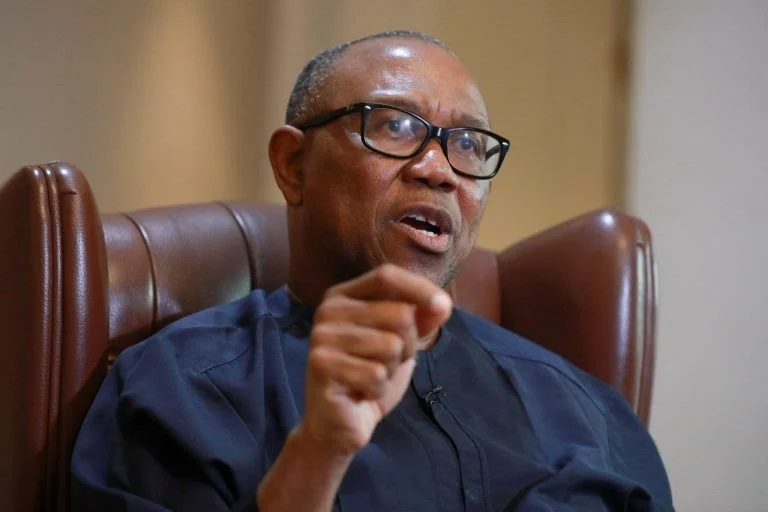
Presidential candidate Peter Obi has asked the University of Nigeria, Nsukka, to release his academic records to anyone making a legitimate request, declaring that he has nothing to hide about his educational qualifications.
Obi’s intervention follows reports of a legal action seeking certified copies of documents relating to his admission, studies and graduation from the university.
The controversy over Peter Obi academic records comes as political scrutiny intensifies ahead of Nigeria’s 2027 general election, with questions surrounding the qualifications and backgrounds of presidential contenders increasingly becoming subjects of public debate.
Obi said he obtained a Bachelor of Arts degree in Philosophy from the University of Nigeria, Nsukka, in 1984 and has no objection to the institution releasing relevant records in accordance with the law.
He also extended the same position to other educational institutions he has attended, saying they were free to make his records available where requests comply with applicable laws and procedures.
For Obi, the issue goes beyond answering questions about his own qualifications. He argued that transparency and accountability should become standard requirements for anyone seeking Nigeria’s highest public office.
Peter Obi academic records become subject of court action
The renewed attention on Peter Obi academic records follows a suit filed at the Federal High Court in Abuja by Abayomi Arabambi.
The action, marked FHC/ABJ/CS/2144/2026, was filed on September 9, 2026.
Arabambi is asking the court to compel the University of Nigeria, Nsukka, to release certified records relating to a Bachelor of Arts degree in Philosophy said to have been awarded to Obi in 1984.
According to court documents, Arabambi had earlier requested a Certified True Copy of Certificate No. D000198 as well as academic and institutional records connected with the award of the degree.
The request was reportedly made under Nigeria’s Freedom of Information Act.
Arabambi told the court that his initial request was dated July 16, 2026, and was subsequently received by the university in August.
After allegedly receiving no substantive response, he sent a reminder dated August 31.
He subsequently approached the Federal High Court seeking orders compelling the institution to respond and release records that are legally available for disclosure.
What exactly is being requested from UNN?
The court action goes considerably further than simply asking to see a photocopy of a university certificate.
The applicant is seeking records that could independently establish details surrounding the degree.
They include relevant academic records, graduation and degree-award records, certificate-register entries, Senate or academic approval records and other existing official documentation connected with the degree.
This distinction is important in understanding the controversy surrounding Peter Obi academic records.
According to the applicant’s case, the court is not being asked at this stage to declare Obi’s certificate genuine or forged.
Rather, the action seeks disclosure of records held by the university from which information concerning the certificate and degree can be independently established.
That distinction should not be lost in the political arguments surrounding the case.
A legal request for records is not, by itself, proof that a certificate is false. Equally, political statements about a certificate are not a substitute for records maintained by the institution that issued it.
Obi says UNN should release the records
Obi has now made his own position clear.
He said he has no objection to the release of Peter Obi academic records held by the University of Nigeria, provided the request is legitimate and disclosure is permitted by law.
His response effectively removes any suggestion that he is personally asking UNN to conceal his educational history.
Obi said public scrutiny should be expected by anyone seeking to lead Nigeria.
He maintained that people asking citizens to entrust them with political power should be prepared to answer legitimate questions about their backgrounds, qualifications and public records.
At the same time, he insisted that such scrutiny must be lawful, fair and consistently applied.
That qualification is significant.
Transparency should not become a political weapon applied selectively against one candidate while the records of others escape comparable examination.
Obi extends challenge to other presidential hopefuls
The controversy over Peter Obi academic records has therefore developed into a wider political argument about transparency among Nigeria’s presidential contenders.
Obi challenged other politicians seeking the presidency to make their educational qualifications and relevant records available for public scrutiny.
The former Anambra State governor said he was prepared to submit himself to the level of examination reasonably expected of someone seeking the highest office in the country.
That position could shift the political conversation beyond Obi himself.
Nigeria has witnessed repeated controversies surrounding the academic qualifications, certificates, identities and personal records of politicians.
Such disputes often become particularly intense during election seasons, when opposition parties and political campaign organisations search through candidates’ histories.
The danger is that legitimate scrutiny can easily become mixed with misinformation, partisan propaganda and unsupported allegations.
The most effective response is documentary evidence from the institutions responsible for maintaining the records.
https://ogelenews.ng/peter-obi-urges-unn-to-release-his-academic-records…
Freedom of Information Act at centre of dispute
The Peter Obi academic records case also raises an important question about Nigeria’s Freedom of Information framework.
Arabambi argues that his request was made under the Freedom of Information Act 2011 and that UNN, as a public institution, was required to respond within the provisions of the law.
He is asking the court for an order of mandamus compelling the university to perform what he considers its statutory obligation.
However, access to information under the Act is not necessarily unlimited. Certain categories of personal and protected information may be subject to statutory exemptions.
That is why the Federal High Court proceedings matter.
The court may ultimately have to determine the extent of the institution’s disclosure obligations and whether the particular records requested fall within information that must legally be provided.
Until that question is determined, claims about what UNN was legally required to disclose should be treated carefully.
Separate actions reportedly involve WAEC and NYSC
The dispute is also broader than the university records.
Separate legal actions have reportedly been brought seeking information from the West African Examinations Council and the National Youth Service Corps concerning records attributed to Obi.
Reports on the court proceedings indicate that the applicant raised questions about variations in the names appearing across some documents.
Again, the existence of those questions should not be reported as evidence of wrongdoing.
The legal actions seek access to institutional records that the applicant believes will provide clarification.
That makes verification, rather than speculation, the central issue.
For a presidential candidate, however, scrutiny of Peter Obi academic records is politically significant because questions surrounding qualifications can rapidly become campaign issues regardless of their eventual legal merit.
Transparency should apply across political divides
There is a larger democratic question behind the controversy.
Citizens have a legitimate interest in knowing the backgrounds of people seeking enormous public power.
Academic qualifications do not automatically determine whether someone will be an effective president. Leadership involves judgement, competence, integrity, experience and the ability to govern.
But where a candidate makes representations about his educational history, citizens are entitled to expect those claims to withstand reasonable verification.
The same standard should apply regardless of political party.
If Peter Obi academic records are subjected to scrutiny, equivalent scrutiny should not suddenly become unacceptable when questions concern another presidential candidate.
Transparency works only when it becomes an institutional principle rather than a partisan instrument.
UNN’s response could settle much of the controversy
Attention will now turn to the University of Nigeria, Nsukka, and the Federal High Court proceedings.
A clear institutional response, within what the law permits, could resolve factual questions that might otherwise continue circulating through political arguments and social media.
Obi has already publicly indicated that he does not object to lawful disclosure.
That means the immediate issue is no longer whether the presidential candidate personally wants the records released. The questions now concern what documents the university holds, what information it can lawfully disclose and how the pending court action will proceed.
As Nigeria moves closer to another presidential election, the controversy surrounding Peter Obi academic records offers a broader lesson for politicians and voters alike.
Candidates seeking public trust should expect serious scrutiny.
But scrutiny must be based on verifiable records rather than rumours, and it must be applied fairly across the political field.
For Obi, the position he has now placed on record is straightforward: let the institutions he attended release his academic documents where legitimate requests and the law permit them to do so.
https://www.unn.edu.ng/?utm_source=chatgpt.com