
















Osun election battleground LGAs
With only days to the August 15 governorship election in Osun State, attention is shifting from campaign rallies and endorsements to the local government areas where the contest may ultimately be won or lost.
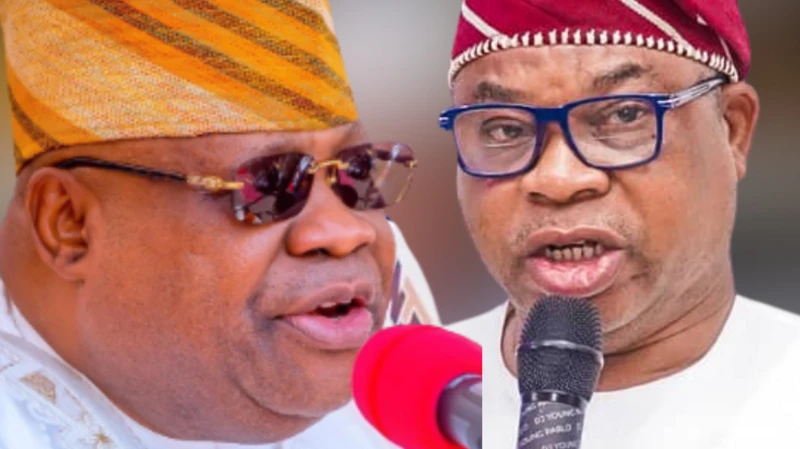
Governor Ademola Adeleke of the Accord Party and All Progressives Congress candidate Bola Oyebamiji enter the final stretch as the principal contenders, but African Democratic Congress candidate Najeem Salaam remains capable of disrupting the calculations of both camps in strategically important areas.
The Osun election battleground LGAs will therefore be crucial in determining whether Adeleke secures another term or Oyebamiji restores the APC to power in the state.
The Independent National Electoral Commission has fixed Saturday, August 15, 2026, for the governorship election.
Although all 30 local government areas matter, voting history, political personalities, candidates’ origins and recent realignments suggest that a smaller group of councils may carry disproportionate significance.
Ogele News identifies 10 areas requiring particularly close attention: Osogbo, Olorunda, Ife Central, Ife East, Ife South, Odo Otin, Iwo, Ilesa East, Isokan and Ayedaade.
Osogbo: The capital remains a major prize
Osogbo is perhaps the most obvious of the Osun election battleground LGAs.
In the 2022 governorship election, Adeleke, then running on the PDP platform, secured 30,401 votes in Osogbo against 22,952 for APC candidate Adegboyega Oyetola.
That represented an advantage of 7,449 votes for Adeleke.
The political circumstances are different four years later.
Adeleke now runs on Accord, while APC National Secretary Ajibola Basiru and other senior party figures are working to recover ground for Oyebamiji.
The Ataoja of Osogbo, Oba Jimoh Oyetunji, has publicly expressed support for Adeleke, while Salaam benefits from the political structure associated with former governor Rauf Aregbesola.
That three-way competition makes Osogbo particularly difficult to predict.
Adeleke does not merely need to win the state capital. He needs to prevent his 2022 margin from being substantially reduced.
Oyebamiji, by contrast, may not necessarily need to defeat the governor there if he can significantly narrow the gap.
Olorunda: Three political forces collide
Olorunda has a similar political character.
In 2022, Adeleke obtained 21,350 votes while APC recorded 18,709, a margin of 2,641 votes.
That was competitive enough to make Olorunda one of the Osun election battleground LGAs again in 2026.
Adeleke still enjoys substantial support around the Osogbo axis, but the APC has influential figures working to improve its performance.
Salaam also has a credible opportunity here because of Aregbesola’s continued political following.
The danger for Adeleke is vote fragmentation.
If voters who supported him against Oyetola in 2022 divide between Accord and ADC in 2026, APC could benefit even without dramatically increasing its previous vote.
This makes Olorunda one of the areas where Salaam’s performance could matter almost as much as the votes secured by either of the two frontrunners.
Ife Central: APC advantage meets Adeleke’s political network
Ife Central produced one of APC’s notable victories in 2022.
Oyetola polled 17,880 votes against Adeleke’s 13,532, giving APC an advantage of 4,348 votes.
Yet the political configuration has changed.
Adeleke’s running mate, Kola Adewusi, has influence in the Ile-Ife axis, while former PDP National Secretary Wale Oladipo is also considered part of the governor’s support network.
Oyebamiji, however, selected Benjamin Adereti, an Ile-Ife indigene, as his running mate.
That decision makes the three Ife councils some of the most intriguing Osun election battleground LGAs.
For APC, Adereti’s candidacy is designed partly to consolidate support in an area where the party performed well in 2022.
For Adeleke, improved performance in Ife Central could offset possible losses elsewhere.
Ife East: A former APC win now under pressure
Ife East was closely fought in 2022.
APC secured 19,353 votes, while PDP recorded 18,071, leaving a margin of just 1,282 votes.
Such a narrow historical margin makes the local government highly significant.
Adeleke’s camp believes its political relationships in Ile-Ife can improve on its previous performance.
Oyebamiji will be equally determined to preserve an area APC carried in 2022.
The role of former APC National Secretary Iyiola Omisore may also be closely watched because of his historical influence in Ile-Ife politics.
Among the Osun election battleground LGAs, Ife East is one where even a relatively small shift in voter preference could change the winner.
Ife South: Can Accord overturn APC’s old advantage?
Ife South was less close in 2022.
APC secured 12,481 votes while Adeleke’s PDP obtained 9,116.
But campaign alignments in 2026 have made the council competitive enough to merit attention.
Adeleke is relying on political figures within the Ife axis, while Oyebamiji expects his running mate to strengthen APC’s position.
The three Ife councils collectively could become one of the most important voting blocs in Saturday’s election.
A major sweep by either Accord or APC would substantially alter the statewide mathematics.
If the councils divide, however, attention will move towards Osogbo, Iwo and the smaller swing areas.
Odo Otin: Oyinlola versus Egbedun factor
Odo Otin produced a remarkably close result in 2022.
Adeleke’s PDP secured 14,003 votes, while APC received 13,482.
The margin was only 521 votes.
The political alignment is now even more complicated.
Former governor Olagunsoye Oyinlola and his political bloc are considered capable of strengthening APC’s position, while Osun State House of Assembly Speaker Wale Egbedun remains an important figure on Adeleke’s side.
That makes Odo Otin one of the clearest Osun election battleground LGAs.
Neither party can confidently classify it as safe territory.
A margin of a few hundred or a few thousand votes could matter enormously if the statewide race is tight.
Iwo: Adeleke seeks gains, APC fights back
Iwo was another exceptionally close council in 2022.
APC received 17,421 votes against 16,914 for Adeleke’s PDP.
Only 507 votes separated the parties.
This time, Adeleke has the support of former Secretary to the State Government Moshood Adeoti, a prominent Iwo politician.
APC, meanwhile, has its own influential political network in the area.
The closeness of the previous election means Iwo cannot safely be placed in either candidate’s column.
It is one of the Osun election battleground LGAs where turnout, grassroots mobilisation and internal party organisation could prove decisive.
For Adeleke, flipping Iwo would represent a valuable gain.
For Oyebamiji, losing an LGA APC narrowly won in 2022 could weaken his path to victory.
https://ogelenews.ng/osun-election-10-battleground-lgas-that-could-decid…
Ilesa East: The Aregbesola complication
Ilesa East offers another fascinating contest.
APC carried the council in 2022 with 13,452 votes against Adeleke’s 10,969.
On paper, that should give Oyebamiji an advantage.
But Ilesa is closely associated with former governor Rauf Aregbesola, whose political network is now relevant to Salaam’s ADC campaign.
That creates the possibility of the traditional APC vote splitting.
For that reason, Ilesa East is not simply an Accord-APC contest.
Salaam could perform strongly enough to influence who eventually takes the council.
Among the Osun election battleground LGAs, Ilesa East may provide one of the clearest examples of how a third candidate can change a two-party race without necessarily winning statewide.
Isokan: A 56-vote margin cannot be ignored
Isokan deserves particular attention even though it was not explicitly included among the eight battleground councils listed in the body of the original PUNCH analysis.
The numbers justify including it.
In 2022, APC won Isokan with 10,833 votes.
Adeleke received 10,777.
The difference was only 56 votes.
That makes Isokan one of the closest contests recorded in the previous governorship election.
It is also politically significant because Oyebamiji comes from the Irewole/Isokan/Ayedaade Federal Constituency.
The APC candidate will be expected to win convincingly within his home political base.
Anything less could signal trouble.
For Adeleke, even keeping the margin close would help limit the advantage Oyebamiji expects to accumulate in his home territory.
Isokan therefore deserves recognition among the Osun election battleground LGAs despite its geographical connection to the APC candidate.
Ayedaade: Oyebamiji’s home bloc faces a test
Ayedaade completes Ogele News’ list of 10.
APC won the council in 2022 with 14,527 votes, while Adeleke secured 13,380.
The difference was 1,147 votes.
Like Isokan, Ayedaade falls within Oyebamiji’s federal constituency.
Former governorship aspirant Dotun Babayemi, who hails from Gbongan in the area, is also considered an important political influence.
APC will be looking for a stronger advantage than it obtained four years ago.
Adeleke’s task is the opposite: prevent Oyebamiji from piling up a large home-area margin.
That arithmetic makes Ayedaade one of the Osun election battleground LGAs that could become decisive even if APC remains favoured there.
2022 numbers show how close Osun can be
History explains why these local contests matter.
In 2022, Adeleke defeated then-governor Adegboyega Oyetola by 403,371 votes to 375,027.
The statewide margin was 28,344 votes.
Adeleke won 17 of Osun’s 30 local government areas, while APC won 13.
Several councils were decided by fewer than 1,500 votes.
Iwo had a margin of 507.
Odo Otin had 521.
Isokan was separated by only 56.
Ife East had a difference of 1,282.
Those figures show why relatively modest shifts across a few Osun election battleground LGAs could change the statewide result.
Salaam may alter the arithmetic
The biggest difference between the present race and a simple repeat of 2022 is Najeem Salaam.
The ADC candidate served as Speaker of the Osun State House of Assembly for eight years and is associated politically with Aregbesola.
His strongest opportunities are considered to include Ejigbo, his home area, as well as Osogbo, Olorunda and Ilesa East.
Even if Salaam does not finish first statewide, his vote share may prove decisive.
If he takes disproportionately from voters who would otherwise support APC, Adeleke benefits.
If his support instead comes substantially from voters dissatisfied with Adeleke, Oyebamiji gains.
That third-force dynamic makes predictions more difficult.
Strongholds still matter
Battleground councils alone will not decide the election.
Adeleke must still maximise votes in his Ede strongholds, particularly Ede North and Ede South.
In 2022, he dominated both councils, winning 23,931 votes against APC’s 9,603 in Ede North and 19,438 against 5,704 in Ede South.
Oyebamiji likewise needs a strong performance across his Irewole-Isokan-Ayedaade axis and other APC-friendly areas such as Boripe.
The election could therefore come down to two questions.
How large are the candidates’ margins in their strongholds?
And who performs better in the Osun election battleground LGAs?
Ogele News perspective
The temptation ahead of Saturday’s election will be to interpret every endorsement, rally crowd and political defection as proof of impending victory.
Election results rarely work that simply.
Adeleke enters the contest with the advantages of incumbency, a visible record to campaign on and a loyal home base.
Oyebamiji has the organisational strength of the APC, influential national and state political figures and strong expectations within his home constituency.
Salaam introduces an unpredictable third force capable of disrupting both calculations.
The Osun election battleground LGAs will therefore provide the clearest indication of how these competing advantages translate into actual votes.
Osogbo and Olorunda will test the strength of Adeleke, APC and the Aregbesola political network.
The three Ife councils will test the impact of both parties’ running mates and local power brokers.
Iwo and Odo Otin will reveal whether previous narrow margins have shifted.
Ilesa East will show how deeply Salaam can penetrate territory that APC won four years ago.
Isokan and Ayedaade will test whether Oyebamiji can turn his home federal constituency into the kind of commanding base required to unseat an incumbent.
No serious analysis should pretend that all 10 councils are certain to determine the winner.
Elections remain dependent on turnout, election-day organisation and voter choices across all 30 LGAs.
But if the statewide result is close, the winner may ultimately be the candidate who loses fewer votes where he is weak and builds bigger margins where the contest remains fluid.
That is why the Osun election battleground LGAs deserve particular attention when voting begins on August 15.
https://punchng.com/osun-election-10-battleground-lgs-that-may-decide-adeleke-oyebamiji-race/