















Rotterdam tram collision
At least 15 people have been injured after two passenger trams collided on the Erasmus Bridge in Rotterdam, one of the most recognisable landmarks in the Netherlands.
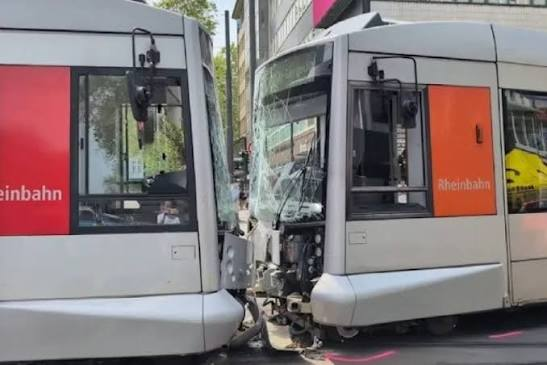
The accident occurred at about 11:10 a.m. local time on Wednesday, July 22, 2026, when a moving tram crashed into the rear of another tram that had stopped on the bridge.
The impact of the Rotterdam tram collision damaged both vehicles, threw debris across the roadway and forced one of the trams partly off the tracks.
Emergency services said one person was seriously injured and taken to hospital. Other passengers were treated at the scene for injuries of varying severity.
One victim was reportedly trapped inside one of the damaged trams and had to be freed by firefighters before being transported to hospital.
Police officers, firefighters, paramedics and other emergency personnel were deployed to the scene, while the bridge was closed to road and tram traffic to allow rescue operations and the removal of the damaged vehicles.
Second tram struck stationary vehicle
Video footage from the Erasmus Bridge showed the first tram coming to a stop before the second tram approached from behind and struck it with considerable force.
Reports indicated that the stationary tram was waiting while the movable section of the Erasmus Bridge was open.
The footage appeared to show little reduction in the speed of the approaching tram before the crash. However, the cause of the Rotterdam tram collision had not been officially established at the time of publication.
It would therefore be premature to conclude that the crash resulted from driver error, brake failure, a signalling problem or any other specific cause.
Transport investigators are expected to examine the trams’ technical systems, operational records and available video footage.
They may also interview the drivers, passengers, emergency workers and witnesses to determine the events leading to the impact.
Casualty figure revised from 18 to 15
Dutch emergency authorities initially reported that 18 people had been injured, including two who were described as seriously hurt.
The figure was subsequently revised to 15 injured, with one victim listed in serious condition.
The updated casualty figure was reported by Dutch media following clarification from the regional safety authorities.
Such revisions are common during major emergency operations because several agencies may initially count the same victim or include people who are examined but later found not to have sustained reportable injuries.
For accuracy, the official toll from the Rotterdam tram collision should be stated as 15 injured, including one seriously, unless the authorities release another update.
Early reports indicating 18 casualties should not be presented as the final figure without explaining that it was later revised.
https://ogelenews.ng/auto-draft
Passenger trapped inside wreckage
Emergency responders faced a difficult operation after one passenger became trapped inside a damaged tram.
Firefighters successfully freed the victim, who was then taken to hospital.
Images from the scene showed sections of the trams crushed by the impact, with broken components and other debris scattered across the bridge.
Paramedics treated some passengers inside the vehicles, while others received assistance on the roadway.
The seriously injured victim’s identity was not immediately disclosed, and authorities did not provide detailed information about the conditions of the other passengers.
The response to the Rotterdam tram collision included ambulances, police units and fire-service personnel. Earlier accounts also reported that a trauma helicopter was dispatched as part of the emergency response.
The number and scale of the emergency vehicles reflected the initial uncertainty about the number of casualties and the condition of passengers trapped inside the trams.Rotterdam tram collision
Erasmus Bridge closed after accident
Authorities closed the Erasmus Bridge in both directions following the collision.
The closure affected motorists, cyclists, pedestrians and public transport passengers travelling between central Rotterdam and the southern part of the city.
The bridge crosses the Nieuwe Maas river and is an important transport corridor as well as a major symbol of Rotterdam.
Its distinctive cable-supported structure has made it one of the best-known architectural landmarks in the Netherlands.
Because trams, private vehicles and other road users share parts of the crossing, an accident on the bridge can quickly cause disruption across Rotterdam’s wider transport network.
The Rotterdam tram collision therefore created consequences beyond the immediate injuries. Commuters had to use alternative routes while emergency workers secured the site and investigators began collecting evidence.
Authorities were expected to reopen sections of the bridge only after confirming that the damaged trams and scattered debris no longer presented a danger.Rotterdam tram collision
Transport operator faces urgent questions
The trams involved were operated by RET, Rotterdam’s public transport company.
The operator will be expected to cooperate fully with the investigation and explain whether the vehicles’ braking, communication and warning systems were functioning correctly.
Investigators must determine why the second tram was unable to stop before reaching the stationary tram.
They will also need to establish whether the driver received sufficient warning that another vehicle had stopped ahead.
The Rotterdam tram collision may lead to a broader review of operating procedures on the Erasmus Bridge, particularly when the bridge opens to allow vessels to pass.
Questions may be raised about whether tram drivers receive automatic signals when traffic is stationary on the crossing and whether existing safety systems can prevent a rear-end collision.
These questions should not be interpreted as proof that a system failed. They represent reasonable lines of inquiry that investigators must examine before announcing their conclusions.Rotterdam tram collision
Investigation must establish the cause
A professional investigation should consider human, technical and operational factors.
Possible areas of examination include the speed of the approaching tram, the condition of its brakes, visibility on the bridge, signalling equipment, driver communication and the interval between the two vehicles.
Investigators should also determine whether any automated collision-warning or speed-control system was available and functioning.
The video recording of the Rotterdam tram collision will provide important evidence, but footage alone cannot establish every technical detail.
It may show the movement of the vehicles, but it cannot reveal what warnings appeared inside the driver’s cabin or whether a mechanical fault occurred moments before impact.
Authorities should therefore resist pressure to announce an early conclusion before the trams’ systems have been examined.
The public will require a clear explanation, particularly because the crash occurred on a heavily used urban transport route.
Previous Rotterdam tram accidents
Rotterdam has experienced tram collisions in previous years.
In July 2025, two trams collided near Kruisplein in the city centre, leaving eight people injured. Three of those victims were taken to hospital, and police questioned one of the drivers as part of their investigation.
Another collision involving Rotterdam trams occurred on Schiekade in October 2022, causing several minor injuries.
Those incidents were separate from the latest Rotterdam tram collision and should not be used to prejudge its cause.
Nevertheless, investigators and the transport operator should examine whether the accidents reveal any recurring weaknesses involving driver training, signalling, vehicle spacing or emergency braking.
Every collision provides lessons that should be incorporated into future safety procedures.
Witness footage demands careful handling
Footage of the crash spread rapidly online after it was captured by cameras overlooking the bridge.
The recording showed the force of the impact and helped news organisations establish how the collision occurred.
However, media organisations should avoid using sensational language or repeatedly circulating disturbing images of injured passengers.
The human impact of the Rotterdam tram collision should remain central to the reporting.
The victims were ordinary passengers using public transport. Their privacy and dignity should be protected while medical personnel and relatives attend to their needs.
The investigation must also be allowed to proceed without unverified online claims being presented as established facts.
Ogele News perspective
The immediate priority after the accident is the recovery of the injured passengers, particularly the person reported to be in serious condition.
The prompt deployment of firefighters and paramedics appears to have prevented the situation from becoming worse.
However, an accident of this nature on one of Rotterdam’s busiest and most visible transport corridors demands a transparent investigation.
The Rotterdam tram collision raises legitimate questions about how one tram was able to approach and strike another vehicle that had stopped ahead of it.
Authorities must establish whether the cause was human error, mechanical failure, defective signalling or a combination of factors.
RET and the relevant safety agencies should publish their findings and explain any corrective measures introduced after the investigation.
Passengers must be able to trust that urban transport systems include sufficient safeguards to prevent one vehicle from colliding with another on the same track.
The final report should not be limited to assigning blame. It should identify practical lessons capable of preventing a similar incident.
For now, the confirmed position is that 15 people were injured, one of them seriously, after two trams collided on the Erasmus Bridge on Wednesday morning.
Until investigators establish what caused the Rotterdam tram collision, responsible reporting requires restraint, accuracy and a clear distinction between visible evidence and verified conclusions.