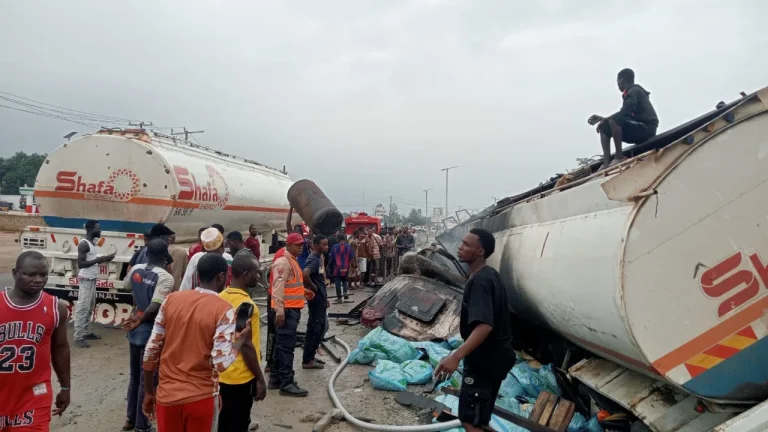
















Anambra tanker accident
AWKA, Nigeria — Two people have died and two others sustained injuries after a diesel-laden tanker was involved in a fiery road accident along the Agu-Awka axis of the Enugu-Onitsha Expressway in Anambra State, triggering an emergency response and renewing concerns over heavy-duty vehicle safety on major Nigerian highways.
The Anambra tanker accident occurred on Thursday night around the Agu-Awka section of the busy expressway, in front of Jezco Fuel Station.
The incident involved a fully loaded diesel tanker belonging to Shafa Filling Station and a 911 truck conveying bags of animal feed.
According to reports citing the Anambra State Fire Service, the tanker struck a barricade mounted around an ongoing road construction area before catching fire and exploding.
The driver and conductor of the tanker died in the incident, while two other people sustained varying degrees of injuries and were taken to hospital for medical attention.
The latest tragedy adds to a troubling series of serious truck accidents recorded on Anambra roads in recent months.
Anambra Tanker Accident Claims Driver, Conductor
Anambra State Chief Fire Officer, Chukwudi Chiketa, confirmed the casualties, identifying the deceased as the driver of the tanker and his conductor.
Firefighters were deployed to the scene following the incident and worked to contain the blaze and prevent it from spreading further.
The Anambra tanker accident presented an especially dangerous situation because of the combustible petroleum product being transported.
A tanker accident can quickly move from an ordinary road crash into a major fire emergency.
That danger becomes even greater when such an incident occurs near a filling station, businesses, residential areas or other vehicles.
Emergency responders therefore faced two responsibilities: rescuing victims and preventing the fire from escalating.
Fire Service personnel remained at the scene as efforts continued to bring the situation fully under control.
Diesel Tanker Reportedly Hit Construction Barricade
Initial accounts indicate that the tanker struck a barricade erected by a construction company along the expressway.
The circumstances leading to the vehicle hitting the barricade were not immediately established.
That distinction matters.
It would be premature to attribute the Anambra tanker accident to speeding, brake failure, reckless driving or another specific cause unless investigators establish that evidence.
Road-crash reporting should distinguish between what happened and why it happened.
What has been reported is that the diesel tanker struck the construction barricade and subsequently caught fire, resulting in an explosion.
A proper investigation should determine the sequence of events, visibility conditions, road signage, vehicle condition and other factors that may have contributed to the tragedy.
Second Truck Was Carrying Animal Feed
Another vehicle involved in the incident was described as a 911 truck loaded with bags of animal feed.
Reports of the incident indicate that both vehicles were affected by the resulting fire.
The presence of another heavy-duty vehicle increased the scale of the emergency and the potential for further casualties.
Fortunately, available reports put the confirmed death toll at two, with another two people injured.
The Anambra tanker accident also demonstrates why incidents involving petroleum tankers require particularly rapid emergency intervention.
Once petroleum products spill following a crash, ignition can produce a rapidly expanding fire.
Motorists and bystanders approaching such scenes can consequently place themselves in considerable danger.
Firefighters Battle to Prevent Escalation
The Anambra State Fire Service mobilised personnel to the accident scene.
Chiketa said firefighters continued working to control the situation and prevent further escalation following the explosion.
Their intervention was particularly important because the accident occurred close to commercial facilities.
Containing a tanker fire requires specialised firefighting techniques because petroleum fires can behave differently from ordinary structural fires.
Water alone may not always be sufficient or appropriate depending on the petroleum product involved and circumstances at the scene.
The priority is preventing the fire from spreading while rescuers establish safe access to affected vehicles and victims.
The Anambra tanker accident therefore required cooperation between firefighters, medical responders, security personnel and traffic authorities.
Enugu-Onitsha Expressway Remains Critical Economic Corridor
The location of the accident also deserves attention.
The Enugu-Onitsha Expressway is one of the most important transport corridors in the South-East.
It connects the commercial city of Onitsha with Awka, Enugu and communities across the region.
Heavy trucks, passenger buses, private vehicles and petroleum tankers use the corridor daily.
An accident involving a tanker on such a road can therefore cause consequences beyond the immediate casualties.
Traffic can be disrupted.
Commercial goods can be delayed.
Emergency vehicles can struggle to reach the scene if congestion develops.
Other motorists can also become exposed to secondary crashes.
Improving safety along the corridor is consequently both a transport and economic priority.
Construction Zones Require Strong Safety Controls
The reported involvement of a construction barricade raises an important road-safety question.
Construction zones on major highways require clear warning signs, reflective materials, appropriate lighting and sufficient advance notice to drivers.
This is particularly important at night.
Heavy-duty vehicles need substantially greater stopping distances than ordinary cars.
A truck driver approaching a construction diversion or obstruction therefore needs enough warning to reduce speed safely.
Investigators should determine whether the construction area involved in the Anambra tanker accident complied with appropriate road-safety requirements.
That question should not be answered through speculation.
But it should be investigated.
Responsibility for road safety does not rest exclusively with drivers.
Contractors, road authorities, transport companies and enforcement agencies all have obligations.
Recent Anambra Truck Crash Killed Three
The latest tragedy comes barely a month after another deadly truck accident in Anambra.
On July 17, three people died and four others sustained serious injuries when a Mercedes-Benz 608 commercial truck crashed near St. Jude Catholic Church, Adazi-Ani, along the Nnobi-Agulu-Awka Road.
The Federal Road Safety Corps said preliminary investigation showed that the truck developed a mechanical problem while moving, caught fire and went out of control.
It subsequently struck a roadside barricade, somersaulted and trapped some occupants as flames engulfed the vehicle.
Seven male occupants were involved in that crash.
Three died and four were seriously injured.
That previous incident and the latest Anambra tanker accident are separate events, but together they reinforce concerns over commercial and heavy-duty vehicle safety.
Vehicle Maintenance Cannot Be Ignored
Mechanical condition remains one of the most important safety considerations for heavy-duty vehicles.
Trucks transporting petroleum products place enormous demands on braking systems, tyres, suspension and other mechanical components.
Operators should therefore treat preventive maintenance as a fundamental safety requirement rather than an optional business expense.
The FRSC made precisely that point after the July Adazi-Ani crash.
The corps urged commercial vehicle operators to ensure their vehicles were mechanically sound before beginning journeys and emphasised regular maintenance as a way of preventing mechanical failures that can lead to devastating accidents.
That advice remains relevant following the latest Anambra tanker accident, although authorities have not yet established mechanical failure as the cause of Thursday’s incident.
Petroleum Transportation Carries Additional Risk
Tankers require an even higher safety standard because they carry potentially hazardous products.
A collision involving an ordinary truck may remain primarily a road accident.
A tanker crash can become a fire, environmental and public-safety emergency within seconds.
Nigeria therefore needs strict enforcement covering tanker maintenance, driver competence, loading practices, speed limits and the transportation of hazardous materials.
Companies operating petroleum tankers also have a responsibility to monitor their fleets.
A vehicle should not remain on the road simply because it can still move.
Brakes, tyres, electrical systems and other safety-critical components should undergo regular inspection.
The cost of poor maintenance can ultimately be measured in lives.
Emergency Response Can Determine Survival
The latest Anambra tanker accident also highlights the importance of emergency response.
The first minutes following a serious crash can determine whether injured victims survive.
Nigeria continues to face challenges with emergency medical response on many highways.
Ambulances may be unavailable.
Emergency numbers may not be widely known.
Traffic congestion can delay responders.
Bystanders frequently become the first people attempting rescues.
Community intervention can save lives, but tanker fires present exceptional dangers.
Members of the public should not approach burning petroleum tankers simply to film the incident or attempt to collect spilled products.
Secondary explosions can occur without warning.
https://ogelenews.ng/anambra-tanker-accident
Road Users Must Give Emergency Teams Space
Another recurring problem after major Nigerian road accidents is crowding.
People often gather around crash scenes.
Some attempt to record videos.
Others move close to burning vehicles.
In petroleum tanker incidents, such behaviour can become deadly.
Motorists should move away from the danger zone and allow firefighters and other emergency responders to work.
Authorities should also establish safety perimeters quickly.
The Anambra tanker accident demonstrates why emergency management requires public cooperation as much as professional response.
One uncontrolled ignition source can worsen a petroleum spill.
One secondary explosion can multiply casualties.
Investigation Should Establish Responsibility
After the fire is extinguished, the next stage should be investigation.
Authorities need to determine precisely what happened.
Was the tanker travelling at an appropriate speed?
Was the vehicle mechanically sound?
Were adequate warning signs positioned before the construction barricade?
Was the construction zone properly illuminated?
Did the tanker driver have sufficient visibility?
Did the second truck contribute to the sequence?
Those questions matter because accident investigation should do more than assign blame.
Its most useful purpose is preventing repetition.
If poor signage contributed, signage should improve.
If vehicle defects contributed, enforcement should increase.
If driver behaviour was responsible, training and sanctions should follow.
Every serious accident should produce lessons.
Road Deaths Should Not Become Routine News
There is a danger that repeated reports of fatal road crashes become normalised.
Two dead here.
Three dead there.
A tanker explodes.
A bus overturns.
Another truck loses control.
Each story appears briefly before disappearing from public attention.
But behind every casualty figure is a family.
The two people killed in the latest incident were not statistics. They were a driver and conductor who left for work and did not return.
That human reality should remain central to reporting the Anambra tanker accident.
Road deaths should not be accepted as an inevitable price of transportation.
Many crashes can be prevented through better roads, safer vehicles, stronger enforcement and responsible driving.
Ogele News Analysis: Original Headline Needs Correction
The original headline, “Two die as trucks collide, catch fire on Anambra road,” is dramatic, but based on the freshest available reporting, it risks oversimplifying the sequence of events.
Reports identify two vehicles: a diesel tanker and a 911 truck carrying animal feed.
However, the more detailed account states that the tanker hit a construction barricade before catching fire and exploding.
That is more precise than simply telling readers that two trucks collided and caught fire.
The better journalistic approach is to report only what can presently be established.
Two people died.
Two others were injured.
A fully loaded diesel tanker was involved.
A second truck carrying animal feed was also involved.
The accident occurred along the Agu-Awka section of the Enugu-Onitsha Expressway.
The tanker reportedly struck a construction barricade and caught fire.
The Fire Service responded.
Those are the established facts.
Questions about speed, mechanical failure, responsibility for the barricade or other possible causes should remain questions until investigators provide answers.
The Anambra tanker accident should also become more than another casualty report.
The reported involvement of a construction barricade provides a legitimate reason for authorities to examine safety arrangements around ongoing highway works.
At the same time, tanker operators should continuously examine the condition of vehicles transporting petroleum products.
The tragedy also comes only weeks after three people died in another fiery truck crash in Anambra.
That makes the broader road-safety question difficult to ignore.
Nigeria cannot eliminate every accident.
But preventable deaths should never be treated as unavoidable.
For the families of the driver and conductor killed in Agu-Awka, that distinction now carries a painful human cost.
https://www.frsc.gov.ng/?utm_source=chatgpt.com