













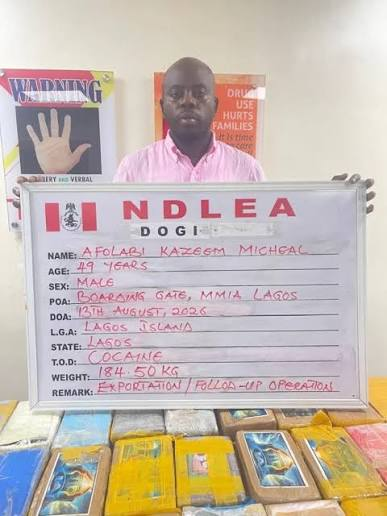
NDLEA cocaine cartel bust
LAGOS, Nigeria — The National Drug Law Enforcement Agency has announced the dismantling of an alleged international cocaine trafficking network and the arrest of social media personality and luxury goods dealer Afolabi Kazeem Michael, popularly known as KC Luxury, following the interception of 184.5 kilogrammes of cocaine in Lagos.
The NDLEA cocaine cartel bust followed what the agency described as one of its most significant narcotics investigations in recent years, exposing an alleged international pipeline stretching from South America through Nigeria to the United Kingdom, other parts of Europe and Asia.
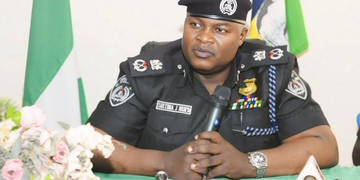
Chairman and Chief Executive Officer of the NDLEA, Brigadier General Mohamed Buba Marwa (retd.), disclosed details of the operation while addressing journalists in Lagos on Tuesday.
According to Marwa, the intercepted cocaine was valued at approximately $27.7 million, equivalent to about ₦39 billion.
The agency described the interception as the largest cocaine seizure ever recorded through a courier company in Nigeria.
Two suspects have so far been identified in connection with the investigation: Michael, better known online as KC Luxury, and Lawal Mujab Kehinde, an employee of the logistics company through which the consignment was allegedly processed.
NDLEA Cocaine Cartel Bust Begins With 184.5kg Seizure
The NDLEA cocaine cartel bust began when operatives intercepted a consignment containing 184.5kg of cocaine concealed for export through a courier logistics channel in Lagos.
The sheer quantity of the drugs prompted the agency to expand the operation beyond the immediate seizure.
Marwa said he directed the establishment of a Special Investigation Team with instructions to trace everyone connected to the shipment, including couriers, intermediaries and alleged masterminds.
That decision transformed what could have ended as another narcotics interception into a wider investigation of an alleged transnational trafficking organisation.
Working with the management of the courier company, investigators began tracing individuals and intermediary businesses connected to the shipment.
The investigation subsequently led to the identification and arrest of suspects the agency alleges played important roles in the network.
NDLEA Names KC Luxury as Alleged Nigerian Coordinator
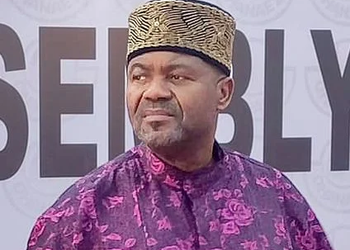
Among those arrested is Afolabi Kazeem Michael, widely known on social media as KC Luxury.
The NDLEA alleges that Michael was a major Nigerian figure in the trafficking network.
Marwa described him as the Nigerian “arrowhead” of the alleged cartel.
According to the agency, Michael publicly presented himself as a social media influencer and businessman involved in gold, jewellery and luxury goods.
Investigators allege, however, that behind that public image was an operation involved in moving cocaine internationally.
These claims remain allegations by the NDLEA and will require proof through the judicial process.
The distinction is important because an arrest, regardless of the seriousness of the accusations, does not amount to a criminal conviction.
Nevertheless, the prominence of Michael’s social media image has made the NDLEA cocaine cartel bust particularly notable.
KC Luxury Arrested at Lagos Airport
The circumstances of Michael’s arrest provide another dramatic element to the investigation.
According to the NDLEA, operatives arrested him on August 13, 2026, at the boarding gate of Murtala Muhammed International Airport in Lagos.
The agency said intelligence indicated that he was preparing to leave Nigeria aboard a business-class flight to Paris.
He was arrested before he could board the aircraft.
Investigators subsequently recovered €7,750, £2,800 and ₦100,000 in cash from him, according to the NDLEA.
The agency also reported recovering expensive jewellery.
A subsequent search of a luxury apartment linked to him on Banana Island, Lagos, led investigators to exotic vehicles and other assets, the NDLEA said.
The agency’s legal, financial and asset investigation teams are now examining property allegedly connected with the suspected trafficking operation.
Logistics Employee Also Arrested
KC Luxury was not the only suspect identified in the NDLEA cocaine cartel bust.
The agency also arrested Lawal Mujab Kehinde, an employee of the logistics company through which the cocaine consignment was allegedly processed.
According to Marwa, investigators established what the agency described as a direct and sustained relationship between Kehinde and the alleged Nigerian coordinator of the network.
The NDLEA alleges that Kehinde packaged and processed consignments for the syndicate and facilitated their movement to destinations including the United Kingdom, Europe and Asia.
He was allegedly paid in cash.
Again, those allegations remain subject to investigation and eventual judicial determination.
The involvement of a logistics employee, if proven, would illustrate one of the challenges confronting anti-narcotics agencies: trafficking organisations often depend on people with legitimate access to transportation, logistics and commercial systems.
Nigeria Allegedly Used as International Transit Point
The NDLEA cocaine cartel bust has also renewed attention on Nigeria’s vulnerability as a transit point in international drug trafficking.
According to the agency, the network under investigation moved cocaine from South America through Nigeria before sending it onwards to international destinations.
The alleged destinations included the United Kingdom, other European countries and parts of Asia.
Nigeria’s major airports, seaports, extensive commercial networks and international transport connections make the country strategically important for legitimate global trade.
Those same systems can attract transnational criminal organisations seeking routes for illicit products.
The challenge for security agencies is detecting criminal shipments without unnecessarily disrupting legitimate trade.
This is where intelligence-led operations, international cooperation and closer engagement with logistics companies become important.
https://ogelenews.ng/ndlea-busts-international-cocaine-cartel-arrests-in…
Courier Companies Emerging as Trafficking Channel
One of the most significant aspects of the NDLEA cocaine cartel bust is the alleged use of a courier logistics channel.
Marwa said trafficking organisations are increasingly looking beyond conventional routes such as airports and seaports and attempting to exploit courier and logistics networks.
This presents a different enforcement challenge.
Courier companies process enormous numbers of legitimate parcels and commercial consignments.
Criminal organisations may try to hide illicit drugs among that legitimate volume, using false identities, intermediary companies and individuals with access to logistics systems.
The NDLEA says the current case involved several such layers.
According to investigators, the network allegedly used intermediaries and companies to process the cocaine shipment.
The cooperation of the courier company’s management was consequently important in tracing the people allegedly connected to the consignment.
International Cooperation Expands Investigation
The investigation has also extended beyond Nigeria.
Marwa said some individuals linked to the same alleged syndicate had been arrested by law enforcement partners abroad.
That international dimension matters because transnational drug networks cannot be effectively dismantled by one country acting alone.
A shipment may originate in South America, pass through an African country and be distributed in Europe or Asia.
Money generated from those transactions can then move through entirely different jurisdictions.
Effective investigations therefore require information sharing among anti-narcotics agencies, border authorities, financial intelligence institutions and law enforcement organisations.
The NDLEA cocaine cartel bust demonstrates the importance of tracing not only the drugs but also the people, companies, financial transactions and assets associated with suspected trafficking operations.
₦39bn Cocaine Haul Raises Stakes
The estimated value of the seized drugs illustrates the scale of the alleged operation.
The NDLEA puts the cocaine’s value at about $27.7 million, or approximately ₦39 billion.
Authorities say the alleged cartel hoped to generate as much as ₦39 billion from international distribution of the consignment.
Such figures help explain why transnational narcotics trafficking remains attractive to organised criminal networks despite the enormous legal risks.
Drug trafficking is not simply a matter of individuals carrying small quantities through airports.
At its more sophisticated level, it can involve complex logistics, international financing, false documentation, multiple jurisdictions and individuals operating behind legitimate businesses.
That is why the financial investigation arising from the NDLEA cocaine cartel bust could prove as important as the physical seizure itself.
Assets and Financial Transactions Under Investigation
The NDLEA says its legal, financial and asset teams are examining the case with a view to prosecution and possible confiscation or forfeiture of assets established to be proceeds or instrumentalities of crime, subject to the applicable legal process.
Following money trails is an important component of dismantling organised crime.
Arresting individual suspects can interrupt an operation, but criminal networks can regenerate if their financial infrastructure remains untouched.
Authorities therefore increasingly seek to identify bank transactions, companies, property and other assets allegedly connected to illegal operations.
Any eventual forfeiture, however, must follow the law and appropriate judicial procedures.
The prosecution will also carry the burden of proving the criminal allegations against those charged.
NDLEA Records Major Drug Destruction in Lagos
The latest operation comes at a period of intensified anti-narcotics activity in Lagos.
Just a day before details of the alleged cartel investigation were announced, the NDLEA publicly destroyed more than 329,865kg of illicit drugs in Lagos.
The drugs, valued by the agency at about ₦301 billion, included cocaine, heroin, methamphetamine, cannabis, tramadol, codeine and other controlled substances.
The destruction covered seizures made by several NDLEA commands and specialised units operating in Lagos between April 2025 and May 2026.
The scale of those seizures highlights the enormous challenge confronting drug enforcement agencies.
It also provides wider context for the latest NDLEA cocaine cartel bust.
Social Media Image Should Not Replace Due Process
The involvement of a well-known social media personality will inevitably attract enormous online attention.
That attention should not replace careful reporting.
A luxurious lifestyle, social media popularity or possession of expensive property is not by itself proof of involvement in drug trafficking.
The relevant issue is the evidence investigators say connects a suspect to a criminal enterprise.
Likewise, descriptions such as “drug kingpin” should remain clearly attributed to the NDLEA until the courts determine criminal responsibility.
This distinction is especially important in the case of KC Luxury because his online profile is likely to make the story highly shareable.
Responsible journalism requires Ogele News to report the seriousness of the allegations without converting accusations into convictions.
Ogele News Analysis: The Bigger Story Is the Network
The headline attraction in this case is obvious: a social media influencer associated publicly with luxury goods has been arrested in connection with a massive cocaine seizure.
But the deeper story is bigger than one personality.
The NDLEA cocaine cartel bust raises questions about how international drug syndicates allegedly exploit legitimate courier systems, commercial businesses, social networks and international travel routes.
The seizure of 184.5kg of cocaine is significant on its own.
What may prove more consequential is whether investigators can establish the entire chain behind it.
Who supplied the cocaine?
Who financed the shipment?
Who arranged its movement into Nigeria?
Who was responsible for processing it through the logistics network?
Who was waiting to receive it in Europe or Asia?
And where would the proceeds have gone?
Those are the questions that will determine whether this operation merely intercepted one large shipment or genuinely dismantled an international trafficking organisation.
For now, the NDLEA cocaine cartel bust has produced a record courier-channel seizure and two publicly identified suspects.
The next phase belongs to investigators and, ultimately, the courts.
If the agency’s allegations are supported by admissible evidence, the case could become an important example of how intelligence, financial investigation, cooperation with private logistics companies and international law enforcement partnerships can be combined against transnational narcotics trafficking.