











Nigeria Commonwealth Games medalists
Team Nigeria has made an impressive start to the Glasgow 2026 Commonwealth Games, winning 10 medals through dominant performances in para powerlifting and weightlifting.
As of Tuesday, July 28, Nigeria’s medal haul stood at six gold and four silver medals, with all 10 podium finishes coming from individual events.
The Nigeria Commonwealth Games medalists have again demonstrated the country’s traditional strength in power-based sports, with para powerlifters delivering six medals on the opening day before conventional weightlifters added four more.
Esther Nworgu, Folashade Oluwafemiayo, Riluwan Idris, Edidiong Umoafia, Onome Didih and Rafiatu Lawal won gold medals.
Esther Oyema, Rita Ferdinand, Roland Ezuruike and Ruth Asuquo Nyong completed the list with silver medals.
Nigeria won its first six medals in para powerlifting, collecting three gold and three silver medals on the opening day of competition. The haul briefly placed the country among the leading nations on the medal table.
The tally increased when Nyong claimed silver in the women’s 48kg weightlifting event, before Umoafia, Didih and Lawal produced a clean sweep of three Nigerian gold medals in one day.
Full list of Nigeria’s 10 medal winners
1. Esther Nworgu — Gold, women’s lightweight para powerlifting
Esther Nworgu opened Nigeria’s gold-medal account with a commanding performance in the women’s lightweight para powerlifting competition.
Nworgu lifted 123kg and recorded 119 points to win the title. Her performance also produced new Commonwealth Games records.
She led a Nigerian one-two finish ahead of compatriot Esther Oyema, confirming Nigeria’s dominance in the event.
Nworgu’s victory provided the first major moment for the Nigeria Commonwealth Games medalists and set the tone for an outstanding opening day.
The official Commonwealth Games review credited Nworgu with gold and a new Games record, while Oyema finished behind her with silver.
2. Esther Oyema — Silver, women’s lightweight para powerlifting
Esther Oyema secured Nigeria’s first silver medal by finishing second behind Nworgu in the women’s lightweight category.
Oyema lifted 125kg and scored 115.5 points, finishing ahead of England’s Olivia Broome, who took bronze.
Although Oyema lifted a heavier absolute weight than Nworgu, para powerlifting medals are determined using a points formula that accounts for the athletes’ body weights.
Her performance ensured that Nigeria occupied the top two positions in the event.
Oyema’s silver added depth to the achievements of the Nigeria Commonwealth Games medalists, showing that the country had more than one world-class competitor in the same category.
3. Roland Ezuruike — Silver, men’s lightweight para powerlifting
Veteran para powerlifter Roland Ezuruike won silver in the men’s lightweight competition to secure Nigeria’s first medal of the Games.
The 50-year-old narrowly missed the gold medal after he was unsuccessful with his final attempt at a Commonwealth Games record.
Despite missing the decisive lift, Ezuruike extended a distinguished international career that has lasted nearly two decades.
His achievement carried particular significance because it showed that experience remained valuable within a Nigerian team that also featured younger champions.
Ezuruike became one of the earliest Nigeria Commonwealth Games medalists in Glasgow and helped establish the country’s momentum before the women’s finals.
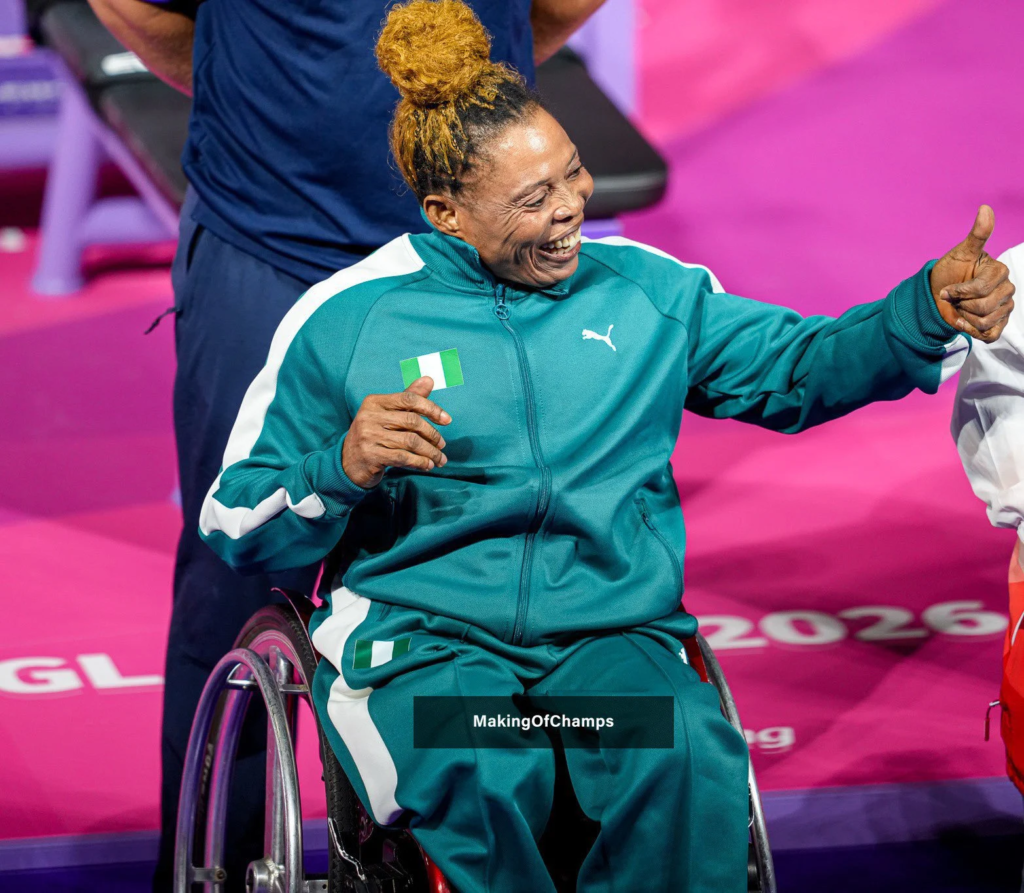
4. Folashade Oluwafemiayo — Gold, women’s heavyweight para powerlifting
Team Nigeria captain Folashade Oluwafemiayo delivered one of the country’s outstanding performances in the women’s heavyweight para powerlifting category.
The multiple world and Paralympic champion lifted 175kg and scored 134.8 points to retain her Commonwealth title.
Her lift was reported as a new world record, reinforcing her position among the finest para powerlifters of her generation.
Oluwafemiayo entered the competition as the reigning Commonwealth, world and Paralympic champion and performed under the pressure attached to that status.
Her victory was the second gold won by the Nigeria Commonwealth Games medalists on the opening day.
5. Rita Ferdinand — Silver, women’s heavyweight para powerlifting
Rita Ferdinand completed another Nigerian one-two finish by taking silver behind Oluwafemiayo in the women’s heavyweight event.
Ferdinand lifted 158kg and recorded 128.2 points.
Her lift was also reported as a world-record performance, although Oluwafemiayo subsequently produced the higher points total required for the gold medal.
The result demonstrated the exceptional standard of Nigerian women’s para powerlifting, with two athletes producing world-class performances in one final.
Ferdinand’s result gave the Nigeria Commonwealth Games medalists their second silver in a Nigerian one-two finish.
6. Riluwan Idris — Gold, men’s heavyweight para powerlifting
Riluwan Idris won Nigeria’s third gold medal in the men’s heavyweight para powerlifting competition.
He finished ahead of England’s Matthew Harding to complete a memorable opening day for the Nigerian para powerlifting team.
Idris’ victory meant Nigeria claimed three of the four para powerlifting gold medals available on the first day.
That level of dominance underlined the country’s established reputation as a global force in para powerlifting.
His gold completed the opening six-medal haul for the Nigeria Commonwealth Games medalists, leaving the delegation with three gold and three silver medals after Day One.
7. Ruth Asuquo Nyong — Silver, women’s 48kg weightlifting
Ruth Asuquo Nyong became Nigeria’s first medallist in conventional weightlifting at the Glasgow Games.
Nyong won silver in the women’s 48kg category after recording a total lift of 168kg.
She lifted 75kg in the snatch and 93kg in the clean and jerk, finishing behind India’s Mirabai Chanu, who won gold with a Games-record total.
Nyong faced intense pressure after missing her first two clean-and-jerk attempts at 93kg. She succeeded with her third and final attempt to secure the silver medal.
Her ability to recover at the decisive moment made her performance one of the most dramatic achievements among the Nigeria Commonwealth Games medalists.
8. Edidiong Umoafia — Gold, men’s 71kg weightlifting
Edidiong Umoafia began Nigeria’s golden weightlifting run by winning the men’s 71kg category.
Umoafia lifted 147kg in the snatch and 172kg in the clean and jerk for a combined total of 319kg.
He maintained the lead after Samoa’s John Tafi failed twice while attempting the 178kg clean-and-jerk lift required to overtake him.
Umoafia’s victory gave Nigeria its fourth gold medal of the Games and its first gold in conventional weightlifting.
The International Weightlifting Federation confirmed that he won the 71kg title before remaining at the venue to support his Nigerian teammates.
His success marked the beginning of three consecutive Nigerian weightlifting victories and lifted the number of Nigeria Commonwealth Games medalists to eight.
https://ogelenews.ng/full-list-nigerias-10-medal-winners-at-glasgow-2026…
9. Onome Didih — Gold, women’s 53kg weightlifting
Onome Didih won the women’s 53kg weightlifting title with a performance that included a sweep of Commonwealth records.
Didih dominated her category and added Nigeria’s fifth gold medal of the competition.
Her result followed Umoafia’s victory and increased the growing excitement around the Nigerian section of the crowd.
The International Weightlifting Federation said Didih claimed a sweep of Commonwealth records while winning the event.
She later joined Umoafia in supporting Rafiatu Lawal during the next Nigerian final.
Didih’s record-breaking performance strengthened the reputation of the Nigeria Commonwealth Games medalists as athletes capable of combining podium finishes with historic marks.
10. Rafiatu Lawal — Gold, women’s 58kg weightlifting
Rafiatu Lawal completed Nigeria’s three-gold weightlifting sweep by winning the women’s 58kg title.
Lawal dominated both sections of the competition.
She set Games records in the snatch before producing an outstanding clean-and-jerk performance.
After lifting 117kg to secure the gold medal, she successfully completed 122kg and then 126kg with her final attempt.
Her commanding performance left her well clear of the other competitors and confirmed her status as one of Nigeria’s most dependable weightlifters.
Lawal had also won Commonwealth Games gold in Birmingham in 2022, when she competed in the women’s 59kg category.
Her victory brought the list of Nigeria Commonwealth Games medalists to 10 and raised the country’s total to six gold and four silver medals at the time of publication.
Nigeria’s medal breakdown
Nigeria’s 10 medals were divided between two sports:
Para powerlifting: three gold and three silver medals.
Weightlifting: three gold and one silver medal.
The six gold medallists were Nworgu, Oluwafemiayo, Idris, Umoafia, Didih and Lawal.
The four silver medallists were Oyema, Ezuruike, Ferdinand and Nyong.
This means that 60 per cent of Nigeria’s medals at that stage were gold.
It also means all the medals were secured in strength-based sports, despite Nigeria competing in several other disciplines.
The performances of the Nigeria Commonwealth Games medalists offer both encouragement and a warning for the country’s sports administrators.
Nigeria has clearly developed world-class strength in para powerlifting and weightlifting. However, relying too heavily on a small number of sports can make the overall medal campaign vulnerable.
Para powerlifting delivers again
Para powerlifting has become one of Nigeria’s most reliable international sports.
Nigerian athletes have regularly won medals and broken records at the Paralympic Games, Commonwealth Games and world championships.
The Glasgow results showed that the country’s success is not dependent on one athlete.
Nworgu, Oyema, Oluwafemiayo, Ferdinand, Ezuruike and Idris all reached the podium.
Two Nigerian one-two finishes were recorded in the women’s lightweight and heavyweight categories.
The Nigeria Commonwealth Games medalists from para powerlifting therefore accounted for 60 per cent of the country’s first 10 medals.
That achievement should strengthen demands for better facilities, consistent funding, specialised coaching and long-term welfare support for para-athletes.
These athletes should not receive attention only when they win major international medals.
They require year-round access to equipment, medical support, competition exposure and timely payment of allowances.
Weightlifters continue the golden momentum
Nigeria’s conventional weightlifters entered the spotlight after the para powerlifters established the early momentum.
Nyong’s silver was followed by three consecutive gold medals from Umoafia, Didih and Lawal.
The three champions won in different categories and demonstrated both technical quality and mental strength.
Umoafia remained in front under pressure from Samoa’s Tafi.
Didih produced record-breaking lifts.
Lawal dominated her event and continued increasing the weight even after securing the gold medal.
The performances showed that Nigerian weightlifting still possesses the talent required to compete successfully against Commonwealth opposition.
However, the federation and sports authorities must ensure that progress is supported by strong anti-doping education, transparent selection, modern training methods and regular international competition.
Women remain central to Nigeria’s success
Seven of the 10 medallists were women.
They were Nworgu, Oyema, Oluwafemiayo, Ferdinand, Nyong, Didih and Lawal.
The female athletes won five of Nigeria’s six gold medals and three of its four silver medals.
Only Idris and Umoafia won gold among the men, while Ezuruike secured silver.
The prominence of women among the Nigeria Commonwealth Games medalists continues a familiar pattern.
At the Birmingham 2022 Commonwealth Games, Nigerian women won all 12 of the country’s gold medals. Nigeria finished that edition with 12 gold, nine silver and 14 bronze medals.
The continued success of female athletes should be matched by greater investment in women’s sports, improved welfare and more commercial recognition.
Medal tally remains subject to change
The Glasgow Commonwealth Games began on July 23 and will continue until August 2, 2026.
Nigeria is competing with a delegation drawn from several sports, meaning more medals may be added before the closing ceremony.
The National Sports Commission had announced financial rewards of $8,000 for each gold medallist, with separate rewards expected for silver and bronze winners. The commission also said Team Nigeria would receive Puma kits for the Games.
Because the competition remains ongoing, the list of Nigeria Commonwealth Games medalists should be updated immediately after every Nigerian podium finish.
Any article published under the words “full list” must include the time and date of the latest update.
Without that clarification, a list accurate in the morning may become outdated before the end of the day.
Strong start, bigger tests ahead
Nigeria’s opening 10 medals represent an excellent start, but the final assessment should wait until all events have been completed.
The country’s athletes have demonstrated courage, discipline and the ability to deliver under pressure.
They have also broken Games, Commonwealth and world records.
Yet the concentration of every medal in two sports shows that Nigeria still needs a broader high-performance system capable of producing podium finishes in athletics, boxing, wrestling, swimming and other disciplines.
The Nigeria Commonwealth Games medalists deserve recognition, financial rewards and sustained career support.
Their achievements should also force administrators to examine why some Nigerian sports consistently succeed while others struggle despite the country’s large pool of talent.
For now, the story of Team Nigeria in Glasgow is one of strength, resilience and record-breaking performances.
Six gold medals, four silver medals and 10 individual heroes have given the country a powerful opening to the 2026 Commonwealth Games.
https://www.olympics.com/en/news/commonwealth-games-2026-medal-table-live-updates