
















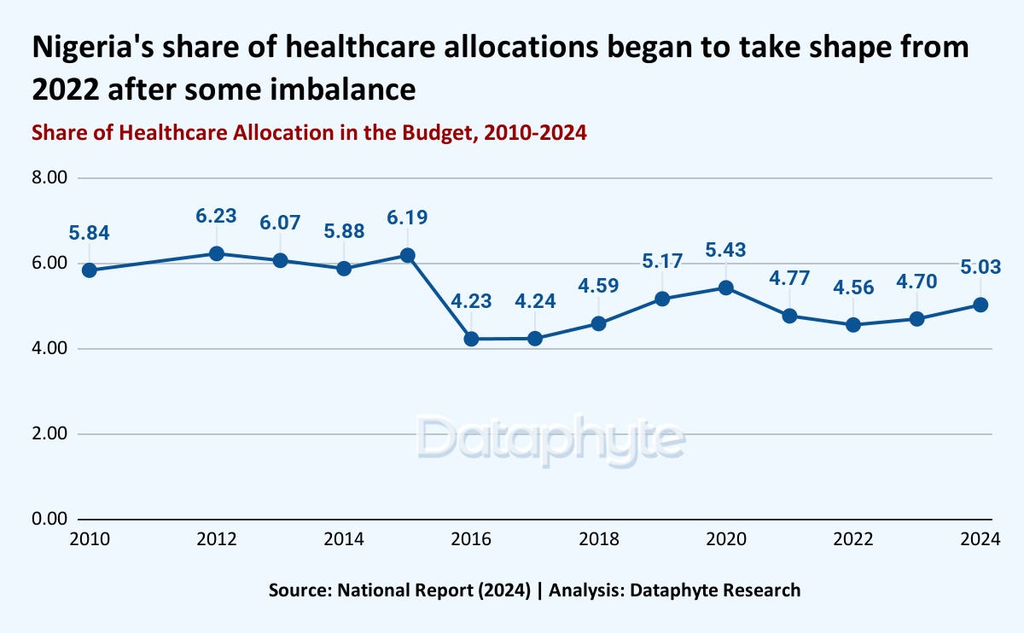
Nigeria healthcare spending
The Federal Government has introduced Health Technology Assessment as a formal mechanism for determining how limited health resources should be spent, in a significant attempt to reduce waste and ensure Nigerians receive greater value from public healthcare investment.
The National Health Insurance Authority has adopted the evidence-based system to evaluate medicines, medical devices, diagnostic procedures, treatments and other health interventions before scarce resources are committed to them.
The reform could mark an important shift in Nigeria healthcare spending, moving decision-making away from simply asking whether a treatment works to determining whether it delivers sufficient clinical benefit and value to justify its cost.
Director-General of the NHIA, Dr Kelechi Ohiri, disclosed the development during the inauguration of the Health Technology Assessment Steering Committee and the official flag-off of HTA in Nigeria.
According to the NHIA, the objective is not simply to spend less on healthcare. It is to ensure that available money is directed towards interventions capable of producing the greatest health benefits for Nigerians.
Nigeria healthcare spending enters evidence-based era
Health Technology Assessment, commonly known as HTA, provides governments and health authorities with a structured method of evaluating healthcare interventions before making major funding decisions.
It examines evidence surrounding a medicine, medical device, diagnostic test, treatment procedure or health programme.
Questions can include whether an intervention works, how safe it is, how much it costs and whether the expected health benefit represents good value compared with available alternatives.
That approach could significantly affect Nigeria healthcare spending.
Nigeria faces competing health priorities but does not possess unlimited resources to fund every medicine, technology or intervention available on the global market.
Health authorities must therefore decide where limited funding can achieve the greatest impact.
HTA provides a more systematic framework for making those choices.
Why Health Technology Assessment matters
Healthcare technology is advancing rapidly.
New medicines, diagnostic equipment, medical devices and treatment procedures enter the market every year.
Innovation can save lives, but new technology can also be expensive.
A newer or more sophisticated treatment is not automatically the best use of public money.
For example, government could face a choice between financing an extremely expensive intervention benefiting a relatively small number of patients and funding a less costly programme capable of preventing illness among thousands of people.
Those are difficult decisions.
The purpose of HTA is to bring clinical evidence, economic analysis and other relevant considerations into such choices.
For Nigeria healthcare spending, that could mean examining not merely the purchase price of an intervention but what health outcomes are achieved for the money invested.
NHIA wants greater value from limited resources
Ohiri said institutionalising HTA would help Nigeria make more transparent and consistent decisions about healthcare priorities.
The underlying principle is straightforward: limited resources should be directed towards interventions that produce meaningful benefits.
This becomes especially important in a country where government health expenditure competes with education, infrastructure, security and numerous other demands for public funds.
Every naira committed to an ineffective or unnecessarily expensive intervention is money unavailable for another healthcare need.
A stronger assessment system could therefore help identify duplication, poor-value expenditure and technologies whose benefits do not justify their costs.
But reducing waste in Nigeria healthcare spending should not be interpreted simply as cutting budgets.
An effective HTA framework can also provide evidence for spending more on interventions that demonstrate strong value.
The objective is better allocation rather than indiscriminate cost reduction.
Nigeria faces high out-of-pocket healthcare costs
The reform comes against a difficult health-financing background.
Many Nigerians still pay directly for medical treatment from household income.
In February 2026, the Federal Government said out-of-pocket expenditure accounted for about 71 per cent of total health spending, while health insurance coverage remained between approximately 10 and 13 per cent of the population.
High out-of-pocket expenditure can have severe consequences.
Families confronted with serious illness may have to borrow money, sell assets or postpone treatment because they cannot afford the cost.
Others may never reach a health facility.
Improving Nigeria healthcare spending therefore requires two things at the same time: mobilising sufficient resources and ensuring that existing resources are used efficiently.
HTA principally addresses the second challenge.
Steering Committee to guide implementation
The inauguration of the HTA Steering Committee is important because adopting the concept is easier than building an institution capable of applying it consistently.
Effective Health Technology Assessment requires expertise in medicine, epidemiology, economics, public health, statistics and health policy.
Researchers must be capable of comparing treatments, evaluating clinical evidence and analysing costs and outcomes.
There must also be clear procedures explaining how assessments influence government decisions.
Transparency will be particularly important.
Patients, pharmaceutical companies, healthcare providers and taxpayers should be able to understand the basis on which major funding decisions are reached.
Without transparent methodology, HTA could become another bureaucratic layer rather than an effective instrument for improving Nigeria healthcare spending.
Reform fits wider health-sector changes
The adoption of HTA is not occurring in isolation.
The Federal Government has introduced a series of reforms intended to strengthen accountability and improve how health resources are managed.
Under the Basic Health Care Provision Fund 2.0 framework, government has expanded funding for primary healthcare while introducing stronger accountability and monitoring requirements.
The Federal Government approved more than ₦32 billion for primary healthcare facilities earlier in 2026 as part of efforts to align financing with measurable outcomes.
Government has also strengthened cooperation between the Federal Ministry of Health and Social Welfare and the Independent Corrupt Practices and Other Related Offences Commission.
A joint task team was inaugurated in August to identify weaknesses in health-sector financial systems, close loopholes and prevent diversion or misuse of public resources.
Taken together, these initiatives show that improving Nigeria healthcare spending increasingly involves both financial accountability and evidence about what actually produces better health outcomes.
https://ogelenews.ng/fg-introduces-health-technology-assessment-to-cut-w…
Digital technology could strengthen accountability
Nigeria is simultaneously building a more integrated digital-health infrastructure.
The National Digital in Health Initiative is intended to improve electronic medical records, health-information exchange and data-driven decision-making.
President Bola Tinubu also approved the establishment of the National Health Technology and Data Analytics Office in June 2026.
The office is expected to coordinate elements of Nigeria’s digital-health agenda and help operationalise the National Digital Health Architecture.
Better data could become particularly important for HTA.
Decision-makers cannot reliably determine whether an intervention represents value for money without credible information about patients, disease patterns, treatment outcomes and costs.
Digitalisation could therefore complement the attempt to improve Nigeria healthcare spending by giving policymakers better evidence on which to base decisions.
HTA could affect medicines and medical technologies
One area where the new approach could become particularly significant is pharmaceutical expenditure.
Modern medicines can transform treatment for conditions that were once extremely difficult to manage.
Some innovative therapies, however, come with substantial price tags.
Government and health insurers must determine whether those costs are justified by the benefits delivered.
Health Technology Assessment can compare a new medicine with existing alternatives, examining whether it improves survival, quality of life or other important clinical outcomes sufficiently to justify additional expenditure.
The same principle applies to diagnostic equipment and medical devices.
Hospitals may want sophisticated technology, but acquiring expensive equipment that is poorly utilised, difficult to maintain or unsuitable for local needs can waste resources.
A disciplined assessment process can help determine whether investment is justified before money is committed.
Implementation will determine whether reform succeeds
The introduction of HTA is significant, but establishing a committee does not automatically guarantee better Nigeria healthcare spending.
The real test will come when evidence-based assessments confront powerful commercial, institutional or political interests.
Healthcare procurement can involve enormous sums.
Manufacturers naturally want their medicines and technologies purchased. Hospitals want equipment. Professionals may favour particular interventions. Political leaders may have their own priorities.
For HTA to work, technical evidence must have genuine influence over funding decisions.
Nigeria will also need sufficient numbers of trained health economists, researchers and analysts capable of conducting rigorous assessments.
The methodology must reflect Nigerian realities rather than simply importing conclusions reached in wealthier countries with different disease burdens, prices and health systems.
Patients must remain at centre of decisions
Cost-effectiveness must also be handled carefully.
Healthcare is ultimately about people, not spreadsheets.
An intervention may appear expensive while remaining essential for patients with serious or rare conditions.
A credible HTA framework therefore has to consider clinical effectiveness, patient needs, equity, ethics and affordability alongside economic evidence.
The purpose should not be to deny treatment simply because it costs money.
It should be to make difficult healthcare choices more rational, transparent and defensible.
That distinction will determine whether Nigerians see HTA as a mechanism for improving healthcare or simply another instrument for restricting access.
From spending more to spending better
Nigeria’s healthcare challenges cannot be solved by efficiency alone.
Hospitals require equipment. Primary healthcare centres need reliable supplies. Health workers need adequate training and remuneration. Millions of Nigerians still need meaningful financial protection against the cost of illness.
But increasing health budgets without addressing inefficient expenditure would solve only part of the problem.
The government’s latest reform introduces another question into public health financing: what health outcome is Nigeria actually purchasing with every naira spent?
That is the real significance of Health Technology Assessment.
If properly implemented, the system could help authorities distinguish between interventions that merely consume public money and those that genuinely improve or save lives.
For Nigeria healthcare spending, that would represent an important change.
The challenge now is to move from launching the framework to applying it consistently, transparently and independently.
Nigeria does not have unlimited healthcare resources. The test of the new system will be whether the resources it does have can reach more patients, produce better outcomes and deliver measurable value for every naira spent.