











NNPP placeholder presidential candidate
The New Nigeria Peoples Party has announced the submission of an unnamed presidential candidate to the Independent National Electoral Commission’s nomination portal ahead of Nigeria’s 2027 general election.
The opposition party described the nominee as a placeholder but declined to reveal the person’s name, raising fresh questions about its eventual choice for the presidential contest.
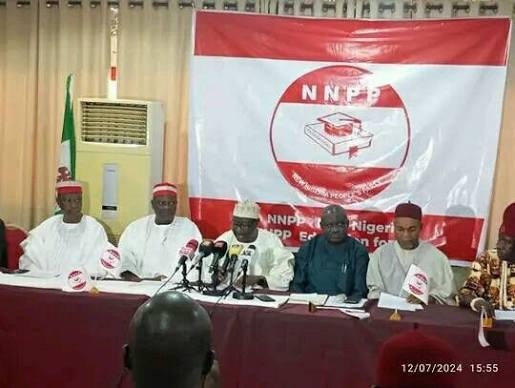
NNPP National Chairman, Dr Major Agbo, announced the development during a news conference in Abuja, saying the party had also uploaded 355 National Assembly candidates from the 36 states and the Federal Capital Territory.
The NNPP placeholder presidential candidate was submitted following a difficult period for the party, which has been divided by a prolonged battle over its leadership, identity and official logo.
Agbo said the submission was completed despite the limited time available after INEC recognised the National Working Committee under his leadership and granted it access to the candidate nomination portal.
He described the exercise as an important step in the party’s preparations for the 2027 election.
Candidate’s identity remains undisclosed
Although the NNPP confirmed that a presidential entry had been completed, it did not identify the person whose details were submitted.
Agbo said withholding the candidate’s identity was a deliberate decision by the party.
The secrecy means the public cannot yet examine the political background, qualifications or electoral strength of the NNPP placeholder presidential candidate.
It also leaves open the possibility that the person may eventually withdraw to allow the party to present another candidate, subject to the provisions of Nigeria’s electoral law and the timetable issued by INEC.NNPP placeholder presidential candidate
The term “placeholder” has become common in Nigerian political discussions, particularly when parties submit candidates before completing negotiations over alliances, running mates or internal power-sharing arrangements.
However, the term should not be misunderstood as creating an unrestricted right of substitution. Political parties remain bound by statutory conditions governing the withdrawal and replacement of candidates.
The Electoral Act provides procedures through which candidates may withdraw, while changes to a party’s list must comply with the law and deadlines established by the electoral commission.
Consequently, the NNPP placeholder presidential candidate remains the party’s submitted nominee unless a valid withdrawal and replacement are completed in accordance with the applicable rules.
NNPP uploads 355 National Assembly candidates
Apart from the presidential submission, the party said it uploaded 355 candidates for Senate and House of Representatives elections.
Agbo said some of the National Assembly entries were also placeholders.
The party completed the exercise across the 36 states and the Federal Capital Territory, although it did not immediately publish a complete list of those uploaded.
Nigeria’s National Assembly has 109 Senate seats and 360 House of Representatives seats. The figure announced by the party therefore indicates that it did not submit candidates for every federal legislative constituency.NNPP placeholder presidential candidate
The NNPP chairman attributed the incomplete coverage and hurried submission to the delay in recognising his leadership.
He said the party’s situation room worked under severe time pressure to ensure that the NNPP placeholder presidential candidate and hundreds of legislative candidates were entered before the portal closed.
The News Agency of Nigeria, PUNCH and Premium Times separately reported the figure as 355 National Assembly candidates, making it the most consistently supported number at the time of publication.
INEC’s eventual publication of the provisional and final candidate lists will provide a clearer picture of the NNPP’s submissions and the constituencies where it will participate.
https://ogelenews.ng/auto-draft
Leadership crisis shaped nomination process
The candidate submission cannot be separated from the internal struggle that has divided the NNPP since the 2023 election.
Rival groups had claimed control of the party’s leadership, structure and electoral identity.
The disagreement also involved the party’s relationship with its former presidential candidate, Senator Rabiu Musa Kwankwaso, and the faction previously recognised on INEC’s platform.
In July 2026, INEC updated its records to recognise Agbo as the NNPP national chairman. The commission also uploaded other members of his National Working Committee, including the national secretary, treasurer, financial secretary and legal adviser.
Agbo’s recognition gave his leadership control of the party’s access to the nomination portal at a critical stage of preparations for the general election.
The NNPP placeholder presidential candidate was therefore uploaded by a leadership that had only recently regained institutional recognition from the electoral commission.
Agbo has argued that the delay caused serious logistical problems for the party and reduced the period available to complete primaries, documentation and candidate submissions.NNPP placeholder presidential candidate
He said the party had instructed its lawyers to approach the Federal High Court to demand ₦10 billion in damages from INEC over what he described as delayed compliance with court orders.
That proposed legal action remains the party’s stated position. No court has awarded the NNPP the claimed amount.
Original NNPP logo restored
The party also announced that its original logo had been restored on INEC’s portal.
The emblem consists of a basket of fruits placed on a map of Nigeria.
Agbo described its restoration as a confirmation of the legitimacy of his National Working Committee and a defeat for those he accused of attempting to take control of the party.
An independent check reported by PUNCH showed the basket-of-fruits emblem displayed above the NNPP’s name on the electoral commission’s portal.
The logo dispute may appear secondary to the submission of the NNPP placeholder presidential candidate, but party symbols carry considerable importance during Nigerian elections.
Many voters identify political parties through their logos on ballot papers. A dispute over the recognised emblem could therefore create confusion among supporters, campaign officials and voters.NNPP placeholder presidential candidate
Restoring the logo before the publication of candidate lists gives the Agbo-led leadership greater control over the NNPP’s electoral identity.
Governorship candidate uploads begin
The NNPP said it had also started uploading governorship and state House of Assembly candidates.
Agbo stated that the party expected to complete that phase by August 8, 2026, before the period for withdrawals, substitutions and other permitted adjustments.
The party will have to manage the process carefully because governorship and legislative nominations often generate disputes among state chapters.
Following years of internal conflict, fresh disagreements over candidate selection could weaken the party’s preparations before campaigns begin.
The handling of the NNPP placeholder presidential candidate will also be closely watched because the eventual nominee could determine whether the party remains a significant opposition force or enters a wider political alliance.
What the submission means for 2027
Uploading a candidate is an administrative requirement, not evidence that the party has settled its political direction.
The NNPP must still explain whether the unnamed nominee will remain on the ballot, withdraw for another aspirant or serve as part of negotiations with another political group.
The party must also clarify its relationship with Kwankwaso, who contested the 2023 presidential election on its platform and built a substantial support base in Kano and parts of northern Nigeria.
Agbo has said Kwankwaso and Buba Galadima have left the party. However, the wider political consequences of that split remain uncertain.
Without Kwankwaso’s established structure, the party faces the challenge of building a nationally recognisable presidential campaign around another candidate.
The identity of the NNPP placeholder presidential candidate could therefore become one of the most consequential decisions facing the opposition party.
If the nominee is eventually replaced, the NNPP must ensure that every step complies with the law. A disputed substitution could produce litigation capable of disrupting the party’s campaign.
INEC must ensure transparency
INEC has a responsibility to publish candidate information within the period prescribed by law and allow Nigerians to scrutinise the personal particulars submitted by political parties.
The commission must also explain the status of any replacement made after the initial upload.
Transparency is particularly important where a party openly admits that the candidate entered on the portal is a placeholder.
The NNPP placeholder presidential candidate should not remain hidden indefinitely. Voters are entitled to know who has been submitted for the country’s highest political office.
Political parties may have strategic reasons for delaying major announcements, but electoral nominations are public matters governed by law rather than private arrangements.
Ogele News perspective
The NNPP deserves credit for meeting the nomination requirement despite its internal crisis and the short period it said was available.
Nevertheless, the decision to conceal the candidate’s identity creates unnecessary uncertainty.
Nigeria’s presidency is not an office for anonymous nominees. Anyone submitted to INEC should be prepared for public examination of their record, qualifications, policies and political associations.
The party should therefore disclose the identity of the NNPP placeholder presidential candidate and clearly explain the process through which the nominee emerged.
It should also avoid treating the nomination portal as a temporary storage platform for names that may be casually changed later.
The law provides regulated procedures for withdrawal and replacement, not an open-ended system for political experimentation.
As the 2027 election approaches, Nigerians will judge the NNPP not merely by its ability to upload names but by the credibility of its candidates, the stability of its leadership and the seriousness of its national programme.
For now, the party has secured a place on the nomination portal. The more difficult task is deciding who will ultimately carry its presidential flag and convincing voters that the candidate represents a genuine alternative