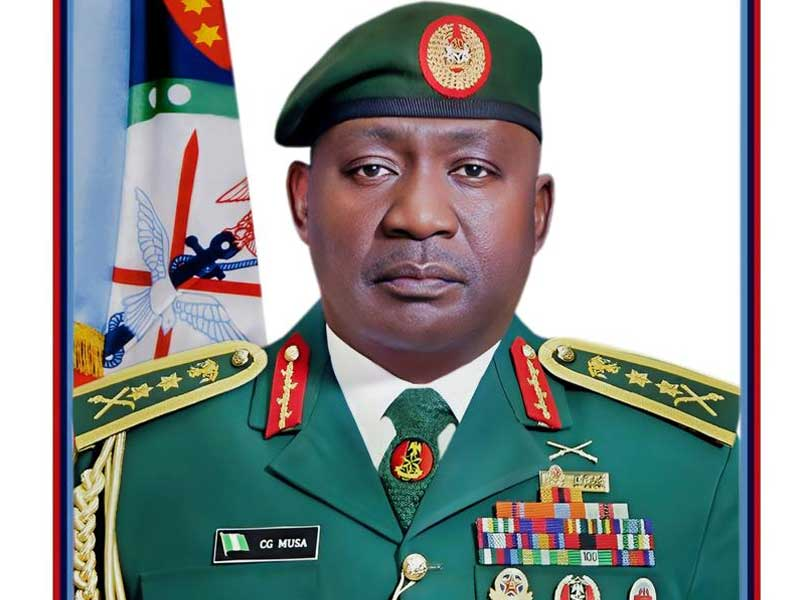
















Christopher Musa resignation rumour
Nigeria’s Minister of Defence, General Christopher Musa (retd.), has dismissed reports that he planned to resign from President Bola Tinubu’s cabinet, describing the claim as false and threatening legal action against those responsible for spreading it.
Musa spoke to State House correspondents on Tuesday after a closed-door meeting with President Tinubu at the Presidential Villa in Abuja.
The minister said he had never discussed resignation with the President or contemplated leaving the administration. He added that he was shocked when he encountered the report and did not know where it originated.
The Christopher Musa resignation rumour had circulated on online and social-media platforms before the Ministry of Defence formally issued a disclaimer rejecting it as fabricated misinformation.
Musa said those responsible would be identified and required to explain the source of their claim. However, he did not disclose whether his lawyers had already written to any individual or media organisation, and no court action had been formally announced at the time of reporting.
Minister says he is not leaving government
Addressing journalists after his meeting with Tinubu, Musa made it clear that he remained in office and had no intention of stepping down.
He said he had not held any conversation about resignation and insisted that the claim had no foundation.
The minister’s response followed an earlier statement by his Special Assistant on Media, Leah Katung-Babatunde, who described the report as malicious and entirely fabricated.
According to the Ministry of Defence, Musa remains committed to his national-security responsibilities and continues to oversee the government’s defence policies and strategies.
The ministry also urged media organisations, bloggers and social-media users to verify sensitive reports through official channels before publishing them.
The Christopher Musa resignation rumour is especially significant because it concerns the leadership of Nigeria’s defence establishment at a time when the country is confronting terrorism, banditry, kidnapping and other security threats.
False reports involving a senior security official can create unnecessary uncertainty within the government, the armed forces and the public.
However, the controversy also raises broader questions about how public officials, their media teams and professional news organisations should respond to unverified claims without amplifying them further.
Meeting with Tinubu was a security briefing
Musa said his meeting with the President was a routine briefing on the security situation across the country rather than a discussion about his position in government.
According to the minister, Tinubu expressed satisfaction with the performance of the security agencies and the progress being recorded in ongoing operations.
Musa said the administration would continue its efforts against terrorists, bandits and other criminal groups.
The minister’s arrival at the Presidential Villa while the report was circulating naturally intensified speculation about his political future. He reportedly arrived at about 3pm and left after 4pm.
But his explanation after the meeting directly contradicted the Christopher Musa resignation rumour.
A visit to the President by a defence minister should not ordinarily be treated as evidence of an impending resignation. Security briefings are a normal part of executive responsibility, especially when military operations and national-security developments require presidential attention.
Professional reporting must therefore distinguish verified facts from political speculation.
The verified facts are that Musa met Tinubu, denied planning to resign and threatened legal action. Claims about the private contents of the meeting beyond the minister’s account require independent confirmation.
Ministry had earlier rejected online report
Before Musa addressed State House correspondents, his office had issued a statement rejecting the report.
Katung-Babatunde said the online claim alleged that the minister had threatened to resign from Tinubu’s cabinet.
She described the story as false and urged members of the public to disregard it.
The statement reaffirmed Musa’s commitment to the administration and said he remained focused on strengthening Nigeria’s security architecture.
The Christopher Musa resignation rumour therefore attracted two levels of denial: an official statement from the minister’s media office and Musa’s direct response after meeting the President.
This is important because rumours involving public officials sometimes evolve rapidly. A report may begin by alleging that an official is considering resignation and later be repeated as though the resignation has already happened.
News platforms must preserve the distinction between an alleged threat to resign, an intention to resign, the submission of a resignation letter and the President’s acceptance of that resignation.
Those are separate events, and none should be reported without evidence.
Confusion may have followed previous ministerial change
The controversy occurred months after Musa replaced former Defence Minister Mohammed Badaru Abubakar.
Badaru resigned on December 1, 2025, citing health reasons. The State House publicly confirmed that President Tinubu accepted the resignation.
That earlier departure followed the proper official process: a resignation letter was sent to the President, and the Presidency issued a statement confirming its acceptance.
Musa was subsequently nominated to become Defence Minister after previously serving as Chief of Defence Staff.
The Christopher Musa resignation rumour, by contrast, was unsupported by any known letter, official announcement or confirmation from the Presidency.
This comparison demonstrates why resignation stories involving cabinet members require careful verification.
A minister does not cease to hold office simply because an online report claims that he intends to leave. Until a resignation is formally submitted and accepted—or the President removes the minister—the official remains in office.
At the time of Musa’s denial, there was no State House statement announcing his departure.
Legal threat must follow due process
Musa said those behind the report would face legal action, but a threat to sue is not the same as filing a case.
For legal proceedings to begin, the minister or his lawyers would ordinarily need to identify the publisher, determine the allegedly false statements, assess whether they caused reputational harm and file an action before a court with jurisdiction.
The defendants would then have an opportunity to respond and present any evidence supporting their publication.
The Christopher Musa resignation rumour could potentially raise questions of defamation if a court finds that false statements were published and caused reputational damage.
However, the eventual legal position would depend on the precise words used, the evidence available, the identity of the publishers and the applicable defences.
Ogele News should therefore avoid writing that Musa has “sued” the publishers unless a case has actually been filed.
The accurate description is that he threatened legal action and said the source of the report would be identified.
It would also be premature to declare any person guilty of spreading false information before investigators or a court establish responsibility.
https://ogelenews.ng/defence-minister-christopher-musa-denies-resignatio…
Security claims require stronger verification
Reports about national-security officials deserve a particularly high standard of verification.
A false report that a Defence Minister has resigned could be interpreted by the public as evidence of a crisis within the government, disagreement over military strategy or a breakdown in the President’s security team.
It may also affect morale within institutions under the minister’s supervision.
That does not mean journalists should avoid reporting legitimate disagreements or impending resignations. It means they should obtain reliable confirmation and clearly attribute information that comes from anonymous sources.
The Christopher Musa resignation rumour illustrates the danger of treating a widely shared online claim as verified news.
Repetition does not transform an unsupported claim into fact.
Before publishing a report of this nature, an outlet should contact the minister’s office, the Ministry of Defence, the Presidency or another official source capable of confirming the development.
Where confirmation cannot be obtained, the report should be labelled as unverified rather than written as an established event.
Minister links rumour to security progress
Musa argued that the resignation claim may have been promoted by people unhappy with what he described as improvements in Nigeria’s security situation.
He said security conditions were getting better and suggested that some actors wanted to weaken public confidence in the government’s progress.
That explanation represents the minister’s interpretation and should be attributed to him rather than presented as an independently established fact.
Nigeria continues to face serious security challenges across several regions. Terrorism, banditry, kidnapping, communal violence and attacks on security personnel remain matters of public concern.
The government may point to successful operations, arrests, rescues and the destruction of criminal camps, but such claims should be evaluated against reliable data and conditions experienced by affected communities.
The rejection of the Christopher Musa resignation rumour should not prevent legitimate scrutiny of the minister’s performance or the government’s security record.
False information must be challenged, but accurate criticism and evidence-based reporting remain essential in a democratic society.
Musa appeals for public cooperation
The Defence Minister thanked Nigerians for supporting security agencies and called for continued civilian cooperation in the fight against terrorism and banditry.
He described national security as requiring a whole-of-society approach.
The phrase recognises that security agencies cannot operate effectively without intelligence, community trust and cooperation from citizens.
Members of the public may provide information about suspicious activities, movements of armed groups and threats to communities. Government agencies, in turn, must protect the identities of informants and respond promptly to credible warnings.
Musa said public support had contributed to improvements and assured Nigerians that security operations would continue.
The controversy surrounding the Christopher Musa resignation rumour should not distract from the need for transparent communication between security authorities and the public.
Where official information is delayed or unclear, rumours often fill the vacuum.
Government institutions should therefore provide timely updates while avoiding the disclosure of operational details that could endanger personnel or compromise missions.
Government must not use “fake news” loosely
Although the minister’s office described the resignation story as fake, public officials should apply that label carefully.
Not every report that embarrasses the government is false. Similarly, not every story based on unnamed sources is necessarily fabricated.
The credibility of the denial in this case rests on Musa’s direct statement that he had neither discussed nor contemplated resignation, alongside the absence of an official letter or presidential announcement.
The Christopher Musa resignation rumour should therefore be reported as a disputed and denied claim.
If the minister proceeds with legal action, the case may reveal who originated the report and what evidence—if any—the publisher relied upon.
Until then, both government officials and journalists should avoid conclusions unsupported by verifiable evidence.
The Ministry of Defence should also publish corrections promptly when false information begins to circulate rather than waiting until it has become widespread.
Rumours thrive during periods of uncertainty
Cabinet speculation is common in Nigeria, particularly when there are rumours of reshuffles or public criticism of ministers.
Such an environment makes resignation claims appear believable even where no evidence exists.
Musa’s recent appointment also makes reports about his departure especially sensitive. Having served as Chief of Defence Staff before becoming minister, he occupies a central role in the administration’s security structure.
The Christopher Musa resignation rumour could therefore be interpreted as suggesting disagreement at the highest level of government.
Musa’s appearance after meeting Tinubu was intended to end that speculation.
His statement that the President was satisfied with the security briefing also projected continuity between the Presidency and the Defence Ministry.
Nevertheless, political reporters should continue to independently verify government claims rather than relying exclusively on official assurances.
Responsible journalism requires scepticism towards both anonymous online allegations and unexamined official narratives.
Social-media publishers must understand liability
The speed of social media allows claims to travel widely before those affected have an opportunity to respond.
A blogger may copy a claim from another account, while other platforms repeat it without checking the original source.
By the time an official denial appears, thousands of people may already believe that the event occurred.
The Christopher Musa resignation rumour provides another reminder that publishers can face consequences for repeating potentially defamatory statements.
Adding phrases such as “breaking,” “reportedly” or “sources say” does not automatically protect a publisher who has made no reasonable attempt to verify a serious allegation.
At the same time, legal threats by powerful officials should not be used to intimidate journalists investigating genuine matters of public interest.
The proper balance is accuracy, evidence, fair opportunity to respond and clear attribution.
Denial settles current status, not wider debate
For now, Musa remains Nigeria’s Defence Minister.
He has publicly denied resigning or threatening to resign, and the Ministry of Defence has reaffirmed that he continues to perform his duties.
No official document reviewed for this report confirms his resignation.
The immediate factual position is therefore clear: the Christopher Musa resignation rumour has been rejected by the minister and his office.
Whether Musa will proceed with the threatened court action remains to be seen. Ogele News should update the report only when a legal filing, lawyer’s notice or official investigation is confirmed.
The episode also offers a wider lesson for government communication and online journalism.
The government must respond quickly to claims capable of affecting public confidence, while media organisations must resist the pressure to publish sensitive allegations without sufficient evidence.
Musa’s denial may end the immediate speculation, but identifying the source of the story—and establishing how it spread—could become the next stage of the controversy.
Until that happens, the facts should remain separated from assumptions: Christopher Musa met President Tinubu for a security briefing, denied planning to leave office and threatened legal action against those behind the disputed report.