













Ramaphosa impeachment inquiry
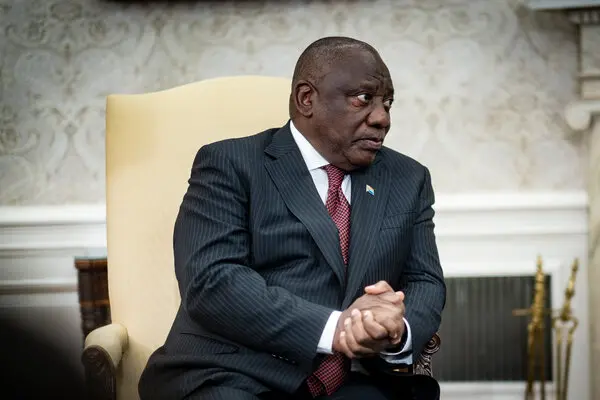
A South African court has temporarily halted Parliament’s impeachment inquiry into President Cyril Ramaphosa over the theft of $580,000 in foreign currency from his private game farm, giving the president a temporary legal reprieve in one of the most damaging controversies of his administration.
The Western Cape High Court granted Ramaphosa an interim order on Friday suspending the work of Parliament’s impeachment committee pending the hearing of his separate application challenging the report that formed the basis of the proceedings.
The substantive review has been scheduled for September 2 to 4, 2026.
The ruling means the parliamentary committee cannot continue investigating the allegations until the court decides whether the 2022 report of an independent panel should remain legally valid.
However, the order does not permanently end the Ramaphosa impeachment inquiry, clear the president of wrongdoing or prevent Parliament from resuming its work if his court challenge fails.
Ramaphosa has consistently denied misconduct. He maintains that the $580,000 stolen from furniture at his Phala Phala game farm in 2020 represented legitimate proceeds from the sale of buffaloes.
Court grants temporary suspension
The Western Cape High Court considered Ramaphosa’s urgent application before a full bench comprising Judges André le Grange, Matthew Francis and Diane Davis.
The president asked the court to suspend the parliamentary process until judges determined his challenge to the findings of the independent panel established under Section 89 of South Africa’s Constitution.
Ramaphosa argued that allowing the committee to proceed while the panel report remained under judicial review could cause him irreparable harm.
The court’s decision temporarily freezes the Ramaphosa impeachment inquiry, which had begun preparing its terms of reference and considering candidates to lead evidence against the president.
Before the ruling, the parliamentary committee had refused to stop working merely because Ramaphosa had approached the court. It was preparing to appoint an evidence leader, develop a witness list and establish a timetable for the investigation.
The interim order now prevents the committee from taking the proceedings forward until the review application is heard.
This distinction is important. The court has not ruled on the truth of the allegations. It has merely decided that the parliamentary inquiry should wait while the legal status of the panel report is determined.
What the Phala Phala scandal involves
The controversy began with the theft of foreign currency from Ramaphosa’s Phala Phala game farm in Limpopo in February 2020.
The money was reportedly concealed inside a sofa or other furniture on the property.
Ramaphosa later said the stolen sum was $580,000 and that it came from the sale of buffaloes to a foreign buyer.
The incident did not become public until 2022, when Arthur Fraser, a former head of South Africa’s State Security Agency, filed a criminal complaint.
Fraser accused Ramaphosa of concealing the theft and using state resources in an attempt to recover the money. The president rejected wrongdoing and maintained that he reported the matter to the head of his security team.
The discovery of such a substantial amount of foreign currency hidden in furniture raised questions about why the money had not been deposited in a bank, whether it had been properly declared and how the theft was handled.
These unresolved questions became the foundation of the Ramaphosa impeachment inquiry and damaged the president’s reputation as an anti-corruption reformer.
Ramaphosa came to power in 2018 promising to restore confidence in government after years of corruption allegations under his predecessor, Jacob Zuma.
The Phala Phala controversy therefore carried particular political weight because it appeared to challenge the clean-government image on which Ramaphosa had built his presidency.
Independent panel found a possible case to answer
In 2022, an independent parliamentary panel examined whether preliminary evidence existed to justify further investigation of the president.
The panel concluded that Ramaphosa may have committed serious constitutional violations and that there was a prima facie case requiring consideration by Parliament.
A prima facie finding does not amount to a final conviction or proof of guilt. It means that the available information may justify a more detailed investigation.
Ramaphosa has challenged the report, arguing that it was seriously flawed, that the panel misunderstood its responsibilities and that it relied on hearsay evidence.
The Ramaphosa impeachment inquiry depends heavily on that report because the document provided the legal and factual basis for Parliament to consider a full investigation.
If the Western Cape High Court eventually sets the report aside, Parliament may have to reconsider whether the current proceedings can continue.
If the court dismisses Ramaphosa’s challenge, the committee could resume its investigation, hear evidence and make recommendations to the National Assembly.
The September hearing will therefore determine far more than the timetable. It could decide whether the present impeachment process retains a valid legal foundation.
Constitutional Court revived the proceedings
The latest court dispute followed a major judgment by South Africa’s Constitutional Court in May 2026.
In December 2022, the National Assembly voted against adopting the independent panel’s report. At the time, the African National Congress held a parliamentary majority, and many of its lawmakers voted to protect Ramaphosa from facing a full impeachment investigation.
Opposition parties challenged that decision, accusing the ANC of using its numerical strength to shield the president.
The Constitutional Court later ruled that the National Assembly had acted irrationally when it rejected the panel report and blocked further proceedings.
It set aside the parliamentary vote and directed that the report be referred to an impeachment committee for proper investigation.
That ruling revived the Ramaphosa impeachment inquiry nearly four years after lawmakers had initially blocked it.
The court did not itself find Ramaphosa guilty or remove him from office. It held that Parliament was required to examine the allegations through the constitutionally prescribed process.
Following the judgment, Parliament established a committee to consider the evidence and determine whether grounds existed for impeachment.
https://ogelenews.ng/ramaphosa-impeachment-inquiry
Temporary order does not clear Ramaphosa
The headline “court stops impeachment” can create the misleading impression that judges have dismissed the case.
That is not what happened.
The Western Cape High Court granted an interim suspension while Ramaphosa pursues a judicial review. The court has not overturned the panel report, rejected the allegations or declared the president innocent.
The Ramaphosa impeachment inquiry remains legally alive but temporarily paused.
Ramaphosa’s office said the president noted the order and would continue cooperating with processes intended to ensure accountability.
The Presidency has maintained that no person is above the law and that allegations should be handled through due process without fear, favour or prejudice.
That position will be tested when the substantive application is heard.
Ramaphosa must persuade the court that the panel exceeded its mandate, relied on unreliable material or committed legal errors serious enough to invalidate its report.
Opposition parties and Parliament are expected to argue that the panel merely identified questions requiring investigation and that the president should answer those questions before the constitutionally established committee.
Opposition demands speedy accountability
Opposition parties have repeatedly called for Ramaphosa to face the inquiry.
The Economic Freedom Fighters and the African Transformation Movement were among those that challenged Parliament’s 2022 decision to reject the panel report.
They argued that ANC lawmakers had prevented proper scrutiny of allegations involving the president.
The Democratic Alliance, a major partner in South Africa’s coalition government, responded to Friday’s order by calling for the court review to be resolved urgently.
The party said South Africans were entitled to answers and assurance that the same standards of accountability applied to every public office-holder.
The suspension of the Ramaphosa impeachment inquiry could intensify arguments that the legal process is delaying political accountability.
However, Ramaphosa is constitutionally entitled to challenge a report he believes is unlawful.
The central issue is therefore not whether he may approach the court, but whether the proceedings can be concluded promptly without weakening either judicial review or Parliament’s oversight authority.
Impeachment would require a high voting threshold
Even if the inquiry resumes and recommends impeachment, Ramaphosa would not automatically lose office.
Under South Africa’s Constitution, removing a president for a serious constitutional violation or serious misconduct requires the support of at least two-thirds of members of the National Assembly.
Ramaphosa’s ANC lost its outright parliamentary majority in the 2024 national election but remains the largest party, controlling roughly 40 per cent of the seats.
The ANC continues to support the president.
That makes it difficult for opposition parties to secure the two-thirds majority required for his removal unless a substantial number of ANC lawmakers and coalition partners turn against him.
Political analysts therefore believe Ramaphosa is likely to survive the Ramaphosa impeachment inquiry, even if the process eventually reaches a parliamentary vote.
That political calculation should not determine whether the allegations are investigated.
An impeachment inquiry serves an accountability function beyond the final vote. It allows evidence to be tested, witnesses to be questioned and the public to understand whether a president complied with constitutional obligations.
Previous investigations produced different outcomes
The Phala Phala affair has been examined by several institutions, producing outcomes that have not always pointed in the same direction.
South Africa’s central bank investigated whether Ramaphosa had violated exchange-control regulations and concluded that he had not.
The Office of the Public Protector also cleared him of certain allegations.
However, the independent parliamentary panel found sufficient preliminary concerns to justify further examination.
These outcomes are not necessarily contradictory because the institutions considered different legal questions, operated under different mandates and applied different standards.
A central bank investigation into currency regulations is not the same as a parliamentary assessment of whether a president committed serious constitutional misconduct.
The Ramaphosa impeachment inquiry is intended to examine constitutional and political accountability, not simply whether prosecutors can prove a criminal offence beyond reasonable doubt.
Three people accused of stealing the money have also faced trial, but their prosecution does not by itself resolve questions about the source, storage or handling of the funds.
Courts and Parliament must respect separate roles
The case raises important questions about the relationship between South Africa’s judiciary and Parliament.
Parliament has a constitutional duty to hold the executive accountable. The courts have a separate duty to ensure that Parliament and the president act within the law.
Opponents of Ramaphosa’s application argued that the judiciary should not interfere unnecessarily with Parliament’s work.
The president’s lawyers argued that Parliament should not proceed on the basis of a report that is being challenged as unlawful.
A responsible resolution must respect both institutions.
The court should not decide whether Parliament ought to impeach the president. Parliament should not ignore a binding judicial ruling concerning the legality of the report before it.
By temporarily pausing the Ramaphosa impeachment inquiry, the Western Cape High Court has attempted to prevent the two processes from producing conflicting outcomes before the review is decided.
The success of that approach will depend on whether the September case is handled without unnecessary delay.
Scandal continues to damage anti-corruption reputation
Regardless of the final legal outcome, the Phala Phala affair has already caused lasting political damage.
Ramaphosa presented himself as a reformer capable of restoring ethical government after the state-capture scandals associated with the Zuma era.
The revelation that hundreds of thousands of dollars were stored in furniture at his farm created an image difficult to reconcile with ordinary financial practices.
His explanation that the money came from a legitimate buffalo sale may ultimately be accepted, but the manner in which the funds were stored and the reported response to the theft continue to attract scrutiny.
The Ramaphosa impeachment inquiry is therefore about more than the original theft.
It concerns whether the president complied with his constitutional obligations, whether state resources were misused and whether Parliament applies the same accountability standards to the country’s most powerful office-holder as it would to other officials.
South Africans require evidence rather than political slogans from either side.
Ramaphosa’s opponents should not pronounce him guilty before the inquiry concludes. His supporters should not treat a temporary court order as complete exoneration.
September hearing becomes decisive
Attention will now turn to the Western Cape High Court hearing scheduled for September 2 to 4.
The court will consider whether the independent panel’s report should be reviewed and set aside.
If Ramaphosa succeeds, the existing parliamentary process may lose its foundation or require major reconsideration.
If he fails, the Ramaphosa impeachment inquiry is likely to resume, with the committee appointing an evidence leader, identifying witnesses and establishing procedures for examining the allegations.
Either outcome may be appealed, creating the possibility of further delays.
The judiciary and Parliament should therefore ensure that the dispute is handled efficiently while preserving fairness.
South Africa cannot allow a matter involving the presidency and serious constitutional allegations to remain unresolved indefinitely.
Court victory offers only temporary relief
Friday’s order gives Ramaphosa immediate political and legal relief.
It prevents an impeachment committee from publicly examining the allegations while his challenge to the panel report remains pending.
But the ruling does not erase the $580,000 theft, answer questions about the storage of the cash or close the constitutional debate.
The future of the Ramaphosa impeachment inquiry will depend on the September review and any appeals that follow.
For the president, the task is to demonstrate through evidence that the panel’s findings were legally defective and that his explanation of the farm transaction can withstand scrutiny.
For Parliament, the responsibility is to protect its oversight powers while complying with the court order.
For South Africans, the central demand remains straightforward: a credible explanation, a lawful process and equal accountability.
The judiciary has applied the brakes, but it has not ended the journey.
Until the substantive case is decided, the accurate position is that Ramaphosa’s impeachment investigation has been temporarily suspended—not permanently cancelled.