














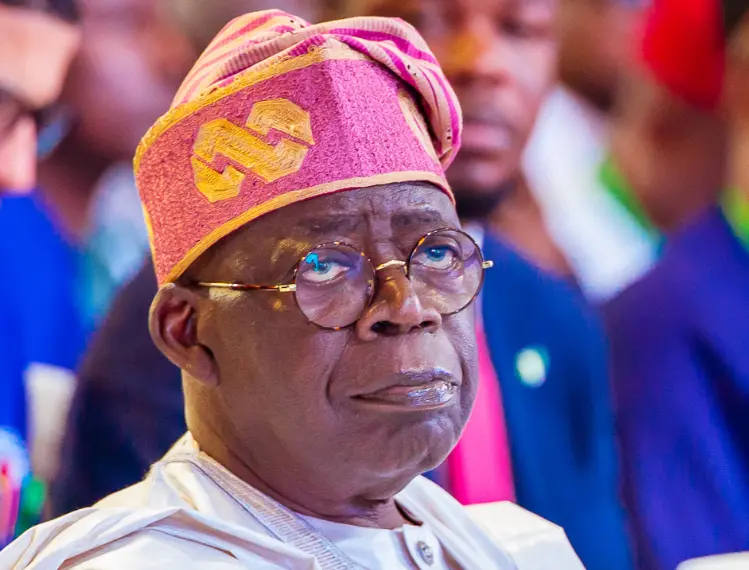
Tinubu 2027 re-election campaign
LAGOS, Nigeria — Political mobilisation for President Bola Tinubu’s second-term bid is gathering momentum as the PBAT Door-To-Door Movement, Southwest, prepares to formally launch its grassroots campaign with a 3,000-man Posterity Walk in Lagos.
The Tinubu 2027 re-election campaign event is scheduled for Wednesday at the Lagos Television premises in Agidingbi, Ikeja, where organisers expect supporters, political stakeholders and residents from across the South-West.
The movement says the walk will mark the formal commencement of its campaign for Tinubu’s re-election in the 2027 general election and demonstrate its determination to build grassroots support across the region.
Zonal Secretary of the movement, Awoyinfa Opeoluwa, announced the programme in a statement on Tuesday, saying the group intends to mobilise voters behind the President and promote what it describes as the progress recorded under his administration.
The planned Lagos event is the latest indication that political organisations supporting Tinubu are moving increasingly from endorsements to structured grassroots mobilisation as Nigeria approaches another election cycle.
Tinubu 2027 Re-Election Campaign Moves to Grassroots
The PBAT Door-To-Door Movement says the 3,000-man walk will bring together supporters from across the South-West as it begins its grassroots drive.
According to the organisation, the Tinubu 2027 re-election campaign will focus on mobilising voters and building public support for the continuation of the President’s administration beyond 2027.
The South-West carries particular political significance for Tinubu.
The President was Lagos State governor between 1999 and 2007 and has maintained a substantial political network across the region.
Beginning the movement’s campaign in Lagos therefore carries both practical and symbolic significance.
But the political environment ahead of 2027 is considerably broader than the President’s traditional base.
The central challenge for pro-Tinubu groups will be converting organised rallies, endorsements and public demonstrations into votes when Nigerians eventually return to the polls.
3,000 Supporters Expected at Posterity Walk
Organisers expect approximately 3,000 participants at Wednesday’s event.
The Posterity Walk is designed as a public demonstration of support while simultaneously serving as the formal launch of the group’s Tinubu 2027 re-election campaign.
Opeoluwa said the organisation is committed to ensuring that what it regards as Tinubu’s vision and progress continue.
The group also intends to use the event to strengthen its grassroots network across the six South-West states.
Those states are Lagos, Ogun, Oyo, Osun, Ondo and Ekiti.
The mobilisation effort suggests that support groups are beginning to organise well before the formal 2027 presidential contest reaches its peak.
That early mobilisation could become important as political parties, candidates and opposition coalitions begin competing for voters.
Support Groups Intensify Tinubu Mobilisation
The PBAT Door-To-Door Movement is not operating alone.
Several political organisations have already begun mobilising support for the President’s re-election.
Earlier this month, former Speaker of the House of Representatives Yakubu Dogara pledged support for grassroots mobilisation in Bauchi and across the North-East during the inauguration of the Tinubu Support Bauchi 2027 movement.
Pro-Tinubu organisations have also moved into the South-East.
Groups including the City Boy Movement and Renewed Hope Movement recently embarked on a tour of universities and communities in the region, targeting youths and students as part of their mobilisation strategy.
In June, another organisation affiliated with the broader Tinubu support network mobilised women and young people in Abuja while declaring support for the President’s second-term ambition.
Taken together, these activities suggest that the Tinubu 2027 re-election campaign is developing through multiple support organisations rather than relying solely on formal party structures.
South-West Remains Critical to Tinubu’s Strategy
The South-West will inevitably be an important part of the President’s re-election calculations.
Tinubu’s political career is deeply rooted in Lagos, and the region has historically been central to the political organisation that eventually developed into the All Progressives Congress.
But electoral politics can change quickly.
Support groups cannot assume that historical political loyalty automatically guarantees future votes.
Economic conditions, security, employment, food prices and public perceptions of government performance are likely to influence voters far more directly as the election approaches.
The Tinubu 2027 re-election campaign will therefore have to make a case based not simply on regional affinity but on the administration’s record.
That will become particularly important among young voters who may judge candidates primarily by economic opportunities and living conditions.
Osun Result Adds New Dimension
The timing of the Lagos mobilisation is particularly interesting because it comes just days after the August 15 Osun governorship election.
Governor Ademola Adeleke defeated the APC candidate, Bola Oyebamiji, in the election, according to results reported following the poll. The African Democratic Congress subsequently said it had cooperated with Adeleke’s Accord Party to prevent the APC from winning.
The outcome provides an important reminder that the South-West should not automatically be treated as a politically uniform bloc.
For pro-Tinubu groups, this strengthens the argument for early grassroots mobilisation.
The Tinubu 2027 re-election campaign will have to compete for voters state by state, community by community and ultimately polling unit by polling unit.
Public walks can create visibility, but elections are won through actual voter mobilisation.
Opposition Also Preparing for 2027
Tinubu’s supporters are not the only political forces preparing for the next presidential election.
Opposition politicians and parties are also discussing alliances, candidate selection and strategies for challenging the APC.
The ADC’s reaction to the Osun election provides an early indication of one possible opposition strategy.
Its National Publicity Secretary, Bolaji Abdullahi, said the party’s cooperation with Accord demonstrated that opposition parties could potentially defeat the ruling APC when they work together.
Whether that kind of cooperation can be replicated nationally remains uncertain.
Presidential elections involve considerably more complicated negotiations over candidates, regional interests, party structures and political ambitions.
Nevertheless, the possibility of opposition cooperation means the Tinubu 2027 re-election campaign is likely to face an organised challenge rather than an uncontested political field.
Economy Likely to Shape 2027 Debate
Campaign organisations can mobilise supporters, but the performance of the economy will likely have a major influence on the presidential contest.
Tinubu’s administration has implemented significant economic reforms since 2023.
Supporters point to infrastructure projects, fiscal reforms, local government financial autonomy, student loans, agricultural interventions and other government programmes as evidence that the administration deserves additional time.
Support organisations have increasingly built their mobilisation messages around those policies.
Critics, however, are likely to focus on the cost of living and the economic pressures experienced by households.
That means the Tinubu 2027 re-election campaign will eventually become a debate over whether the administration’s reforms have produced sufficient improvements in ordinary Nigerians’ lives.
Rallies can generate political energy.
Economic conditions can determine whether that energy survives until election day.
Youth Vote Will Be Fiercely Contested
Another important battleground will be Nigeria’s young population.
Recent pro-Tinubu mobilisation in the South-East has specifically targeted university students and young people.
That is unlikely to be accidental.
Young Nigerians have become increasingly important to political communication, particularly through social media.
They also represent a large segment of the voting population.
The challenge for political organisations is that young voters cannot always be reached through conventional rallies and endorsements.
Employment, education, entrepreneurship, technology, insecurity and economic opportunity are likely to feature strongly in their political choices.
The Tinubu 2027 re-election campaign will therefore need more than slogans if it intends to win over undecided young voters.
https://ogelenews.ng/tinubu-2027-re-election-campaign
Door-to-Door Strategy Signals Shift Beyond Rallies
The name PBAT Door-To-Door Movement itself reveals something about the group’s intended strategy.
Door-to-door campaigning involves taking political messages directly into communities rather than relying exclusively on mass rallies.
That approach can be effective because national elections are ultimately decided by individual voters.
Grassroots campaigners can explain policies, distribute campaign materials, identify supporters and encourage voter turnout.
The 3,000-man Posterity Walk therefore appears designed partly to demonstrate the organisational strength required for a wider mobilisation programme.
If the group follows through with sustained community-level engagement, its activities could become one component of the broader Tinubu 2027 re-election campaign architecture in the South-West.
Support Groups Must Distinguish Campaign Claims From Facts
As political mobilisation intensifies, another responsibility falls on support groups and the media.
Claims about government achievements should be independently verifiable.
Campaign organisations naturally present the candidates they support in favourable terms.
Opposition organisations do the reverse.
Neither should automatically be treated as an objective source.
For Ogele News and other media organisations, the approaching election cycle will require careful separation between political statements and independently established facts.
If a support group says a government policy has succeeded, that claim should be attributed.
If the opposition says a policy has failed, that should also be attributed.
The same standard must apply across the political divide.
Campaign Season Will Test Nigeria’s Political Discourse
The 3,000-man Lagos walk may appear relatively modest within the scale of national politics, but it represents an early sign of what is coming.
Support organisations will hold rallies.
Opposition groups will organise.
Politicians will travel across the country.
Social media campaigns will intensify.
Endorsements, defections and alliances will dominate headlines.
The Tinubu 2027 re-election campaign will increasingly compete with alternative political projects for public attention.
The quality of that competition matters.
Nigeria benefits when elections are fought over policies, records, competence and competing visions for government.
It gains little when campaigns descend into ethnic hostility, misinformation or violence.
Political support groups therefore carry a responsibility not only to mobilise voters but to do so peacefully.
Ogele News Analysis: A Walk Is Visibility, Not Yet Votes
The original headline, “Tinubu support group kicks off 2027 campaign with 3,000-man walk,” is strong but slightly premature.
At the time the story was published on Tuesday, August 18, the walk had been announced for Wednesday. It had not yet occurred.
A more precise headline should make that distinction clear.
More importantly, the story should not be treated simply as another political rally.
The significance lies in what it tells us about the approaching 2027 contest.
Tinubu’s supporters are organising early.
Groups are mobilising in the South-West, North-East and South-East. Opposition politicians are also testing cooperation and electoral strategies.
The campaign is beginning to move from endorsements by political figures towards organised grassroots activity.
But the central test for the Tinubu 2027 re-election campaign will not be the number of people who attend a walk in Lagos.
It will be whether the administration can persuade Nigerians that conditions have improved sufficiently to justify another four years.
For the opposition, the challenge will be equally demanding: transforming dissatisfaction into a coherent electoral alternative capable of competing nationally.
Wednesday’s 3,000-man walk therefore represents one small part of a much larger contest.
The road to 2027 is beginning to take shape, and Lagos is once again one of its starting points.