














Tinubu 2027 re-election
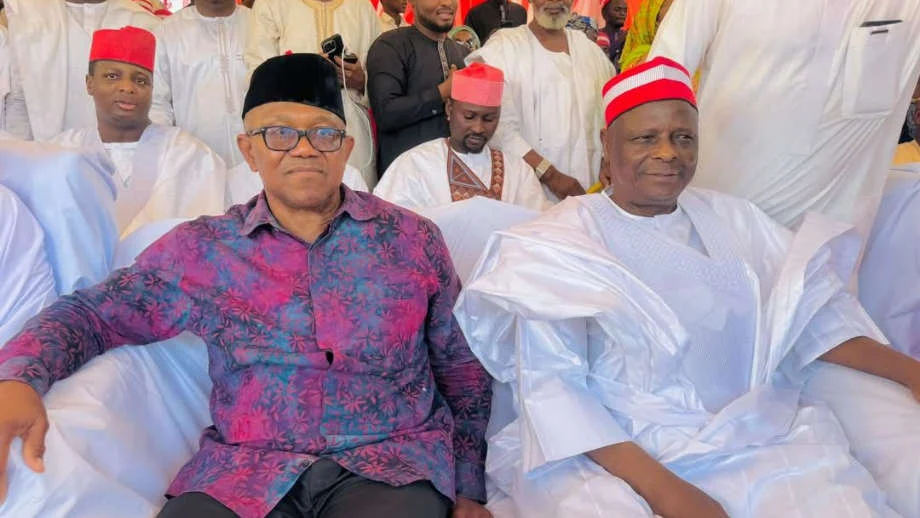
The Federal Government has dismissed predictions by Peter Obi and Rabiu Kwankwaso that President Bola Tinubu can be defeated in the next presidential election, declaring that the ruling All Progressives Congress remains confident of victory as the battle over the Tinubu 2027 re-election bid intensifies.
Defence Minister Christopher Musa pushed back against suggestions that the APC was losing political ground, particularly in northern Nigeria, insisting that the ruling party remained capable of winning the presidency and other major contests.
Musa spoke on Channels Television’s Politics Today on Thursday as Obi and Kwankwaso stepped up their campaign against the administration and challenged the political calculations behind the Tinubu 2027 re-election campaign.
The exchange offers an early glimpse of what is rapidly becoming one of the defining arguments of the 2027 race: whether the enormous advantages of incumbency and the APC’s expanding political structure will translate into votes when Nigerians return to the polls.
FG confident Tinubu will win 2027
Musa rejected suggestions that growing dissatisfaction in parts of northern Nigeria could cost the APC the election.
Asked about the party’s prospects in Kaduna State, the minister expressed confidence that the APC would prevail at the presidential, governorship and other levels.
He also disputed claims that President Tinubu had suffered irreversible political damage in the North.
According to Musa, some of the opposition to the administration reflected perception and political sentiment rather than an accurate assessment of the government’s standing.
The minister defended some of Tinubu’s difficult economic decisions, arguing that their benefits were emerging gradually and would become clearer to Nigerians with time.
That argument is likely to form a central pillar of the Tinubu 2027 re-election campaign.
The administration has repeatedly presented its economic reforms as difficult but necessary measures intended to address longstanding structural problems. The political question is whether voters who have experienced the immediate costs of those policies will accept that argument when casting their ballots.
Obi says voters will defend their ballots
Peter Obi, who is contesting the presidency on the platform of the Nigeria Democratic Congress, offered a sharply different assessment during a town hall meeting in Port Harcourt.
He told supporters that voters must be prepared to ensure their ballots are protected and counted.
Obi argued that intimidation at polling units would be more difficult if voters remained organised and determined to protect the electoral process.
He also returned to concerns surrounding the use of technology in election result management, particularly the INEC Result Viewing Portal.
The opposition candidate’s comments indicate that electoral integrity will feature prominently in the campaign against the Tinubu 2027 re-election bid.
Obi contested the 2023 presidential election on the Labour Party platform and finished third according to the results declared by the Independent National Electoral Commission.
INEC’s official 2023 election report shows that Tinubu received 8,794,726 votes. Atiku Abubakar of the Peoples Democratic Party received 6,984,520, while Obi secured 6,101,533 votes.
Obi challenged the outcome after the election, but Tinubu’s victory ultimately survived the legal challenges brought against it.
The 2027 contest, however, presents a substantially different political configuration.
Kwankwaso invokes Jonathan’s 2015 defeat
Rabiu Kwankwaso, Obi’s running mate, attacked another assumption surrounding the Tinubu 2027 re-election campaign: that control of a large number of state governments gives the APC an overwhelming advantage.
The former Kano State governor argued that history shows an incumbent President can lose despite possessing considerable political machinery.
His example was Goodluck Jonathan.
Jonathan entered the 2015 presidential election as the sitting President but was defeated by Muhammadu Buhari, producing Nigeria’s first presidential transfer of power from an incumbent party to the opposition.
Kwankwaso said those who believe the APC cannot lose because it controls more than 30 governors could be making a serious political mistake.
His argument is straightforward: governors matter, political structures matter and incumbency matters, but ultimately none guarantees victory.
That historical comparison is uncomfortable for any ruling party because 2015 demonstrated that a sufficiently powerful national opposition movement can overcome the institutional advantages associated with incumbency.
Whether today’s opposition can reproduce the conditions that existed in 2015 is another question entirely.
APC dismisses opposition confidence
The APC has rejected the opposition’s predictions.
Party National Secretary Ajibola Basiru described claims that Tinubu would lose as wishful thinking and expressed confidence that Nigerians would return the President to office.
The ruling party also has its own historical example.
While Jonathan lost as an incumbent in 2015, Muhammadu Buhari successfully secured re-election in 2019.
Both sides can therefore find Nigerian electoral history that supports their argument.
For supporters of the Tinubu 2027 re-election campaign, incumbency combined with the APC’s extensive national structure gives the President a formidable platform.
For Obi and Kwankwaso, however, 2015 proves that neither the presidency nor control of state governments can substitute for votes.
https://ogelenews.ng/tinubu-will-win-2027-fg-fires-back-at-obi-kwankwaso
Tinubu already carries APC ticket
The argument is no longer about whether President Tinubu intends to seek another term.
He has already emerged as the APC’s presidential candidate.
In May 2026, Tinubu received the party’s certificate of return and flag following the APC presidential primary process.
The President subsequently pledged to consolidate his administration’s economic reforms if elected for another four years.
That formal nomination has moved the Tinubu 2027 re-election project from speculation into an active electoral campaign.
The opposition must therefore persuade Nigerians that the administration has failed to justify another term, while the APC must convince voters that the hardships associated with its reforms are producing results worth preserving.
That is likely to be a much harder argument than campaign slogans from either side suggest.
The North could become a major battleground
Musa’s comments about Kaduna and northern Nigeria are politically significant.
The North has historically been central to presidential arithmetic because of its population, number of registered voters and ability to deliver large electoral margins.
Kwankwaso also possesses an established political following in Kano and other parts of the region.
In the 2023 presidential election, he contested on the New Nigeria Peoples Party platform and received 1,496,687 votes nationwide, with Kano providing the centre of his electoral strength.
His presence alongside Obi in the current opposition arrangement therefore changes some of the calculations surrounding the Tinubu 2027 re-election contest.
But political arithmetic on paper does not automatically become votes.
The opposition will need organisation, agents, financing, grassroots structures and turnout across thousands of communities. The APC, meanwhile, will have to demonstrate that its dominance among political officeholders reflects support among ordinary voters.
Those are two very different things.
2023 numbers provide important context
The 2023 results also show why the coming election cannot simply be reduced to the number of governors controlled by either camp.
Tinubu won with 8.79 million votes in an election in which the three leading opposition challengers collectively secured substantially more votes than the eventual winner.
That does not mean those votes can simply be combined in another election. Nigerian voters do not belong permanently to politicians, and alliances at leadership level do not guarantee that supporters will transfer their votes accordingly.
But it explains why opposition consolidation has become central to calculations about the Tinubu 2027 re-election campaign.
The ruling party understands that arithmetic as well.
Its response has been to expand its political reach, defend the administration’s economic record and present Tinubu as the candidate capable of consolidating reforms already under way.
Economy may matter more than political arithmetic
For all the arguments about governors, coalitions and regional voting blocs, the economy could ultimately prove more important.
Millions of Nigerians will judge the election through their own experience of food prices, transportation, employment, security, electricity, business conditions and household income.
The administration argues that Tinubu inherited serious structural problems and took painful decisions that previous governments avoided.
The opposition’s counterargument is that Nigerians should judge those policies by their effect on everyday life.
That contest over lived experience could prove decisive in the Tinubu 2027 re-election battle.
A government can control governors without controlling public opinion. An opposition coalition can command large rallies without converting enthusiasm into sufficient votes.
Both sides still have to persuade the electorate.
2027 battle taking shape
The latest confrontation between the Federal Government, Obi and Kwankwaso shows that Nigeria’s next presidential election is already moving beyond preliminary positioning.
The lines are becoming clearer.
The APC will campaign on continuity, reform, political reach and the argument that Tinubu’s difficult decisions require more time to produce their full benefits.
Obi and Kwankwaso will seek to turn economic hardship, concerns about governance and demands for electoral accountability into a national case for change.
Neither argument has been settled.
Kwankwaso is correct that Nigeria has previously removed a sitting President through the ballot box. The APC is equally correct that incumbency does not automatically mean defeat, as Buhari’s 2019 re-election demonstrated.
Ultimately, the Tinubu 2027 re-election question will not be decided by the number of governors standing behind the President or by the confidence of opposition leaders.
It will be decided by Nigerian voters.
Between now and election day, both camps must make their case to an electorate that has heard promises before and will increasingly demand evidence of what another four years under either political direction would actually mean for their lives.