
















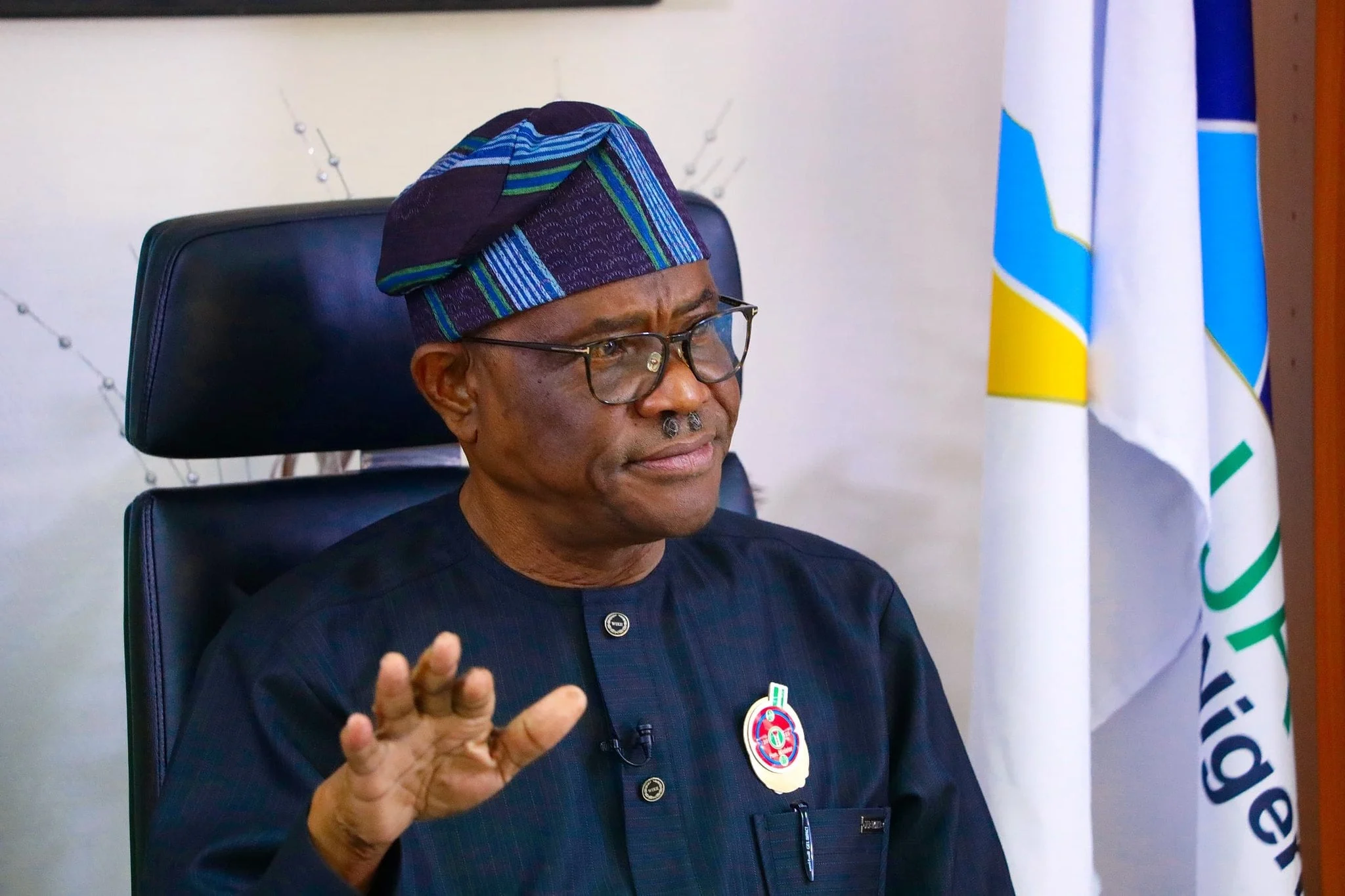

Wike APC governors rift
Fresh political calculations are unfolding within the All Progressives Congress as the disagreement between the Minister of the Federal Capital Territory, Nyesom Wike, and governors elected on the ruling party’s platform deepens ahead of the 2027 general elections.
The dispute centres on Wike’s Rainbow Coalition, a cross-party political arrangement through which the FCT minister is mobilising support for President Bola Tinubu’s re-election while maintaining that politicians should remain free to support candidates of their respective parties in governorship and legislative elections.
Some APC governors reject that formula.
They insist that support for the President should go together with support for APC candidates at every level, creating a fundamental disagreement over what an alliance for Tinubu should mean in practical electoral terms.
The Wike APC governors rift has consequently developed into a wider debate over party loyalty, state-level contests, National Assembly seats and the political structure that will support Tinubu’s re-election campaign.
Some APC stakeholders are now reportedly considering their options as party leaders attempt to prevent the disagreement from becoming a more damaging internal crisis.
Wike APC governors rift centres on Rainbow Coalition
At the centre of the dispute is a political arrangement that would have appeared unusual under conventional party politics.
Wike remains a leading figure in the Peoples Democratic Party while serving as FCT minister in an APC-led Federal Government.
He has repeatedly declared support for Tinubu’s re-election in 2027.
But that support does not mean Wike intends to campaign for every APC candidate.
Under his Rainbow Coalition concept, politicians from different parties can support Tinubu for President while continuing to back candidates from their own political parties for governorship, Senate, House of Representatives and other offices.
Wike argues that Nigeria has already experienced this form of cross-party voting.
He points to the 2023 elections, when members of the PDP’s G5 governors opposed their party’s presidential candidate while continuing to support PDP candidates in other races.
In Rivers State, Wike’s political structure backed Tinubu for President while supporting PDP candidates in National Assembly and state elections.
He believes a similar arrangement can work in 2027.
APC governors disagree.
APC governors insist on party-wide support
The Progressive Governors Forum has publicly distanced itself from political arrangements that could weaken APC candidates.
Its chairman, Imo State Governor Hope Uzodimma, has said the governors remain committed to their party and will support APC candidates at all levels.
That position goes directly to the heart of the Wike APC governors rift.
From the governors’ perspective, it would be politically contradictory to mobilise voters for Tinubu at the top of the ballot while simultaneously helping opposition candidates defeat APC governorship and legislative candidates.
The governors have therefore argued for a conventional party structure in which APC members campaign for the APC presidential candidate alongside the party’s other candidates.
Wike maintains that such an approach ignores local political realities.
His argument is that politicians supporting Tinubu should not automatically be expected to abandon their own parties or candidates.
That disagreement has turned what began as an unusual political alliance into one of the major internal strategic questions surrounding the ruling party’s preparations for 2027.
Some APC figures reportedly weighing alternatives
The latest development is that some APC leaders and stakeholders are reportedly reassessing their political options.
According to party sources cited in reports, concerns have emerged among some governors over the potential consequences of Wike’s political activities for APC candidates in their states.
Some unnamed stakeholders have even suggested that alternative presidential alignments could be considered if the dispute remains unresolved.
Such claims require careful treatment.
No formal resolution by the APC governors or National Working Committee abandoning Tinubu’s candidacy has been announced.
The publicly stated position of the Progressive Governors Forum remains support for the APC and its candidates.
The reports about alternative options therefore represent internal discussions and claims attributed to unnamed political sources rather than an official change in party position.
Nevertheless, their emergence demonstrates how seriously some actors are treating the Wike APC governors rift.
Wike says governors have their own interests
Wike has responded by arguing that the governors’ opposition to his coalition is not primarily about protecting Tinubu.
He alleges that some governors are concerned about controlling APC tickets and influencing the composition of the next National Assembly.
The FCT minister has specifically accused some governors of attempting to determine which politicians emerge as senators and members of the House of Representatives.
He has also alleged that the struggle is connected to future contests over the Senate Presidency and Speakership of the House of Representatives.
Those are Wike’s allegations.
The governors have publicly framed their position differently, saying they are protecting the interests of the APC and its candidates.
That distinction is important.
The Wike APC governors rift should not be reduced to claims about personal motives that have not been independently established.
What is publicly established is that the two sides disagree over whether a coalition supporting Tinubu can simultaneously campaign against APC candidates in other elections.
Uzodimma becomes central figure in dispute
Hope Uzodimma has become one of the most prominent figures in the disagreement.
As chairman of the Progressive Governors Forum, he has articulated the governors’ position that their political commitment is to APC candidates.
Wike, however, has directly challenged the Imo governor.
The FCT minister alleged that Uzodimma’s opposition to the Rainbow Coalition is connected to future political ambitions, including the Senate Presidency.
Wike went further by saying he would not support Uzodimma for such a position.
Uzodimma’s camp and the governors’ forum have maintained their broader argument that party leaders have a responsibility to protect APC candidates.
The dispute therefore contains two overlapping dimensions.
One concerns the principle of party loyalty.
The other involves the personal political relationships and future ambitions of influential actors.
Ogele News cannot independently establish the motivations attributed to either side, so those claims must remain clearly attributed.
https://ogelenews.ng/2027-apc-leaders-weigh-options-as-wike-governors-cl…
South-East APC backs governors
The disagreement has also spread beyond the governors themselves.
APC leaders in the South-East have publicly supported the Progressive Governors Forum and criticised Wike’s comments about governors opposed to his coalition.
Party leaders in the zone argued that APC governors have a responsibility to protect the interests of their party and candidates.
They also demanded that Wike withdraw comments they considered disrespectful to the governors.
That intervention demonstrates how the Wike APC governors rift is gradually drawing other sections of the ruling party into the debate.
What began as a disagreement over electoral strategy is now producing public responses from regional party structures.
This increases pressure on the APC national leadership to define its own position.
APC leadership seeks political settlement
The APC National Working Committee is reportedly attempting to prevent the dispute from escalating further.
Party sources say the national leadership intends to engage the President and other principal actors in search of a political settlement.
Earlier reports had indicated that Tinubu could personally intervene in the disagreement.
The President’s role is particularly important because both sides publicly say they support his re-election.
This makes the dispute unusual.
It is not principally a contest between one group supporting Tinubu and another opposing him.
It is a disagreement between political actors who say they want the same presidential outcome but disagree fundamentally over what should happen further down the ballot.
That is what makes the Wike APC governors rift politically significant.
The real battle is below the presidential ballot
The most important aspect of the Rainbow Coalition debate may not be the presidential election itself.
It may be governorship and National Assembly contests.
If Wike’s model operates as he describes it, a politician could campaign for Tinubu for President and then ask the same voter to support a PDP or another party’s candidate for governor.
The same voter could potentially support opposition candidates for Senate or the House of Representatives.
APC governors fear such arrangements could weaken their party structures.
Wike argues that voters are capable of making different choices for different offices.
Both positions explain why the dispute has become intense.
For governors, control of state political structures extends beyond who occupies the presidency.
Governorships determine substantial political influence within states.
National Assembly seats also matter because senators and House members ultimately elect the leadership of both chambers.
The disagreement is therefore about much more than campaign slogans.
It concerns the distribution of political power after the election.
Rivers remains important to Wike’s strategy
Rivers State provides the clearest example of Wike’s political model.
In 2023, Tinubu won the presidential election in Rivers despite the state traditionally being a major PDP stronghold.
At the same time, PDP candidates remained competitive and successful in other elections in the state.
Wike repeatedly cites that experience to argue that cross-party presidential support is workable.
But Rivers politics has changed considerably since 2023.
The prolonged political confrontation involving Wike and Governor Siminalayi Fubara has altered alliances and created new divisions.
Any attempt to reproduce the 2023 arrangement in 2027 will therefore operate under different political circumstances.
That makes Rivers one of several states where the consequences of the Wike APC governors rift could become particularly visible.
No confirmed nine-state deal
Wike has also rejected reports suggesting that Tinubu agreed to concede nine states to the PDP or candidates associated with the Rainbow Coalition.
He challenged those making the allegation to identify the states supposedly covered by such an arrangement.
No publicly documented agreement confirming such a nine-state deal has emerged.
That is another point requiring newsroom discipline.
Political negotiations frequently generate claims attributed to anonymous sources, particularly as elections approach.
Unless an agreement is confirmed by the parties involved or supported by documentary evidence, Ogele News should not present such claims as established arrangements.
2027 calculations becoming more complicated
The dispute illustrates how alliances ahead of Nigeria’s 2027 elections are becoming increasingly fluid.
Traditional party boundaries do not fully explain current political relationships.
Wike is a PDP figure serving in an APC administration and supporting an APC President.
Some politicians who lost APC tickets have moved or may move to opposition parties.
Other opposition figures have expressed support for Tinubu while maintaining their own party identities.
The result is an increasingly complex political landscape in which presidential alliances may not automatically determine governorship and legislative alliances.
That reality is at the heart of the Wike APC governors rift.
The question facing the ruling party is whether it can accommodate cross-party support for its presidential candidate without undermining candidates carrying the APC flag elsewhere on the ballot.
Tinubu faces delicate balancing exercise
Tinubu’s eventual approach will be closely watched.
Wike has repeatedly maintained that the President understands his Rainbow Coalition concept and is aware of his political activities.
APC governors, meanwhile, remain central to the ruling party’s state-level structures and electoral mobilisation.
Any settlement would therefore have to address competing interests without assuming that the dispute is simply personal.
The governors want protection for APC candidates.
Wike wants freedom for coalition members to support Tinubu while retaining their existing party loyalties in other contests.
Those positions are not automatically compatible.
A political compromise may eventually emerge, but no definitive settlement has been publicly announced.
Wike APC governors rift enters crucial phase
The latest developments show why the Wike APC governors rift has become one of the important political disputes to watch ahead of 2027.
The argument is not simply Wike versus a group of governors.
It raises a larger question about how far cross-party presidential alliances can operate without weakening the political parties participating in them.
For Wike, the Rainbow Coalition offers a way to build support for Tinubu beyond the APC.
For APC governors, supporting a coalition that helps opposition candidates defeat members of their own party would undermine the purpose of party organisation.
Both sides continue to publicly support Tinubu.
Their disagreement begins further down the ballot.
That is where the political consequences may ultimately be felt most strongly.
For now, APC leaders are seeking ways to contain the disagreement while Wike continues to defend his coalition.
Whether those positions can be reconciled remains unresolved.
What is already clear is that as Nigeria moves closer to the 2027 general elections, the battle over political alliances will involve much more than who supports whom for President.
https://punchng.com/2027-wike-draws-fresh-battle-lines-with-apc-govs/?utm_source=chatgpt.com