













Daniel Akanni ₦2m medical appeal
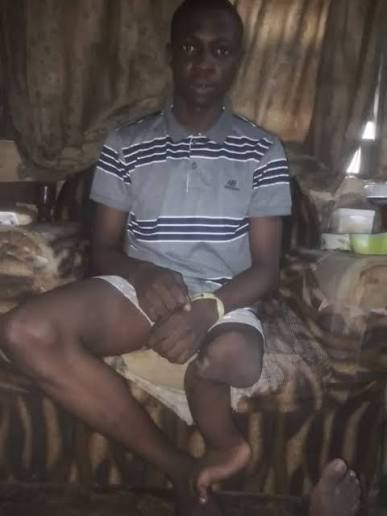
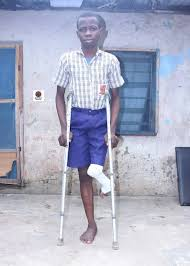
Seventeen-year-old Daniel Akanni is appealing to Nigerians for financial assistance to undergo the amputation of his left leg and receive a prosthetic limb after years of treatment for a congenital deformity left him unable to walk normally.
The Daniel Akanni ₦2m medical appeal follows a recommendation by doctors at the National Orthopaedic Hospital, Igbobi, Lagos, that his severely affected leg be amputated from the knee and replaced with an artificial limb.
His family says the entire procedure, including the surgery and prosthesis, will cost approximately ₦2 million, a sum they can no longer afford after years of medical expenses.
Daniel, who still hopes to study Petroleum Engineering, says his greatest wish is simple: to regain his mobility and continue his education.
Born with a leg deformity
Daniel’s struggle began in childhood.
According to his mother, Oluwatoyin, he was born with a deformity affecting his left leg.
When he was about 18 months old, the family took him to the National Orthopaedic Hospital, Igbobi, where doctors carried out corrective surgery.
The operation was considered successful because Daniel became able to walk.
However, the corrected leg remained shorter than the other one, causing him to limp and lean towards one side.
For the family, that early improvement offered hope that additional treatment could eventually give him better mobility.
The Daniel Akanni ₦2m medical appeal therefore comes after years of attempts to correct a problem that began almost from birth.
Family could not afford second surgery
Daniel’s mother said doctors later advised that another operation would be needed if he was to walk properly.
But the family could not afford the procedure at the time.
Financial difficulties meant they continued searching for other options.
That experience is familiar to many Nigerian families facing long-term orthopaedic conditions, where treatment can involve multiple consultations, surgery, rehabilitation and eventually prosthetic devices.
The Akanni family says the cost of repeated treatment gradually exhausted its resources.
It is against that background that the Daniel Akanni ₦2m medical appeal has now become public.
https://ogelenews.ng/daniel-akanni-₦2m-medical-appeal
2020 surgery worsened condition, mother says
Oluwatoyin said the family later learned of a free surgery programme in Lagos in 2020.
They hoped the programme would finally correct Daniel’s gait.
She told PUNCH that a procedure was subsequently carried out in Gbagada, but Daniel’s condition deteriorated afterwards.
According to her, the leg became more twisted and his ability to walk worsened.
The family returned for follow-up care, including the application of a plaster cast, but there was no improvement.
She said doctors later told them that they did not have the equipment needed to correct the complication.
At that point, the family returned to the National Orthopaedic Hospital, Igbobi.
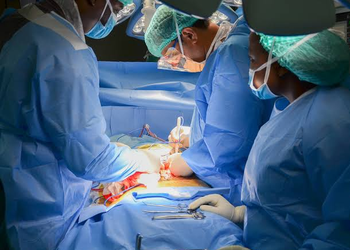
Doctors recommend amputation
According to Daniel’s mother, specialists at Igbobi examined the leg and concluded that the remaining option was amputation from the knee followed by fitting of an artificial limb.
This recommendation transformed the family’s challenge.
They were no longer seeking another corrective procedure that might preserve the leg.
They were now facing the prospect of amputation and the cost of rehabilitation and prosthetic care.
The family says surgery alone is estimated at about ₦710,000, while the total amount needed for surgery and the artificial limb is approximately ₦2 million.
That amount forms the basis of the Daniel Akanni ₦2m medical appeal.
Daniel still dreams of university
Despite his physical challenges, Daniel has not abandoned his educational ambitions.
He hopes to study Petroleum Engineering.
His appeal is therefore not only about mobility.
For a teenager preparing for adulthood, being able to move more independently could affect his education, social life and long-term career opportunities.
Daniel told Nigerians that his parents had already spent what they could on his treatment and appealed for help to give him another chance to walk.
His determination gives the Daniel Akanni ₦2m medical appeal a dimension beyond medical treatment.
It is also about restoring independence.
Prosthetic limbs can transform young lives
Across Nigeria, access to prosthetic limbs remains expensive for many families.
The Associated Press reported in 2024 that Nigerian charity The IREDE Foundation had provided hundreds of artificial limbs to children, largely through crowdfunding, because many families could not afford prosthetic care. AP reported that some prosthetic limbs normally cost between $2,000 and $3,000.
Children who received prostheses through the programme were able to return to school, move more independently and participate more fully in everyday life.
That wider context helps explain why the Daniel Akanni ₦2m medical appeal matters.
For many families, the cost of an artificial limb can be beyond what ordinary household income can absorb.
Medical crowdfunding becoming common
Public appeals for medical treatment have become increasingly common in Nigeria because many patients still pay healthcare costs directly from their own pockets.
PUNCH reported earlier this year that medical crowdfunding has become an important source of support for vulnerable patients, although the rise of fraudulent appeals has also made verification increasingly important.
That means responsible news organisations have two duties when publishing fundraising stories.
First, they should give genuine patients visibility.
Second, they should clearly attribute bank details and medical claims to the family or verified source rather than encouraging readers to transfer money blindly.
In Daniel’s case, PUNCH published the family’s account details and identified his mother as the person associated with the fundraising account.
Parents say resources are exhausted
Daniel’s mother said the family can no longer fund the treatment alone.
Years of appointments, procedures and attempts to improve his condition have taken a financial toll.
The Daniel Akanni ₦2m medical appeal is therefore being presented as a last resort.
For families living on modest income, the cumulative cost of orthopaedic treatment can become overwhelming even before prosthetic fitting begins.
There may also be rehabilitation costs after amputation, including physiotherapy and future adjustments to a prosthetic limb as the patient adapts.
Those longer-term costs are an important reminder that recovery does not end immediately after surgery.
Amputation is the beginning of rehabilitation
A successful amputation is not the same thing as immediately returning to normal walking.
Patients who receive prosthetic limbs may need rehabilitation, physiotherapy, gait training and periodic review.
Children and teenagers can also require replacement or adjustment of prostheses as their bodies change.
That is one reason specialist follow-up matters.
The Daniel Akanni ₦2m medical appeal should therefore be understood as an attempt to begin the next stage of his treatment rather than a guarantee that one operation will solve every challenge.
Daniel’s doctors will ultimately determine the rehabilitation process appropriate for him.
A wider problem of access
Daniel’s story also raises a larger question about access to specialist healthcare.
A child born with a limb deformity may need several stages of treatment over many years.
When families cannot afford recommended procedures at the right time, conditions can become harder to manage.
Nigeria has experienced doctors and specialist orthopaedic institutions, but affordability remains a serious barrier for many households.
The recurring need for public fundraising demonstrates the gap between available medical expertise and patients’ ability to pay for it.
The Daniel Akanni ₦2m medical appeal should therefore prompt conversation not only about charity but also about health insurance, rehabilitation services and support for children living with disabilities.
Ogele News perspective
Daniel Akanni’s appeal deserves attention because behind the ₦2 million figure is a teenager who has spent much of his life trying to achieve something most people take for granted: walking comfortably.
His family sought medical help early.
He underwent surgery as a toddler.
They pursued further treatment when his condition remained unresolved.
Now, according to the family, doctors have concluded that amputation and a prosthetic limb offer the best remaining path towards improved mobility.
The Daniel Akanni ₦2m medical appeal is therefore not simply another viral fundraising story.
It reflects the financial reality faced by families managing complex medical conditions over many years.
Nigerians who choose to support Daniel should do so through verified information and established channels.
Government institutions and disability-support organisations should also consider whether they can assist.
At 17, Daniel is still planning his future.
His dream of studying Petroleum Engineering has not disappeared.
What he needs now is the medical intervention that may allow him to face that future with greater independence.
The Daniel Akanni ₦2m medical appeal should remind policymakers that mobility is not a luxury.
For a young person, it can determine access to school, work, relationships and opportunity.
Daniel is asking Nigerians to help him walk again.
The deeper challenge for Nigeria is to build a healthcare system in which families facing such conditions do not have to depend almost entirely on public charity before treatment becomes possible.
https://punchng.com/help-me-walk-again-17-year-old-boy-seeks-n2m-for-amputation-artificial-limb/