














Nigeria solar power projects
By Ogele News | Abuja, Nigeria
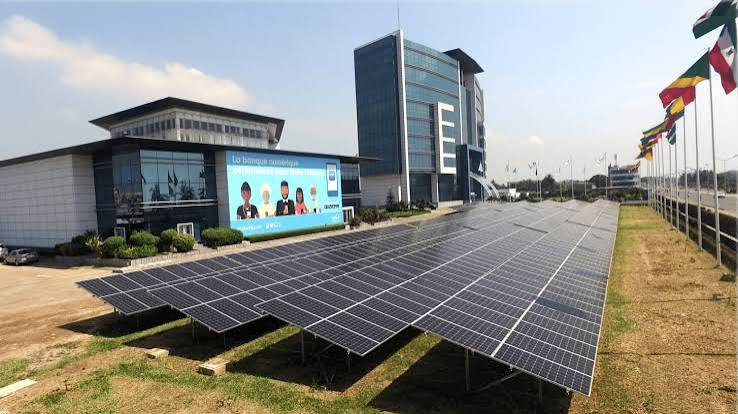
The United Nations has commended Nigeria’s rural electrification programme for expanding electricity access to more than five million people through solar power initiatives, describing the country’s approach as an example of how targeted government support and private investment can improve energy access in underserved communities.
The recognition, contained in the World Social Report 2026 released by the United Nations Department of Economic and Social Affairs (UN DESA), highlights the contribution of Nigeria’s solar power projects to electricity access, employment creation and economic inclusion.
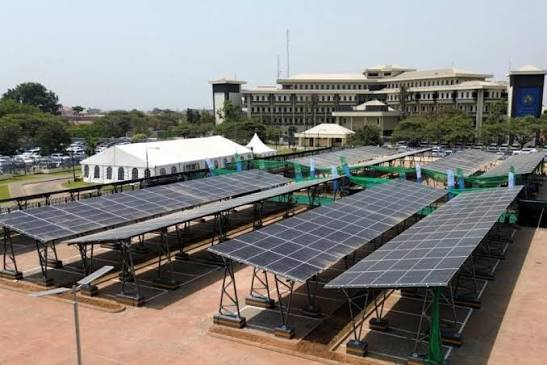
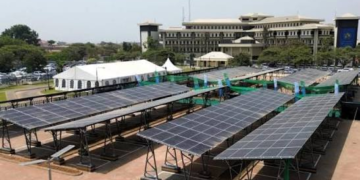
According to the report, the Nigeria Electrification Project supported the establishment of 125 mini-grids and the sale of more than one million solar home systems, providing electricity to over five million Nigerians.
The programme also contributed to the creation of more than 5,000 green jobs, offering employment opportunities in renewable energy installation, maintenance and related services.
The UN praised Nigeria’s use of targeted subsidies to attract private companies into communities where electricity infrastructure has traditionally been inadequate or commercially difficult to develop.
The development represents an important recognition of Nigeria’s solar power projects, particularly as the country continues to confront electricity shortages, unreliable grid supply and unequal access to energy between urban and rural areas.
The latest assessment, released on October 19, draws on earlier World Bank findings rather than reporting five million newly connected people in 2026 alone, Nigeria solar power projects.
Nigeria’s Solar Power Projects Deliver Electricity to Over Five Million People
The United Nations identified the Nigeria Electrification Project as a practical example of how developing countries can use renewable energy technology to provide electricity to previously underserved populations.
The programme supports decentralised electricity generation, allowing communities to receive power without depending entirely on extensions of the national transmission network.
According to the World Bank, the project operated between 2018 and 2024, supporting private-sector investment in solar hybrid mini-grids and standalone solar energy systems.
The initiative helped establish 125 mini-grids and facilitated the sale of more than one million solar home systems.
These interventions enabled more than 5.5 million Nigerians to gain electricity access, according to the World Bank’s detailed assessment published in March 2025.
The UN’s 2026 report references the same project achievements, describing the beneficiaries more broadly as over five million people.
This distinction is important because the recognition is based on documented achievements accumulated over several years, rather than a new programme launched in October 2026, Nigeria solar power projects.
The findings nevertheless demonstrate how decentralised renewable energy can contribute to addressing electricity access challenges in Nigeria.
Key Achievements of Nigeria’s Rural Electrification Programme
People with electricity access
5.5m+
Solar mini-grids established
125
Solar home systems sold
1m+
Green jobs created
5,000+
Source: World Bank assessment of the Nigeria Electrification Project, cited in the UN’s World Social Report 2026. The numbers are cumulative historical project results.
UN Praises Government Subsidies and Private Investment
A central finding of the World Social Report 2026 is that government support can encourage investment in energy services for communities that commercial electricity providers might otherwise overlook, Nigeria solar power projects.
The UN highlighted Nigeria’s use of subsidies for rural mini-grids, explaining that targeted public financial support can reduce the cost of electricity access for lower-income households.
This approach involves using government and development-partner resources to encourage private companies to develop electricity infrastructure in underserved areas.
Private developers can then invest in the construction, operation and maintenance of mini-grids, while public support helps reduce financial barriers.
The UN presented this model as an example of how renewable energy expansion can combine commercial participation with broader social objectives.
However, the availability of subsidies does not automatically guarantee affordable electricity for every household.
Electricity tariffs, equipment costs, household incomes and the long-term sustainability of individual projects remain important considerations.
The UN’s wider argument is that economic transformation should deliver practical benefits to people who might otherwise be excluded from new technologies and infrastructure.
Nigeria’s Solar Power Projects Create Over 5,000 Green Jobs
Beyond electricity access, Nigeria’s solar power projects have supported employment in the renewable energy sector.
The World Bank reported that the Nigeria Electrification Project contributed to the creation of more than 5,000 private-sector local green jobs.
These opportunities are associated with activities such as solar installation, distribution, system maintenance, technical services and renewable energy business operations.
The employment figures demonstrate that the benefits of decentralised electricity infrastructure can extend beyond households receiving power.
For communities where electricity access supports new commercial activity, reliable power may also create opportunities for businesses that depend on refrigeration, lighting, telecommunications and electrical equipment.
Agricultural processing facilities, workshops, small retail businesses and service providers are among the types of enterprises that can benefit from improved electricity availability, Nigeria solar power projects.
However, the reported 5,000 jobs relate specifically to the project results documented by the World Bank.
They should not be interpreted as a verified count of all employment generated by Nigeria’s renewable energy industry.
The broader employment implications will depend on how the sector develops, whether new projects remain operational and whether local technicians and businesses can participate in future investment.
https://ogelenews.ng/un-hails-nigerias-solar-power-projects-for-electrif…
UN Highlights Solar Farming Initiatives in Nigeria and Ghana
The United Nations also identified Nigeria and Ghana as countries exploring the integration of solar electricity generation with agricultural land.
The approach, often described as agrivoltaics, involves combining agricultural production with solar energy installations on the same land.
Under suitable conditions, solar panels can generate electricity while farmers continue cultivating crops or undertaking other agricultural activities.
The UN noted that such arrangements could strengthen food security, improve water management and provide additional economic opportunities for rural communities,Nigeria solar power projects.
For Nigerian farmers, electricity access can support irrigation pumps, cold storage, processing equipment and other technologies needed to improve agricultural productivity.
However, the feasibility of combining solar generation with agriculture depends on factors such as crop requirements, panel placement, land availability and investment costs.
Not every farm will be suitable for the same arrangement.
The report’s recognition of these initiatives suggests that renewable energy planning can be connected to agricultural development rather than treated solely as an electricity supply issue, Nigeria solar power projects.
World Bank Plans Further Electricity Access for 17.5 Million Nigerians
The achievements recognised by the UN also provide background for subsequent efforts to expand electricity access.
Following the Nigeria Electrification Project, the World Bank approved a $750 million International Development Association financing programme aimed at expanding distributed renewable energy solutions.
According to the World Bank, the follow-on initiative is designed to provide new or improved electricity access to more than 17.5 million Nigerians.
The programme is intended to support decentralised systems capable of delivering electricity to households, businesses and other users.
Its projected beneficiaries should be distinguished from those already reached by the earlier programme.
The figure of 17.5 million represents a future programme objective, not an achievement already recorded.
In October 2026, Nigeria also launched a $300 million Distributed Renewable Energy Fund involving the Nigeria Sovereign Investment Authority, Africa50 and Sustainable Energy for All, Nigeria solar power projects.
The fund is intended to support investment in mini-grids, solar home systems and other decentralised electricity infrastructure, Nigeria solar power projects.
Taken together, the initiatives illustrate how Nigeria’s solar power projects are attracting continued attention from development institutions and investors.
UN Report Examines Nigeria’s Economic Transformation and Social Inclusion
Beyond renewable energy, the World Social Report 2026 examined the relationship between economic transformation and social inclusion across 168 countries.
The report assessed developments involving economic activity, digital technology, energy systems and social conditions over the period from 2000 to 2024.
Nigeria recorded an economic transformation score of 44.30 and an inclusiveness score of 56.36, producing a reported combined index of 100.67.
These figures form part of the UN’s analytical framework and should not be confused with an electricity access percentage or an independent ranking of Nigeria’s power sector, Nigeria solar power projects.
The report’s broader message is that technological advancement and economic growth do not automatically ensure that vulnerable populations benefit.
It argues that countries need policies designed to improve access to education, energy, employment opportunities, social protection and essential services.
For Nigeria, the significance of the assessment extends beyond the number of solar systems installed.
It raises questions about whether infrastructure investments are reaching communities facing the greatest disadvantages and whether those investments are producing lasting improvements in livelihoods.
Electricity Access Remains a Major Challenge in Nigeria
Despite the progress recorded through Nigeria’s solar power projects, electricity access remains a significant development challenge.
The World Bank reported in March 2025 that more than 80 million Nigerians, representing nearly 40 per cent of the population at the time, lacked access to electricity.
The figure illustrates the scale of the challenge facing the country’s electricity sector, even after several years of investment in grid and off-grid infrastructure.
Some communities remain beyond the reach of the national electricity network, while others face unreliable supply.
For households and businesses, these difficulties can increase reliance on petrol or diesel generators and other alternative sources of power.
Solar mini-grids and standalone systems provide options for addressing part of this gap, particularly in rural and remote areas.
Nevertheless, sustaining those systems requires financing, maintenance, equipment replacement and arrangements that make electricity affordable for users.
The UN’s recognition does not mean that Nigeria’s electricity challenges have been resolved, Nigeria solar power projects.
Rather, it identifies a policy approach that has produced documented results and could inform further investment.
What UN Recognition Means for Nigeria’s Energy Future
The United Nations’ assessment provides international recognition of the achievements recorded under Nigeria’s rural electrification programme.
By highlighting the combination of subsidies and private investment, the report identifies an approach that can help extend electricity services to communities with limited access.
For policymakers, the findings underline the importance of maintaining clear rules, targeted support and effective oversight of renewable energy investments.
For private developers, the documented project results provide evidence that decentralised solar systems can reach significant numbers of customers.
For households and small businesses, the most important measure of progress remains whether electricity is available, reliable and affordable over time.
Future assessments of Nigeria’s solar power projects will therefore need to consider more than installation figures.
They should also examine operating performance, customer affordability, maintenance arrangements, employment quality and long-term community benefits.
The UN’s recognition of electricity access for more than five million Nigerians and the creation of over 5,000 jobs represents a documented milestone.
However, the wider task of providing dependable electricity to underserved populations remains unfinished.
As Nigeria pursues further investment in clean energy infrastructure, the performance of its existing and upcoming programmes will help determine how widely the economic and social benefits of electrification are shared, Nigeria solar power projects.