

















Sokoto police anti-bandit operation
SOKOTO, Nigeria — The Sokoto State Police Command has killed two suspected bandits and arrested 11 other suspects in a series of security operations targeting armed banditry, motorcycle theft and other criminal activities across the state.
The latest Sokoto police anti-bandit operation followed an attempted attack on Dankadu village in Illela Local Government Area, where police tactical teams confronted suspected bandits and forced them to retreat into the surrounding forest.
Police said subsequent clearance operations resulted in the killing of two suspected members of the armed group.
Two AK-47 rifles, two magazines and 54 rounds of live ammunition were recovered during the operation, according to police accounts. No police officer or resident was reported killed in the confrontation.
The command also announced the arrest of 11 suspects in separate operations involving alleged motorcycle theft and other offences, with 14 motorcycles recovered.
The developments come amid continuing security pressure in Sokoto, where several communities have recently suffered killings, kidnappings, cattle rustling and displacement linked to armed groups.
Sokoto Police Anti-Bandit Operation Foils Village Attack
The most significant part of the latest security operations occurred in Illela LGA.
According to police, armed men attempted to attack Dankadu village on August 15.
Police tactical teams responded and engaged the attackers, forcing them to retreat into the forest.
Security personnel subsequently conducted clearance operations in the area.
It was during those operations that two suspected bandits were killed.
The Sokoto police anti-bandit operation also resulted in the recovery of two AK-47 rifles, two magazines and 54 rounds of live ammunition.
The quantity and type of weapons recovered underline the firepower available to some criminal groups operating across the North-West.
Police said neither security personnel nor residents suffered casualties during the Dankadu operation.
That outcome is particularly significant given the deadly consequences of some recent confrontations between security forces and armed groups elsewhere in the region.
Police Recover Two AK-47 Rifles, Ammunition
The recovery of weapons is an important part of the operation.
AK-47 rifles remain among the firearms commonly associated with armed groups operating across parts of north-western Nigeria.
Taking weapons out of circulation can reduce the operational capability of criminal gangs, particularly when seizures are followed by intelligence efforts to identify supply networks.
The latest Sokoto police anti-bandit operation yielded two rifles alongside 54 rounds of ammunition.
But recovering weapons after attacks addresses only part of the problem.
Security agencies must also establish how armed groups obtain firearms and ammunition, where they are stored and how they move across state and international boundaries.
Disrupting those supply chains could have a more lasting impact than repeatedly confronting armed groups after they have already reached vulnerable communities.
https://ogelenews.ng/sokoto-police-anti-bandit-operation
11 Suspects Arrested in Separate Police Operations
The arrest of 11 suspects should be treated separately from the Illela confrontation.
The individuals were arrested during different police operations involving alleged motorcycle theft and other criminal activities, according to the report.
Police also recovered 14 motorcycles.
This distinction matters journalistically.
A headline combining “two bandits killed” with “11 suspects arrested” can inadvertently create the impression that all 11 suspects were members of the same armed group involved in the Dankadu attack.
That has not been established in the available reports.
The Sokoto police anti-bandit operation and the other arrests form part of a wider security crackdown, but they involve different allegations and circumstances.
The arrested individuals also remain suspects unless and until their alleged offences are established through the judicial process.
Motorcycles Remain Important in Rural Crime
The recovery of 14 motorcycles is another notable element of the police operations.
Motorcycles have legitimate and essential economic uses throughout northern Nigeria, particularly in rural communities where conventional transportation can be limited.
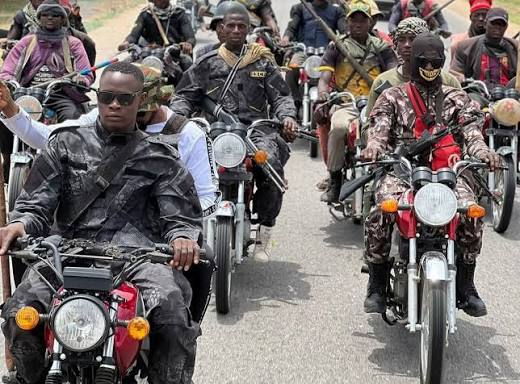
But motorcycles are also frequently used by armed groups because they can travel through difficult terrain and forest tracks that conventional vehicles may struggle to navigate.
Reports of major bandit attacks across the North-West often describe armed men travelling on large numbers of motorcycles.
Earlier this month, for example, police said an armed group involved in a deadly confrontation in neighbouring Kebbi State numbered about 240 men travelling on more than 200 motorcycles.
That does not mean motorcycles themselves are suspicious.
It means law-enforcement agencies must distinguish between legitimate ownership and vehicles that are stolen or used to facilitate criminal activity.
Sokoto Communities Remain Under Pressure
The success of the latest Sokoto police anti-bandit operation should also be viewed against a difficult security backdrop.
Recent weeks have seen serious attacks across parts of the state.
Earlier this month, fresh attacks in Sabon Birni LGA reportedly left at least 21 people feared dead and 37 abducted, while thousands of residents fled affected communities.
In another incident, suspected bandits killed a man and abducted seven residents of Tsamiya town in Tureta LGA.
Separately, attacks on communities in Goronyo LGA reportedly resulted in deaths and abductions.
These incidents demonstrate why a single successful operation, while important, cannot be interpreted as the end of Sokoto’s security challenge.
Police Have Recently Faced Deadly Attacks
Security personnel themselves have also suffered casualties.
On August 4, police confirmed that an officer and two civilians were killed after suspected Lakurawa militants attacked Girkau community in Kebbe LGA.
Several people were injured and cattle were reportedly rustled.
The attack illustrates the risks officers face when responding to heavily armed groups.
Elsewhere in the North-West, police have suffered even heavier losses.
In neighbouring Kebbi, 10 police officers and two civilians were killed during a confrontation with a large armed group earlier this month. Police said 17 suspected bandits were also killed.
The wider pattern shows that armed groups remain capable of mounting substantial attacks despite sustained military and police operations.
Army Operations Also Underway in Sokoto
The police are not operating alone.
The Nigerian military has also conducted recent anti-bandit operations in Sokoto.
On August 5, troops of the Nigerian Army’s 8 Division Garrison rescued 14 kidnapped victims during an operation in Shagari LGA.
The troops also recovered 281 rustled livestock.
The simultaneous activities of police and military units demonstrate the scale of the security challenge.
But multiple security agencies also require effective coordination.
Intelligence obtained by one agency should be shared rapidly where operationally appropriate.
Otherwise, criminal groups can exploit gaps between jurisdictions and security formations.
Intelligence Must Drive Sokoto Police Anti-Bandit Operation
The successful disruption of an attempted village attack is particularly important because prevention is preferable to responding after residents have been killed or abducted.
That should increasingly become the standard for the Sokoto police anti-bandit operation.
Security agencies need intelligence capable of detecting armed groups while they are assembling or moving towards communities.
Local intelligence can be especially valuable.
Residents, traditional leaders, vigilante structures and other community networks may notice unusual movements before an attack occurs.
But residents will provide intelligence only when they believe information can be passed securely and acted upon quickly.
Trust between communities and security agencies is therefore an operational asset.
Forests Remain Major Operational Challenge
Armed groups frequently retreat into forests after attacking communities or encountering security forces.
The Dankadu attackers reportedly fled into the forest after the police response.
This pattern creates serious difficulties.
Forested terrain can provide concealment, camps and movement corridors connecting communities and sometimes different states.
Clearance operations can push criminal groups out of particular locations, but they may simply relocate unless security forces maintain pressure.
The Sokoto police anti-bandit operation therefore needs to be supported by surveillance, intelligence gathering and cooperation with neighbouring states.
Banditry does not respect administrative boundaries.
A group driven from Sokoto can move towards Kebbi or Zamfara and later return.
Security Operations Need Prosecution Component
Killing armed attackers during legitimate security operations is only one aspect of law enforcement.
Arrests and prosecutions are equally important.
The 11 suspects arrested in the latest operations should be investigated according to law and, where sufficient evidence exists, prosecuted.
That serves two purposes.
It holds offenders accountable while allowing the justice system to distinguish between individuals against whom evidence exists and those who may have been wrongly suspected.
The Sokoto police anti-bandit operation should therefore be measured not only by numbers of arrests but also by successful investigations and prosecutions.
Suspects should not disappear into an indefinite cycle of arrest without judicial resolution.
Arms Supply Networks Require Greater Attention
Another important question arising from the Dankadu operation concerns the recovered AK-47 rifles.
Where did they come from?
Who supplied them?
How were they transported?
Who provided the ammunition?
Every recovered weapon potentially provides investigators with information about a wider supply network.
Serial numbers, ammunition markings and intelligence obtained during investigations can help authorities understand trafficking routes.
The Sokoto police anti-bandit operation will achieve greater long-term impact if recovered weapons become starting points for deeper investigations rather than simply items displayed after successful operations.
Protecting Communities Is the Real Measure
Security agencies understandably publicise arrests, weapons recoveries and successful operations.
Those achievements matter.
But residents measure security differently.
Can farmers safely reach their fields?
Can traders travel between communities without being kidnapped?
Can families sleep without fearing nighttime attacks?
Can displaced residents return home?
Those are ultimately the most meaningful indicators of whether the Sokoto police anti-bandit operation and other security measures are working.
The goal is not simply to kill or arrest individual suspects.
It is to make communities safe enough for normal life to continue.
Ogele News Analysis: One Successful Operation, But a Larger Battle Remains
The original headline, “Police kill two bandits, arrest 11 suspects in Sokoto,” is broadly accurate but needs greater precision.
First, responsible crime reporting should preferably use “suspected bandits” unless their identities and involvement have been conclusively established.
Second, the two suspected bandits killed in the Illela operation and the 11 suspects arrested in other operations should not be presented as though they were all members of one group.
The stronger Ogele News story is therefore:
Sokoto Police Kill Two Suspected Bandits, Arrest 11 in Separate Operations, Recover Rifles, Motorcycles.
The operation at Dankadu deserves recognition.
Police say they disrupted an attempted attack, forced the armed group to retreat and subsequently killed two suspected bandits during clearance operations without losing officers or villagers.
That is preferable to arriving only after communities have suffered casualties.
But recent events demonstrate that Sokoto’s security problem remains serious.
Communities have suffered killings and mass abductions. Police officers have died confronting armed groups. Residents have been displaced. The Army has continued rescue and recovery operations.
The real test is therefore sustainability.
Security forces must maintain pressure on armed groups, disrupt weapons and logistics networks, improve intelligence and strengthen protection around vulnerable rural communities.
Success should eventually be measured by declining attacks, fewer kidnappings and the return of displaced residents, not simply the number of weapons displayed after operations.
The latest Sokoto police anti-bandit operation represents progress.
But in communities where families still fear the next attack, the larger job remains unfinished.